I suppose most pastors reading this blog have a larger-than-average library of Christian books. But that does not mean you own every book you’d like to have, right? Raise your hand if you would like 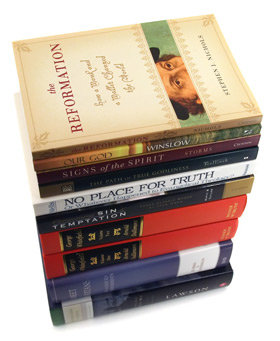 to see your library doubled or tripled in size. And although I am personally blessed with a nice collection of books, I see many gaping holes in my basement library (I am weak in OT commentaries).
Despite their size, how do we best use our libraries in our exegetical research? Today I’ve attempted to assemble a number of places I go—some obvious and some perhaps less obvious—in my exegetical research.
I know there are many technically nuanced definitions of “exegesis.” However, here in this post I am very loosely defining exegetical research by the question, What have others said about my text?*
Now, some software programs will help you here. But assuming you don’t have a program on your computer, or if you are more comfortable with your printed books, or if you just want to better use the books you already own, there are a number of places to look for exegetical help.
My list of 15 useful tools for exegetical research:
1. Commentaries. What commentaries are available on my passage? I’ll begin with the most obvious. If you are a pastor you should have several biblical commentaries at hand. Technical exegetical commentaries are a great resource to better understand the original languages. Expositional and devotional commentaries will also help out. For example, on the epistle to the Ephesians I would consult Peter O’Brien (exegetical), Martyn Lloyd-Jones (expositional), and John Stott (devotional). BestCommentaries is an excellent website to find the best commentaries.
2. Grammar and syntax. What grammatical and syntactical particularities exist in my passage? I have just enough Greek to find my way around the more technical NT commentaries. But I have also discovered that Greek textbooks can provide a lot of help when studying a particular passage. Daniel Wallace’s Greek Grammar Beyond the Basics references thousands of NT passages, pointing to a host of grammatical anomalies that I might otherwise overlook.
3. Biblical theology. Where along the continuum of God’s unfolding plan of redemption does my passage sit? Very often in exegetical preparation I consult the scriptural indexes to the works of Geerhardus Vos, and especially his classic work Biblical Theology. Vos will help you see the development of Scripture. It’s rarely possible to understand a text of scripture without first understanding where it fits in the biblical storyline. This is the work of biblical theology.
4. Systematic theology. Does this passage play an important role in defining a particular doctrine? Consult the scriptural index in Calvin’s Institutes, Wayne Grudem, John Murray, Herman Bavinck, Concise Reformed Dogmatics, John Frame’s The Doctrine of God and The Doctrine of the Knowledge of God. Every couple of months or so I watch this video by Dr Derek Thomas to be reminded that when systematic theology is done well, you can preach it. Keep one eye on systematic theology as you study scripture verse by verse, and you may be surprised at how much doctrinal ground you can cover from the pulpit.
5. Creeds. Does my passage supply the biblical support for a particular doctrine defined and defended in the classic reformed confessions? Here I will consult the scriptural index of Reformed Confessions Harmonized by Beeke and Ferguson. I am surprised at the tonnage of biblical references underpinning the reformed confessions. Identify how your text has been used in church history. This discovery may shed light on the historical importance of your text, or open up new topical avenues for further study.
6. Apologetics. Does my passage help defend the Christian faith or inform the Church’s engagement of a fallen world? In seeking to engage non-Christian thought with scripture, it is useful to know which passages are most helpful in the dialogues and discussions. When studying a passage take a look at the scriptural index in books by guys like Cornelius Van Til, Greg Bahnsen, and Scott Oliphint and check if your text has been used and how.
7. Biblical counseling. Does this passage play an important role in any of my biblical counseling resources? Consult the scriptural index in CCEF books along with an electronic search of the CD-Rom version of The Journal of Biblical Counseling 1977-2005. In my research I heavily weigh any references to my text in solid biblical counseling resources. Guys like Powlison, Paul and Tedd Tripp, and Jay Adams will hold your hand and help you understand certain texts in light of marriage, parenting, specific sin struggles, and idols of the heart.
8. Ethics. Does this passage play a role in the study of biblical ethics? Consult the index in Joachim Douma, John Frame’s Doctrine of the Christian Life, and John Murray’s Principles of Conduct. What contemporary ethical issues does this passage address? Euthanasia, abortion, stem cell research, divorce, capitol punishment, pornography, corporate greed, etc.
9. Spurgeon. What did Spurgeon say about this text? While Spurgeon is no model of careful exegesis, he is wise, applicable, cross-centered, and quotable. You can find a list of his sermons arranged by biblical text here. And you can buy the complete works of Spurgeon on CD-Rom for about $20. Apart from flowers for your wife, there is no better reason to slap down an Andrew Jackson.
10. The Puritans. Have any of the primary Puritan authors preached on this passage? Consult Robert P. Martin’s A Guide to the Puritans and the PCA website of Puritan resources. Because of their trusted exegetical integrity, and because their complete works include a detailed scriptural index, I will individually consult the Works of John Owen, Thomas Goodwin, and Thomas Manton. I consult about a dozen Puritans, a list of which can be found in my Puritan Study series I developed a while back.
11. Jonathan Edwards. Where has Edwards developed my text in his theology, books, and sermons? The new Works of Edwards Online website produced by Yale make a search of scriptural references a breeze (note the “Scripture Lookup” feature). And the resource is completely free. Try it for yourself.
12. Single-topic books. Is my text referenced in a topical book or monograph in my library? Here is where flipping through the scriptural index in any number of topical books will come in handy. Flip through the index in books by J.I. Packer, R.C. Sproul, D.A. Carson, John Piper, John MacArthur, Jerry Bridges, John Stott, etc. I think Knowing God by J.I. Packer could be quoted in half of all the sermons you could preach. Collect 10-30 topical books you really appreciate and use them in researching a particular text.
13. Audio messages. Are audio messages available from respected preachers on my text? A wonderful, but often-untapped resource for exegetical research, are the thousands of free MP3 audio files available online. The Gospel Coalition has a wonderful collection of sermons all organized by scripture reference. As you are likely aware men like John MacArthur and John Piper have produced a wealth of sermons that are easy to locate. Occasionally you will find some gems at SermonAudio or Monergism.
14. Christian classics. What did Augustine or Chrysostom say about my text? Check out the Christian Classics Ethereal Library website. You can run a nifty little scriptural passage search of all their resources here. Always worth a look.
15. Google. For fun, throw a “hail Mary” and run a search string on your particular passage. You will not always find exegetical gems—but sometimes you will. Google search your text, say, “John 1:1-18” and see what you find. Also try the same search string in Google Books. It’s impossible to know what you will find—or if what you find will be worthy of your time to read—but it’s worth a shot.
Quality not Quantity
So why do I consult a broad chunk of my library in my exegetical research? I can tell you why I don’t. I don’t read broadly in order to jam every blog post and sermon with as much content as possible. Content saturation is not my goal. I research to ensure that I communicate the best-selected and most strategic content. I think maturity in communication is revealed by the quality of material you include in what you say, and by the large pile of “good” content that you leave behind.
Please remember that at every stage you must use careful biblical discernment. As you move into broad Google searches you are more likely to encounter unhelpful and confusing resources, or straight up error. So please read carefully and weigh the source of exegetical information. Do not assign the same authority you would attach to the Westminster Confession to a random online sermon.
What say you?
So what about you? What sources do you consult in your exegetical research? What tools, locations, and books would you suggest? Any single books you find helpful in your exegetical research? I’d love to hear from you in the comments.
Thanks for reading!
————
* I find this concept difficult to communicate with single terms like “scriptural,” “canonical,” “expositional,” etc. “Exegetical” seems to work best because of the nuance of “study,” although it’s not the perfect word, I admit. Strict paramiters must remain between what scripture originally meant from the contemporary application of that meaning. Here in this post these two tend to merge.

 This past week I was mostly in downtown Baltimore at the
 Tony Reinke