Book(s) Updates

books

Here’s a real quick update on my book projects (past, present, and future).

First, a special thank you to everyone who lent a hand to launch my new book, Newton on the Christian Life: To Live Is Christ (Crossway). Apart from a glitch in Amazon’s automation process that prevented the book from being restocked in a timely manner (and which dragged the launch out longer than expected), everything went very well. I’m grateful to God for many friends who wrote encouraging endorsements and who helped spread the word online. A special thanks to Westminster Books who ran a special offer on the book for a couple of weeks and brought some level of consistency to the launch (and sanity to me).

Newton is book #2 for me. Book #3 is nearly complete. Last week I was graciously given some time to finish up the book in a remote cabin in the woods of Minnesota. The time was focused and productive and I’m now done with it. From here it will go through two final rounds of edits in the coming weeks. The endorsements are in and the cover is finished (and it’s beautiful!). I speak in veiled terms because it is a secret. All I can say it will be 130 pages long, it will launch in October, and it will be given away free of charge to the world (which is the fulfillment of a dream for me).

Today I signed a contract for book #4, and I launch into the big ocean of writing and research in early July. The book will be my third with Crossway (book #1, you may remember, is titled Lit! A Christian Guide to Reading Books, and was published back in 2011). Book #4 will also be my third book in which I will be working closely with Justin Taylor, which is a privilege only an author in such a position can fully appreciate. I’ll share more about book #4 later this fall (after #3 launches).

Over the last several months the Lord has been kind to me, sparking many potential book ideas and delivering a lot of creative energy. My new urgency in writing books is the culmination of a two-year process of evaluating two questions: (1) Has God called me to write or edit? And, (2) If I’m called to write, what should I be writing (both in format and theme)? Authoring books is a calling others have affirmed, and there are few things I love more than writing thickly researched, highly edited, and refined projects on targeted subjects, all to serve the local church. I do not write to write; I write to serve. And I firmly believe writing books is a primary calling on my life, at least for the near future.

Speaking of writing, a number of friends online have asked if I would share my writing process for the Newton book — the ins and outs of what a typical week looked like for me (as a weekend writer with a family). I have also been asked to explain my formal process for how I envisioned writing what I have called “pastoral synthesis,” the art of taking Newton’s 1,000 letters and drawing them together under an umbrella of selected universals of the Christian life. I’m under deadline to finish three article projects in the next week, but when I get those done I hope to return to those journal pages, transcribe my notes, and share my process here at tonyreinke.com.

So those are my book updates.

What a joy to serve you as a writer. As I have come to appreciate, authors labor for long hours in isolation, for an audience they cannot see, to address a future they cannot predict. So to now have the Newton book out and to see it bless particular readers is a thrill for me (and especially to hear from a number of pastors and from Christians who are struggling with depression). I thank you for your online encouragements and for the incredibly kind reviews that have begun appearing on the Newton page in Amazon.

Of course you can always find an updated list of books I have written or edited at the bottom of the About page, here.

As old Bunyan once said, I am honored to serve you with what little I have to offer.

Blessings in Christ!

Tony Reinke
My Favorite Quote on Writing

I keep on hand a folder of great quotes from admired writers on the art of prose style. Perhaps my favorite is from C.S. Lewis, Mere Christianity, page 227:

Even in literature and art, no man who bothers about originality will ever be original: whereas if you simply try to tell the truth (without caring twopence how often it has been told before) you will, nine times out of ten, become original without ever having noticed it.

Steven Pinker on Good Writing

If you’re a writer (or you aspire to it), be sure to check out a brand new book by language expert Steven Pinker, The Sense of Style: The Thinking Person’s Guide to Writing in the 21st Century (Viking). It was released earlier this week and quickly claimed the top spot in its category in Amazon.

Just a few days back, Pinker delivered a worthwhile lecture on good writing. It includes some Q&A at the end. Have a listen here:

Newton’s Comfort for Christian Bloggers, Writers, and Preachers

Taken from the diary of a friend of John Newton’s, recounting a personal conversation they enjoyed:

January 26, 1804 —

He [Newton] told me that after he was settled at Olney [his first pastorate], and had preached six sermons, he thought he had told them his whole stock, and was considerably depressed.

“But,” he said, “I was walking one afternoon by the side of the river Ouse; I asked myself, How long has this river run? Many hundred years before I was born, and will run many years after I am gone. Who supplies the fountains from whence this river comes? God. Is not the fund for my sermons equally inexhaustible? — the word of God. Yes, surely. I have never been afraid of running out since that time.”

I asked if he had consumed all the variety in the Bible now he was an old man and an old minister. He smiled, and said, “O no, Sir; O, no, Sir.”

Personal Update (Newtcation Ends)

Today Newtcation ends. It’s been a wonderful several days spent mostly off-line and with a lot of time with the family at the local pool and lakes, and bowling, and attending little league softball and baseball games.

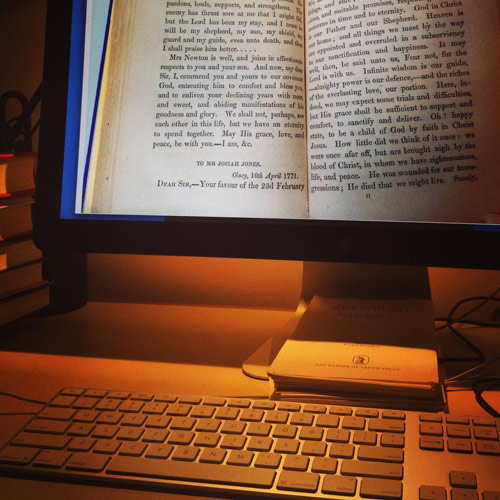
Two weeks steeped in Newton’s letters have been a tremendous blessing to my own soul. On most mornings I awoke to make new discoveries in the pages of the rarest published letters of Newton, many of them made available by the generosity and ingenuity of friends who volunteered university library credentials and iPad cameras to the cause. A lot of my Newtcation mornings looked something like this:

newtcation-1

I’m now emerging out of the 18th century and find myself playing catch-up on DOMA, Tsarnaev, Randy Travis, Metta World Peace, Trayvon, Chris Weidman, Sharknadoes, plane crashes in Alaska and SFO, unrest in Egypt, and wildfires in Arizona. So much has happened in the last two weeks.

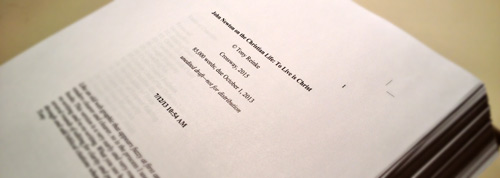
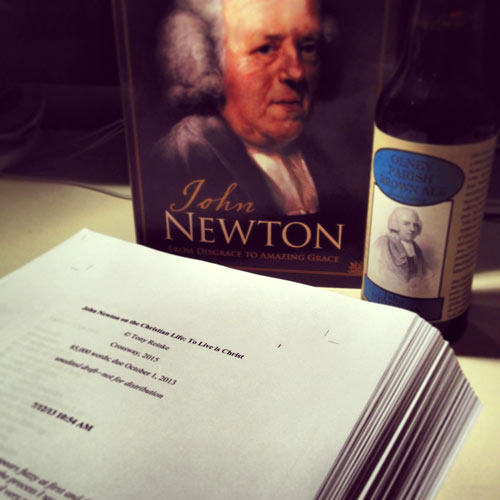
Going off-line has been worth it. Yesterday I finished the first draft of the Newton book, which I began writing 9 months, 25 days ago. Over these past two weeks I’ve had time to write the final 20% of the book. At 87,606 words, the draft is far too long and will need to be trimmed in the next phase of re-writing (and re-re-writing) that begins now. In the coming months I will be trimming content, tightening sentences, and sharpening the language of the book. From my experience, this is the most enjoyable stage in the writing process.

newtcation

The manuscript, in its present form, has been passed along to Pastor John, who has kindly offered to read it (gulp) and pen the foreword. Piper’s enthusiasm over the years for Newton, and his popular biographical sketch, have all become significant factors in the enduring legacy of Newton and his works in the Church today. Irrespective of whether my book is any good, to have a foreword from him is not only an honor, but will also provide a push behind Newton’s legacy to extend its life for at least one more generation.

And of course Newtcation has reminded me of the amazing blessing I have been given in my wife. She was up before the kids to edit chapters, kept the kids busy after they awoke so I could write, and then served us all afternoon as we enjoyed family time together. The back of our minivan is a drink and snack taxi, stocked for whatever adventure we filled our afternoons with. I would post a picture of my precious wife here, but, in her words, “Your pictures of me are always so horrible.”

Alas, a lot of great memories will stay with me from Newtcation, but I look forward to getting back to work tomorrow. Thank you to everyone who prayed for me over these past two weeks as I completed research and writing the first draft of Newton on the Christian Life. I was sustained by God’s amazing grace all along.

newtcation-2

John Henry Newman on Writing

Today marks the 212th birthday of John Henry Newman (1801–1890), a prolific Roman Catholic author. And while there’s much in his theology to trouble a reformed reader, he was a bright intellectual giant with a lot of wisdom on topics like education, church history, and literature (to name a few categories). I enjoy reading Newman mostly for his prose style, and while reading along I like to capture and collect his best advice to writers. Four of those excerpts I’ll post here, all taken from his book The Idea of a University Defined and Illustrated (London, 1875):

Study and meditation being imperative, can it be denied that one of the most effectual means by which we are able to ascertain our understanding of a subject, to bring out our thoughts upon it, to clear our meaning, to enlarge our views of its relations to other subjects, and to develop it generally, is to write down carefully all we have to say about it? People indeed differ in matters of this kind, but I think that writing is a stimulus to the mental faculties, to the logical talent, to originality, to the power of illustration, to the arrangement of topics, second to none. Till a man begins to put down his thoughts about a subject on paper he will not ascertain what he knows and what he does not know; and still less will he be able to express what he does know. (422)

There are two sorts of eloquence, the one indeed scarce deserves the name of it, which consists chiefly in laboured and polished periods, an over-curious and artificial arrangement of figures, tinselled over with a gaudy embellishment of words, which glitter, but convey little or no light to the understanding. This kind of writing is for the most part much affected and admired by the people of weak judgment and vicious taste. … The other sort of eloquence is quite the reverse to this, and which may be said to be the true characteristic of the Holy Scriptures; where the excellence does not arise from a laboured and far-fetched elocution, but from a surprising mixture of simplicity and majesty, which is a double character, so difficult to be united that it is seldom to be met with in compositions merely human. (270)

A great author, Gentlemen, is not one who merely has a copia verborum, whether in prose or verse, and can, as it were, turn on at his will any number of splendid phrases and swelling sentences; but he is one who has something to say and knows how to say it. … He writes passionately, because he feels keenly; forcibly, because he conceives vividly; he sees too clearly to be vague; he is too serious to be otiose; he can analyze his subject, and therefore he is rich; he embraces it as a whole and in its parts, and therefore he is consistent; he has a firm hold of it, and therefore he is luminous. When his imagination wells up, it overflows in ornament; when his heart is touched, it thrills along his verse. He always has the right word for the right idea, and never a word too much. If he is brief, it is because few words suffice; when he is lavish of them, still each word has its mark, and aids, not embarrasses, the vigorous march of his elocution. He expresses what all feel, but all cannot say. (291-93)

Speech, and therefore literature, which is its permanent record, is essentially a personal work. It is not some production or result, attained by the partnership of several persons, or by machinery, or by any natural process, but in its very idea it proceeds, and must proceed, from some one given individual. Two persons cannot be the authors of the sounds which strike our ear; and, as they cannot be speaking one and the same speech, neither can they be writing one and the same lecture or discourse — which must certainly belong to some one person or other, and is the expression of that one person’s ideas and feelings — ideas and feelings personal to himself, though others may have parallel and similar ones — proper to himself, in the same sense as his voice, his air, his countenance, his carriage, and his action, are personal. (273-74)