Tolkien himself may object to a blog post about Narnia on such an otherwise perfect Hobbit Day, but since we’re reading The Voyage of the Dawn Treader as a family the book is on the brain and, hence, on the blog. The reading (or re-reading or re-re-reading, depending on who in the family you are talking about) is in anticipation of the 3D movie release in December. The extra time will allow us to slow our pace and to read and study the book carefully and benefit from secondary sources. Over the past few days I have been digging through a few books for background it was while researching that I stumbled upon an interesting point made by Alan Jacobs. He proposes that TVDT is ultimately an allegory of the Church. Here’s the argument in Jacobs makes in The Narnian (HarperOne, 2005), page 209-210:
… The Voyage of the “Dawn Treader,” … I am tempted to call an allegory of the Church. After all, historically Christians have linked the Church with Noah’s Ark: each boat is, in its time and place, a unique vessel of salvation. As the Church sails toward Heaven, so the Dawn Treader sails toward Aslan’s country at the end of the world.
And on this voyage Eustace’s situation is the most significant one. He finds himself on this ship, knowing no one, comprehending nothing, and staying with the others only because he has no other option, as the slave trader Pug discovered when he “threw him in free with other lots and still no one would take him.” He doesn’t see that the Dawn Treader is his only hope of survival; he doesn’t see that from the other members of that crew he could learn skills and virtues alike. Thanks to his parents and his school, he is a “boy without a chest” and is simply incapable of understanding what motivates the others, the martial Mouse Reepicheep above all.
And the only way for this to be remedied … is for Eustace to undergo a kind of death: to have his very skin stripped away by Aslan, and only by Aslan, and to emerge newly born from the encounter. Moreover, the first part of what he must learn is simply that he is not a very good boy, that he is weak and cowardly—that, to put it bluntly, he is simply inferior to Caspian and Edmund and, yes, Reepicheep. It is noteworthy that after he becomes a boy again he tells Edmund, “You’d think me simply phony if I told you how I felt about my own arms. I know they’ve no muscle and are pretty mouldy compared with Caspian’s, but I was so glad to see them.”
This is the first time that Eustace has considered himself anything but superior to everyone else, and if it seems obvious that Eustace’s musculature would be dwarfed by that of the powerful young king, well, in the matter of self-knowledge everyone has to start somewhere. Only once he has acknowledged the “mouldiness” of his arms and the “beastliness” of his behavior is Eustace ready to begin the process of becoming a real member of the Dawn Treader’s crew.
If Jacobs is right and TVDT is an allegory of the Church, that allegory is ripe with application about what it means to live humbly within the community, to depend upon Christian friends (reminiscent of Bunyan’s allegory), and what it means to welcome and care for ungrateful wretches like Eustace who are yet in need of God’s sovereign and gracious skinning. Needless to say, after reading this excerpt from Jacobs I think I will be reading TVDT with new eyes.
But Narnia will wait until another day because this day is Tolkien’s day. And tomorrow on the blog I hope to have a few pictures of our coney stew feast.
Happy Hobbit Day.

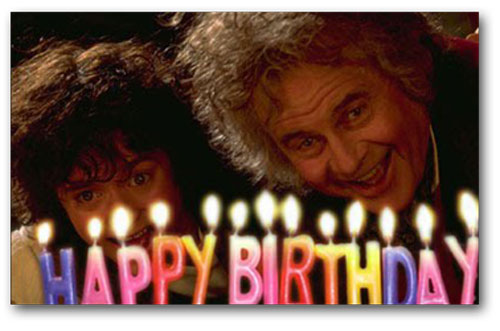 “Bilbo and Frodo happened to have the same birthday, September 22nd,” wrote Tolkien. And since 1978, September 22 (Wednesday) has become the annual date that LOTR fans celebrate Hobbit Day by dressing in costume, eating themselves silly, drinking a bit,
  Tony Reinke