The Methods of Grace

John Newton is most famous for his hymns (e.g. Amazing Grace) and for his campaign to abolish the slave trade, but he was also a skilled author of personal letters. Many of those letters survive and have been published over the centuries. It doesn’t take long for the reader to notice his pastoral wisdom. In one letter to a pastor/friend on Nov. 6, 1778, he addressed the dangers that appeared in the writings of “New England divines” by which he means Solomon Stoddard and perhaps Stoddard’s grandson, Jonathan Edwards. The NEDs were not particularly sensitive to the work of God in the life of the sinner and tended to be formulaic, undermining assurance and encouraging doubt in genuine believers, said Newton. Newton saw this tragedy and raised the flag of concern in a letter. Here’s what he wrote in one letter [published in Wise Counsel (BoT, 2009), pages 120–121]:

Most of the New England divines I have met with have in my judgment one common fault: they abound with distinctions and refinements in experimental matters [ie evaluating grace in the life of a person], which are suited to cast down those whom the Lord would have comforted. And in their long account of what they call a preparatory work, they include and thereby depreciate some real and abiding effects of true grace. They require such an absolute submission to the righteousness and sovereignty of God, before they will allow a person to be a believer, as I apprehend is seldom the attainment of a babe in Christ.

I think if Mr Stoddard had been at Philippi, and the jailer had sprung trembling in to him (instead of Paul and Silas) with the same question he would have afforded him but cold comfort, and would have made him wait a few weeks or months to see how the preparatory work went on before he would have encouraged him to believe in Jesus. …

It would be well if both preachers and people would keep more closely to what the scripture teaches of the nature, marks and growth of a work of grace instead of following each other in a track (like sheep) confining the Holy Spirit to a system; imposing at first the experience and sentiments of others as a rule to themselves, and afterward dogmatically laying down the path in which they themselves have been led, as absolutely necessary to be trodden by others. There is a vast variety of the methods by which the Lord brings home souls to himself, in which he considers (though system-preachers do not) the different circumstances, situations, temperament, etc. of different persons. To lay down rules precisely to which all must conform, and to treat all enquiring souls in the same way, is as wrong as it would be in a physician to attempt to cure all his patients who may have the same general disorder (a fever for instance) with one and the same prescription. A skilful man would probably find so many differences in their cases, that he would not treat any two of them exactly alike.

The words of a skilled soul-physician.

Retreat

Starting today I’ll be enjoying a three-day writing/reading retreat. During the retreat I hope to edit a number of the chapters in my forthcoming book and enjoy reading a few favorite authors. Here’s what I’ll be working on over these days (from the bottom-up):

My manuscript. That stack of pages on the bottom is a version of my manuscript. I hope to edit the final nine chapters (6–15) this weekend. The manuscript is due in 50 days and at this stage, more than anything else, I am sharpening the prose style, smoothing out any lumpy-flow-issues, and taking time to address notes and questions from editors.

William Shakespeare, The Tragedy of King Lear in The RSC Shakespeare: The Complete Works (Palgrave Macmillan, 2008), pgs 2004–2073. Last week I received this newly edited version of Shakespeare’s works (1623 First Folio ed.) and I’m impressed with the clear and abundant footnotes and the penetrating introductions. I find this edition is far more helpful than other collections I own (ie Riverside). I was delighted to read portions of The Tempest last week. This weekend I’ll skip over to KL.

The Chicago Manual of Style, 16th Edition (University Of Chicago, 2010). I will flip through the new manual to learn things I should have learned in English class but didn’t because I wasn’t paying attention. At this stage in my book writing I’ll need to invest time formatting all the knotty ends that have been largely neglected (footnotes).

John Newton, The Works of the Rev. John Newton: Vol. 1 (London, 1820). Apart from the letters in the New Testament, no other personal letters more consistently edify my soul than those from Newton’s hand. This weekend I plan to read and study three of his letters more closely, each from the first volume in his six-volume works. I plan to share these letters on the blog early next week.

Frans Bengtsson, The Long Ships (NYRB Classics, 2010). A recent re-release of two Viking tales originally published in Sweedish in 1941 and 1945, translated into English in 1954, combined into one novel, and then fell out of print and was forgotten for a while. The book is now back in print. TLS is an absorbing read and provides a sobering look into the savagery of the 10th century Viking world. I’ve rowed for 75 pages. 400 to go.

Wendell Berry, Life is a Miracle: An Essay Against Modern Superstition (Counterpoint, 2000). Just arrived. The book opens with a line from King Lear: “Thy life’s a miracle. Speak yet again.” Berry is profound, although the reader knows what to expect: “…under various suasions of profession and personality, this legitimate faith in scientific methodology seems to veer off into a kind of religious faith in the power of science to know all things and solve all problems, whereupon the scientists may become an evangelist and go forth to save the world” (p. 19). Berry always makes the true Savior more beautiful in my eyes, and he tightens my clinch on the grace of God that I need to survive this mystery called life, although I don’t recall him ever mentioning Christ in a meaningful way. Often the great authors are marked by their influence that can slowly and subtly and permanently change your outlook on the world (eg Marilynne Robinson).

So that’s a bit about my weekend which has now officially begun at 5:30 AM on Saturday morning.

But first, personal devo’s.

Serious Writing

Harper Lee is a novelist best known for her Pulitzer Prize winning work, To Kill a Mockingbird. In documenting her life, Charles Shields records these words from Lee about about the writing task [Mockingbird: A Portrait of Harper Lee (Henry Holt, 2006) p. 258]:

“To be a serious writer requires discipline that is iron fisted. It’s sitting down and doing it whether you think you have it in you or not. Everyday. Alone. Without interruption. Contrary to what most people think, there is not glamour to writing. In fact, it’s heartbreak most of the time.”

On Burning Religious Books

September 11th is four days away, and it will mark the ninth anniversary of 9/11. As a large portion of the world mourns, one church in Florida plans to celebrate with “Burn a Qur’an” day. How many copies of the Qur’an it will take to make a newsworthy flame I’m not sure, but I am sure the media will be there when the pile is lit.

The top US military commander in Afghanistan, General Petraeus, says this anti-Muslim act will only vex America’s enemies in the Middle East and give Islamic radicals more clout in the eyes of the moderate Islamic world. The Florida church now says it will be “praying about” whether to continue with the burning ceremony. Whether the event will actually happen is yet to be seen, but my guess is that Islamic moderates around the world have learned to distinguish religious devotion from the meretricious display of zealots.

The Bible, as far as I can tell, mentions one account where religious texts are thrown to the flames (Acts 19:11-20). On the heels of the great work of God in Ephesus, the people had come to fear God and to trust in the Savior. As a result, “a number of those who had practiced magic arts brought their books together and burned them in the sight of all. And they counted the value of them and found it came to fifty thousand pieces of silver” (v. 19). In modern terms they ignited a bonfire using very expensive magic books.

What were these books? According to Eckhard Schnabel, they were occultist documents that described how to make amulets to protect against demons and how to make love charms (Early Christian Mission, 1221). The books gave directions for casting spells on others, either for good or ill, and they would have been quite expensive, which highlights the effect of the gospel upon the wealthy inhabitants of Ephesus. That Paul went toe-to-toe with the owners of documents, which later led to a book burning, tells me they qualify as religious texts, and probubly comprised the pop religion of the day.

From this account here are six points to ponder:

1. The Ephesian people burned their own books. These new believers renounced their past. This was not an act of Christians barging into homes to ransack libraries for kindling, or weeding out the public library, or buying up all available copies from the local bookshop. They gathered the valuable books from their own houses.

2. No Christian leader encouraged the book burning. At least the text doesn’t say it. Or would have been better for the books to be sold and the money given to the Apostolic ministry? Perish the thought. There there is no indication that Paul advised the people to burn (or sell) their occultist books.

3. The books posed no threat to the gospel. The gospel overcame the magic power of the books. The gospel is like a hurricane and nothing will stop its wind, certainly not a book of demonic spells.

4. God’s display of power convinced the people that their books were worthless. There was no need to address the value of the magic books directly. Once God’s power and his gospel were seen in the city, the matter was settled.

5. The book burning was a display of godly sorrow. The recently converted Christians wanted to confess their sin before “all.” The high value of the books (50,000 days wages worth!) made a strong statement. It was an act of personal sorrow for their own sin.

6. The burning illustrated the victory of the gospel. The magic books were burned because the gospel was spreading like wildfire: “So the word of the Lord continued to increase and prevail mightily” (v. 20).

These six points should make us very hesitant about burning other people’s religious books.

May God give the Church open doors to preach the gospel, and may he bless his Word with self-authenticating gospel fruit. If we take our eyes off the priority of the gospel, we will be tempted to settle for the sparks of a small bonfire in a church parking lot, a miniature replica of what happened in Ephesus. The true gospel spreads like a wildfire, if we are faithful to lovingly and boldly proclaim it.

A Real Writer

Two-time Pulitzer Prize-winning journalist/humorist Gene Weingarten collected 20 of his best articles that have appeared in The Washington Post over the years and published them as a new book titled The Fiddler in the Subway (Simon & Schuster, 2010). In the intro he writes about writing:

“A real writer is someone for whom writing is a terrible ordeal. That is because he knows, deep down, with an awful clarity, that there are limitless ways to fill a page with words, and that he will never, ever, do it perfectly. On some level, that knowledge haunts him all the time. He will always be juggling words in his head, trying to get them closer to a tantalizing, unreachable ideal.”

Truth be told, Weingarten came pretty close to this ideal in his April 2007 article, “Pearles Before Breakfast” which earned him the 2008 Pulitzer Prize for Feature Writing. The article is included in the book.

On the Incarnation

Some say we should avoid reading two new books consecutively without sandwiching an old book in between them. I agree with this rule, it just happens to be a good rule I rarely apply in practice. So when my copy of St. Athanasius’ On the Incarnation (St. Vladimir’s Press, 1977) arrived yesterday, I dove in, partly out of curiosity, but mostly out of guilt for my disproportionate time reading new books lately, and in hopes that an especially old book (originally written in c. AD 318) would make up for my negligence.

At the outset let me say the book’s title is a bit misleading. Athanasius covers the Incarnation well but he sets the incarnation within the contexts of creation, the imago Dei, the fall, redemption, and the consummation of all things while at the same time showing how the Incarnation relates to the full scope of our Savior’s life and work—from his birth, throughout his life, death, resurrection, and forthcoming return. Much more could have been said on all these topics, but the theological breadth of the work is very impressive. For Athanasius the Incarnation is a gospel truth and his chapter on the cross (4: The Death of Christ) was brilliant and devotionally rich, something that came as a bit of a pleasing surprise.

When I finished the book its brevity was another impressive feature (I read it in just over 2 hours). The book is clear and pointed, and of course clear/pointed books are rarely lengthy. C.S. Lewis praised it saying, “only a master mind could, in the fourth century, have written so deeply on such a subject with such classical simplicity.” And later, “The whole book, indeed, is a picture of the Tree of Life—a sappy and golden book, full of buoyancy and confidence.” High words of praise from a man who knew a bit about good books (and bad ones).

Lewis’ introduction on the importance of reading old books (perhaps the most famous Christian introduction ever penned) was a treat at the beginning. The book closes with an appendix, a letter written by Athanasius on the importance, value, and Christ-centeredness of the Psalms. That letter was a treat at the end.

I’ve been waiting for a few years to read On the Incarnation. I finally got around to it and I confer with Lewis: this book is great.

Before you read another new book, read this one.

————————

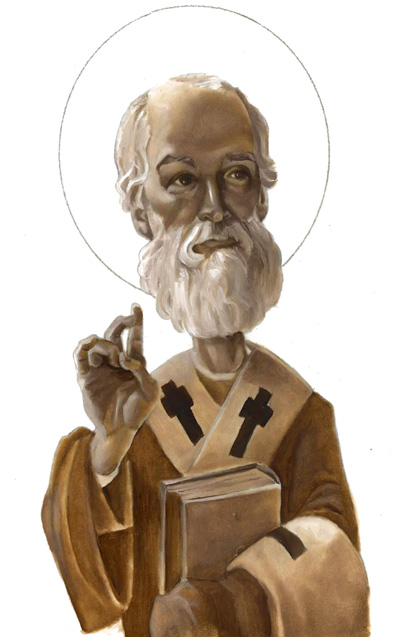
Cool portrait by Zach Franzen