[Note: Due to the length of this article you may find it easier to read/print as a PDF document. You can do this by clicking here. -Tony]
Does God delight in non-Christian art?
 This is a whale of a question, but let’s begin with a few basic points.
(1) The origin of the human artistic impulse cannot be humanly explained. In comparing theories on the origin of art 19th century Dutch theologian Herman Bavinck wrote, “today there are just as many divergent ideas as there were in earlier days: one person explains art from play, another from sexual desire, a third from rhythm, a fourth from feelings and actions that also occur with animals, and so forth. But more and more the conviction is gaining ground that with art, just as with religion, we must accept an original human impulse and an urge that we cannot explain from other inclinations or activities” (Essays, page 252-253). Exactly. There are many factors that influence the artists, but nothing can explain the origin of the artistic impulse. We are born with it.
(2) The artistic impulse is spiritual. Again Bavinck writes, “with the sense of beauty, we are dealing with a phenomenon that is part of human nature: a predisposition and susceptibility of the soul to find pleasure and to enjoy oneself in things that fulfill certain conditions” (Essays, page 251). Exactly. The artistic impulse is a spiritual reality. And by “spiritual” Bavinck does not mean to say that art can save sinners from their sin. Art has no salvific influence, apart from an understanding of Christ and the gospel. It is only in light of the gospel that art has any salvific power like, for example, in the dramatic testimony of Peter Hitchens.
(3) The artistic expression of man is a reflection of God’s artistic expression in this world. Quite famously, Abraham Kuyper has written, “The world of sounds, the world of forms, the world of tints, and the world of poetic ideas, can have no other source than God; and it is our privilege as bearers of his image, to have a perception of this beautiful world, artistically to reproduce it, and humanly to enjoy it” (Lectures, 156-157). The world is populated by artists because God is The Artist.
Let me add one important qualification before we get to the question. In this short blog post I cannot begin to define what constitutes “true” art, and what does not. Obviously by “art” I do not mean art that seeks to glorify evil (i.e. pornography). Without going into the whole structure of beauty, that would be another post altogether, I am referring to good-natured beauty, the kind of beauty displayed in the riff of a skilled jazz band, or in the brush strokes of a 17th century French painter, or in the heart-exposing prose of a 19th century Russian novelist. To some degree I think this all qualifies as art. For the sake of brevity I am assuming that we are talking about “good-natured art.”
And thus we arrive to the meat of the question: Does God delight in art even if it’s performed, written, or painted by a non-Christian? Or to put the question in another way, Does the fact that a sinner who is unredeemed and under the wrath of God make his or her art repulsive to God?
It was in reading He Shines in All That’s Fair: Culture and Common Grace Richard Mouw that I first came across this discussion. Mouw says that God can—and does—delight in non-Christian art. He writes:
I think God takes delight in Benjamin Franklin’s wit and in Tiger Wood’s putts and in some well-crafted narrative paragraphs in a Salman Rushdie novel, even if these accomplishments are in fact achieved by non-Christian people. And I am convinced that God’s delight in these phenomena does not come because they bring the elect to glory and the non-elect to eternal separation from the divine presence. I think God enjoys these things for their own sakes.
Here is the crux of his reasoning:
The above examples of God’s delight do not necessarily involve moral approval of the ‘inner’ lives of non-elect people. When an unbelieving poet makes use of an apt metaphor, or when a foul-mouthed major league outfielder leaps high into the air to make a stunning catch, we can think of God as enjoying the event without necessarily approving of anything in the agents involved—just as we might give high marks to a rhetorical flourish by a politician whose views on public policy we despise.
But how can this be true? What proof can we find in scripture and theology?
I asked a friend of mine—a sturdy Calvinist finishing up a dissertation on a preeminent Puritan theologian—to explain this concept a little further. He agrees with Mouw because this view is based upon the understanding that all men are made in God’s image. This means that, to some degree, all men reflect God’s image. In an email he explained it like this:
The central idea here, I think, surrounds the imago dei. God is the most perfect lover of his image. The image resides within humanity in the substantial human soul. Accordingly, it coruscates [glitters] in culture in infinitely different ways. It is impossible that God should see such reflections of his glory and not find himself wrapped in cognitive delights. He thinks most highly of his own image. He delights in it most profoundly.
So in some way art is the reflection of God’s image in man. And where God’s image glitters in society we can logically assume that this brings delight to the One who treasures His own image. It is something of a Self-reflection.
Thus Mouw can argue at length that the foundation of this delight is not found in the inherent greatness of the athlete, the painter, the poet, or the novelist. In fact we have an impulse to glorify the human artist rather than the ultimate Artist. It’s much more likely that we will be tempted to praise the greatness of the small-a artist. Rather, Mouw teaches us an important lesson. The foundation for God’s delight in non-Christian art is that it’s a reflection of Himself.
To understand this we must comprehend this dignity of man alongside his wretchedness. Somehow—mysteriously it seems to me—man can continue to reflect God’s image although that image is now “frightfully deformed” (Calvin) because of sin. Spiritual death cannot fully erase the imago dei. In fact it’s hard to miss the irony of the fact that each of us possesses a hateful and debased tongue that we use to curse our fellow image bearers (James 3:9). Man is both wicked and splendid. The wickedness is never more evident than when we spew hate towards a fellow image bearer. It is the splendor of man’s gifts that make his sin so scandalous. So in some way, unredeemed men can be both frightfully deformed and yet a reflection of the Creator. That is a mystery, but I see it in Scripture.
In his book The Road from Eden: Studies in Christianity and Culture, John Barber makes a number of adjustments to the Kuyper/Mouw position and many of them are helpful (pgs 445–460). For example, Barber disagrees with Mouw that God maintains “multiple divine purposes;” one purpose established for the Church before the fall, and another purpose established for creation after the fall.
Yet despite his disagreements, when it comes to the question of whether God delights in non-Christian art, Barber agrees with Mouw:
…because the cultural labor of unregenerate men is vitally important to the forward progress of the world, and to God’s long-range redemptive scheme, and because that labor stems from gifts that God has given, the product of unregenerate culture is pleasing to God. However, these observations do not lessen the “antithesis” Kuyper spoke of—the fact that there is, and always shall be, a fundamental difference between the Christian and the non-Christian cultural agent by virtue of the Cross. (453)
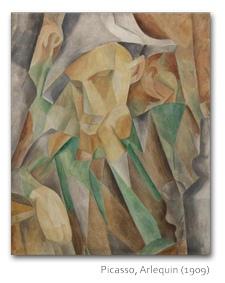
So God does in fact delight in certain non-Christian art, Barber argues. Yet if you are reading carefully you can hear in these words a caution. That is because the artistic skill of non-Christian artists is limited by sin. In regards to Pablo Picasso, for example, Barber writes, “While from a human perspective, his life-production may be considered ‘great,’ sin had reduced him to a mere vestige of the image of God, meaning that his work never reached its full potential” (452). That full potential requires an artist living under the Lordship of Christ and developing works that seek to glorify God.
Yet despite this lack of reaching full potential, the artistic gifting of Picasso finds its origin in God. Non-Christian artists show us, in Calvin’s words, “how widely the rays of divine light have shone” and reveals to us “the excellent gifts of the Spirit that are diffused through the whole human race” (Commentary on Gen. 4:20).
The implications of all this is explained in the words of Anthony Hoekema in Created in God’s Image:
We as Christian believers, therefore, may learn much from great works of literature written by unbelievers, even though we do not share their ultimate commitment. We may appreciate what has been produced by non-Christians in such areas of artistic endeavor as architecture, sculpture, painting, and music, since their gifts are from God. We may therefore enjoy the cultural products of non-Christians in such a was as to glorify God through them—even though such praise of God was not part of the conscious intent of these artists.
What makes it possible for Christians to delight in the artistic gifts of non-Christians is an understanding of where those gifts originate. They are from God. They reflect the character of God. And who better to recognize the origin of artistic gifts in non-Christians than God?
Christian artists should seek to use their artistic gifting to serve the Church. But this does not mean that art disconnected from the life of the church is not God-reflecting. It can be. And this is why we ourselves can delight in the beautiful artistic expressions of non-Christian artists because, as I have tried to show from reliable theologians, that is in fact what God himself does. Like God, we can separate the reflected gift from the depravity of the mirror, we can look beyond the wicked tongue and the wicked heart and still recognize God’s character in the reflection of beauty.
Conclusion
It seems to me that until we are open to this idea that God delights in the display of beautiful art by the non-Christian, we will find it difficult to glorify God through the art we see. This is specially true in the artisans who are not Christians, who bear the marks of their Creator while remaining under the guilt of their sin, and who are in desperate need of a Savior.
So here’s a brief summary of what I have learned over the months in reading on this topic:
- The artistic gift in man is intrinsic.
- The artistic creativity of God is on display in his creation.
- The human artistic impulse is, at least in part, a reflection of God’s image.
- God delights in Himself and therefore delights in the reflection of his own character, artistic beauty being one reflection of Him in our culture.
- Non-Christian artists, while remaining in a state of enmity with God, will never achieve their fullest artistic potential.
This perspective offers the Christian a wide foundation for the appreciation of non-Christian art in these ways:
- It will open our eyes to God’s common grace in the art around us.
- It will remind us that in every gifted artist we see a reflection of The Artist, the source of all goodness, truth, and beauty.
- It will help us appreciate the gifts of non-Christian artists and the beauty of non-Christian art.
- It will protect us from glorifying the glittering mirrors rather than the Sun.
- It will remind us that the artistic potential of non-Christians, no matter how great, is tragically limited.
- It will remind us that while there is beauty in non-Christian art to be enjoyed, art is not a “neutral territory” that should be pursued without a concern for God and truth.
- Finally, it will remind us that God’s highest purpose for art is beautiful work that flows from an artist who lives and works under the fear of God and under the Lordship of Jesus Christ, and expresses that artistic talent with the goal of bringing glory to The Artist.
 Tony Reinke