Rescuing Ambition

One of the most important books published in 2010 is Dave Harvey’s Rescuing Ambition (Crossway). But rather than tell you about it, I’ll let Dave explain the purpose behind the book through six short Q&A video clips. Watch the clips, meet Dave, get motivated, then go find a copy.

Q: “Why did you write ‘Rescuing Ambition?'”

Q: “Why is ambition important?”

Q: “What happens when ambition is lost?”

Q: “How do we fight selfish ambition?”

Q: “What’s the relationship between ambition and contentment?”

Q: “What part of this message would you share with your son on his graduation day?”

Bolt on Bavinck

In anticipation of the release of Herman Bavinck’s Reformed Dogmatics as an ebook for Logos, Kent Hendricks asked leading Bavinck scholar John Bolt four questions:

  • Who was Herman Bavinck?
  • What is the mission and role of the Dutch Translation Society in translating the works of Bavinck and other theologians?
  • The translation project took a decade to complete. Can you describe the process? What was your role in the translation and editorial process?
  • You write in the introduction to Bavinck’s Prolegomena in volume 1 that “the Gereformeerd Dogmatiek represents the concluding high point of some four centuries of remarkably productive Dutch Reformed theological reflection,” including “Voetius, De Moor, Vitringa, van Mastricht, Witsius, and Walaeus.” How does Bavinck both reflect and develop the theological system of his predecessors?

Read Bolt’s answers here.

Love for others

This excerpt from John Calvin reminds me a bit of the quote I posted earlier in the week from James Davidson Hunter. In The Institutes, Calvin writes (2.8.55; McNeil/Battles, 1:419):

“…we ought to embrace the whole human race without exception in a single feeling of love; here there is no distinction between barbarian and Greek, worthy and unworthy, friend and enemy, since all should be contemplated in God, not in themselves. When we turn aside from such contemplation, it is no wonder we become entangled in many errors. Therefore, if we rightly direct our love, we must first turn our eyes not to man, the sight of whom would more often engender hate than love, but to God, who bids us extend to all men the love we bear to him, that this may be an unchanging principle: Whatever the character of the man, we must yet love him because we love God.”

The ascent to morality maturity

C.S. Lewis, closes his essay “Man or Rabbit?” [now published in God in the Dock (Eerdmans, 1970), pp 108–113] with this image:

“’When that which is perfect is come, then that which is in part shall be done away’ [1 Cor 13:10]. The idea of reaching ‘a good life’ without Christ is based on a double error. Firstly, we cannot do it; and secondly, in setting up ‘a good life’ as our final goal, we have missed the very point of our existence. Morality is a mountain which we cannot climb by our own efforts; and if we could we should only perish in the ice and unbreathable air of the summit, lacking those wings with which the rest of the journey has to be accomplished. For it is from there that the real ascent begins. The ropes and axes are ‘done away’ and the rest is a matter of flying.”

Mt Sinai + Mt Transfiguration

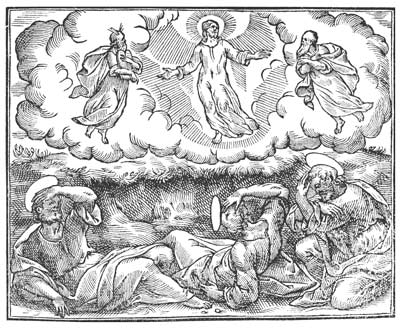
I find it interesting how Mark’s version of the Mount of Transfiguration echoes the Mount Sinai episode in the Old Testament. At least seven parallels surface:

  • The most obvious is that Moses is present at both Mount Sinai and the Mount of Transfiguration (Ex, Mark 9:4)
  • Both accounts take place on a high mountain (Ex 24:12–15, Mark 9:2)
  • In both cases a cloud covers the mountain (Ex 24:15–16, Mark 9:7)
  • A six-day interval leads up to the climactic events (Ex 24:16, Mark 9:2)
  • In both cases God speaks from the mountain on the seventh day (Ex 24:16, Mark 9:2,7)
  • At Mt Sinai, Moses’ face shines (Ex 34:29–35); at Mt Transfiguration, Jesus’ clothes shine (Mark 9:3)
  • The fear of the people in seeing Moses is paralleled by the fear of the disciples (Ex 34:30, Mark 9:6).

And another interesting connection links Moses and Jesus together in the Transfiguration. In the OT Moses says to look forward to a coming prophet—a new prophet—and when he comes, listen to him. Compare this to God’s words at the Mount of Transfiguration:

  • Moses: “The LORD your God will raise up for you a prophet like me from among you, from your brothers—it is to him you shall listen” (Deut 18:15).
  • God: “This is my beloved Son; listen to him” (Mark 9:7).

Exactly what Mark intended us to understand through this parallelism is not immediately clear. But it does seem to indicate two things:

  1. As God delivered revelation through Moses at Sinai, so now Jesus is a new revelation of God. Everyone should be listening.
  2. Jesus’ redemptive work is the outworking of an ancient redemptive lineage. After his transfiguration, Jesus turns his thoughts and his words to his approaching death and resurrection (see Mark 9:10-11, 31). This work is firmly rooted in the OT promises.

William Lane, in his commentary on Mark (NICNT), summarizes the data well when he concludes:

When the cloud lifted, Moses and Elijah had vanished. Jesus alone remained as the sole bearer of God’s new revelation to be disclosed in the cross and resurrection. Moses and Elijah had also followed the path of obedience, but having borne witness to Jesus’ character and mission, they can help him no more. The way to the cross demanded the submission of the Son and Jesus must set out upon it alone.