Prayer and Blood

Prayer is multidimensional and it can be defined in several ways and taught through many principles of scripture. But one of the most foundational themes—especially obvious in the Old Testament—is that prayer is a bloody thing.

Take these few examples:

• The Lord blesses Solomon’s desire to build a temple, a place of sacrifice, and says it will be a place where “I will hear their prayers” (2 Chronicles 7:11—17). After the temple was completed it was dedicated and in this dedication ceremony Solomon offered a prayer on behalf of the people (1 King 8:22—53), said a corporate benediction (8:54—61), and this was followed by a blood sacrifice (62—66). In the temple, prayer and sacrifice went hand-on-hand, as God intended.

• In one place David builds an altar and his prayer is heard (2 Samuel 24:18—25). At another place, David entered the presence of God with sacrifice (Psalm 66:13—15) in the hopes of answered prayer (19—20). The Psalmist commonly weds together the themes of prayer and sacrifice (Psalm 4:1,5; 54:2,6; 54:2,6).

• The value of Job’s prayer for his friends is inseparable from the sacrifice made by his friends (Job 42:7—10).

• The prophet Isaiah decried the hypocrisy of Israel which made the sacrifices useless and, as a result, God closed his ears to their prayers (Isaiah 1:10—13 with v. 15). Without proper sacrifices there was no hearing.

• The nations were invited to worship God by assembling at “a house of prayer” where God would hear their prayers because offering and sacrifices were offered (Isaiah 56:7).

For the Old Testament saint, prayer and sacrifice were linked. And the same is true today. No prayer from our lips reach the ear of God without the sacrifice of Christ for our sins. The only pathway to the Living God is paved with Blood.

So we mustn’t grow content with the absence of Blood in our contemporary books on prayer.

Homer, Plato, Virgil, and the Christian Life

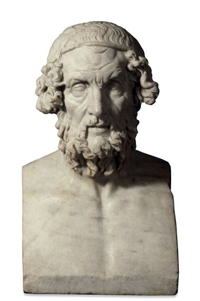
homerI appreciate all the thoughts and comments you left on the previous post. The priority of ancient literature in the reading diet of the Christian is a topic of great interest to me. But the topic brings some baggage due to the wide pendulum of opinion. Is reading this literature idolatrous? Is it helpful? Helpful merely as philosophy? Is it ethically useful? Theologically? C.S. Lewis, Luther, and Calvin seem to answer these questions differently.

John Calvin, for example, encouraged others to study and to appreciate the “profane authors.” “If we reflect that the Spirit of God is the only fountain of truth,” Calvin writes, “we will be careful, as we would avoid offering insult to him, not to reject or condemn truth wherever it appears. In despising the gifts, we insult the Giver” [see his Institutes 2.2.14—16].

Cornelius Plantinga has summarized Calvin’s approach in this way:

Calvin understood that God created human beings to hunt and gather truth, and that, as a matter of fact, the capacity for doing so amounts to one feature of the image of God in them (Col. 3:10). So Calvin fed on knowledge as gladly as a deer on sweet corn. He absorbed not only the teaching of Scripture and of its great interpreters, such as St. Augustine, but also whatever knowledge he could gather from such famous pagans as the Roman philosopher Seneca. And why not? The Holy Spirit authors all truth, as Calvin wrote, and we should therefore embrace it no matter where it shows up. But we will need solid instruction in Scripture and Christian wisdom in order to recognize truth and in order to disentangle it from error and fraud. Well-instructed Christians try not to offend the Holy Spirit by scorning truth in non-Christian authors over whom the Spirit has been brooding, but this does nor mean that Christians can afford to read these authors uncritically. After all, a person’s faith, even in idols, shapes most of what a person thinks and writes, and the Christian faith is in competition with other faiths for human hearts and minds. [Engaging God’s World (Eerdmans 2002) p. x.]

Martin Luther distinguished the philosophical value from the theological value of the ancients. Gerrish in his Grace and Reason: A Study in the Theology of Luther makes this comment (thanks Tom!):

To Luther’s mind it was quite astonishing that anyone should fail to see the incompatibility of Aristotle and ‘Catholic Truth’. And yet one recalls that it was the special concern of his own teacher, Trutvetter, to demonstrate their harmony. The important thing to note, however, is that he does not deny some validity to the heathen master’s philosophy in its own sphere. Aristotle wrote with admirable learning on the problems of ethics. Both his books and Cicero’s are extremely useful for the conduct of this life. In other words, Aristotle’s moral philosophy is of value in the Earthly Kingdom. This, no doubt, explains the apparent contradiction between the abuse which Luther heaps on Aristotle’s Ethics in one place and the praise which he bestows upon it in another. When Luther looks at Aristotle’s natural philosophy and moral philosophy, weighing them strictly on their own intrinsic merits, he much prefers the latter;  but he can conceive of nothing more mischievous than Aristotle’s ethics when they are mixed up with the theology of grace and salvation. In any case, he calls it mere philistinism (barbarum) to be ignorant of Aristotle’s natural philosophy, even though it may not be universally true. After all, the Greek philosopher’s views form an integral part of culture and rest upon sound arguments. Clearly, as long as the distinction between theology and philosophy is kept before the mind, there is nothing to prevent one from passing favourable judgements upon Aristotle or, at least, giving him a fair trial.

Another quote originates from the pen of Peter Leithart. While I disagree with him on a number of various theological points, I find him cautious and helpful on this particular topic. Here is one excerpt of what he has written:

Given the fact that the classics are idolatrous through and through, why should we want to preserve them? Why should we keep alive the memory of Greek gods? Should we be studying the exploits of heroes who served these gods? Should we not instead throw all of Homer, Aeschylus, Sophocles, and Virgil into one flaming heap in the town square? Wouldn’t Moses?

A part of the answer to these questions is that Christians have no more moral duty to read and study Greek and Roman literature than ancient Israelites had a duty to study the myths of Baal and Asteroth. Nor should Christian schools or home schoolers think that they can have a good Christian education only if the “classics” are prominent in the curriculum. The goal of Christian education is to train a child to be faithful in serving God and His kingdom in a calling, and certainly this goal can be achieved by a student who never cracks the cover of a Homeric epic. Given the appalling ignorance of the Bible among evangelical Christians today, mastering Scripture must be an overwhelming priority in all Christian education. If one must choose between studying Leviticus or Livy, Habakkuk or Homer, Acts or Aeschylus, the decision is, to my mind, perfectly evident, and the point holds even if the non-biblical literature were Christian. The genealogies of 1 Chronicles 1-9 are vastly more important to study than Dante, Shakespeare, Milton, or Dickens.

But, of course, students and teachers are not always faced with a stark either/or choice. Assuming a student has a strong grounding in Scripture, there may be good reasons for taking up a study of other literature. And a few texts of Scripture demonstrate that it is not necessarily sinful for believers to study pagan literature. Daniel and his three friends learned the language and literature of the Chaldeans (Dan. 1:4), which undoubtedly focused on Chaldean mythology. In the New Testament, Paul occasionally reveals that he knew some of the literature and philosophy of the Greeks and Romans. [Heroes of the City of Man: A Christian Guide to Select Ancient Literature (Canon Press, 1999), p. 18.]

So these are a few of the prominent quotes that are helping me think through the priority of ancient myth in the reading diet of a Christian (or not). Keep the comments coming. I appreciate your feedback! Your feedback—learning from you and learning together—is why I continue to blog. Thanks to each of you who have (and will) respond.

Tony

Homer, Plato, Virgil, and the Cross

“What then shall we say if we would restore the medieval bridge from Homer, Plato and Virgil to Christ, the Bible and the church? Shall we say that Christianity is not the only truth? Certainly not! But let us also not say that Christianity is the only truth. Let us say instead that Christianity is the only complete truth. The distinction here is vital. By saying that Christianity is the only complete truth, we leave open the possibility that other philosophies, religions and cultures have hit on certain aspects of the truth. The Christian need not reject the poetry of Homer, the teachings of Plato, or the myths of the pagans as one hundred percent false, as an amalgamation of darkness and lies (as Luther strongly suggests), but may affirm those moments when Plato and Homer leap past their human limitations and catch a glimpse of the true glory of the triune God.

I reject the all-or-nothing, darkness-or-light dualism that Luther at times embraced. But I also reject the modern relativist position that truth is like a hill and there are many ways around it. Yes, truth is like a hill, but the truth that stands atop that hill is Christ and him crucified. To arrive at the truth of Christ, the people of the world have pursued many, many different routes. Some have only scaled the bottom rim of the hill; others have made it halfway. But many have reached the top and experienced the unspeakable joy that comes only when the truth they have sought all their lives is revealed to them. …

If we are to accept these verses [Romans 2:14-15] in a manner that is in any way literal, we must confess that unregenerate pagans have an inborn capacity for grasping light and truth that was not totally depraved by the Fall. Indeed, though the pagan poets and philosophers of Greece and Rome did not have all the answers (they couldn’t, as they lacked the special revelation found only in Jesus), they knew how to ask the right questions—questions that build within the readers of their works a desire to know the higher truths about themselves and their Creator.”

—Louis Markos, From Achilles to Christ: Why Christians Should Read the Pagan Classics (IVP Academic 2007), pp. 13-14

Do those look like the hands of a God who doesn’t care?

alcorn“When we lock our eyes on our cancer, arthritis, fibromyalgia, diabetes, or disability, self-pity and bitterness can creep in. When we spend our days rehearsing the tragic death of a loved one, we will interpret all life through the darkness of our suffering. How much better when we focus upon Jesus!

‘Let us fix our eyes on Jesus…who for the joy set before him endured the cross.’ The following verse commands us, ‘Consider him who endured such opposition from sinful men, so that you will not grow weary and lose heart’ (Hebrews 12:2—3).

However great our suffering, his was far greater. If you feel angry at God, what price would you have him pay for his failure to do more for people facing suffering and evil? Would you inflict capital punishment on him? You’re too late. No matter how bitter we feel toward God, could any of us come up with a punishment worse than what God chose to inflict upon himself?…

If you know Jesus, then the hand holding yours bears the calluses of a carpenter who worked with wood and carried a cross for you. When he opens his hand, you see the gnarled flesh of the nail scars on his wrists. And when you think he doesn’t understand your pain, realize that you don’t understand the extent of his pain. Love him or not, he has proven he loves you.

If you hate suffering, does it make sense to choose eternal suffering when God has already suffered so much to deliver you from it?

In your most troubled moments, when you cry out to God, ‘Why have you let this happen?’ picture the outstretched hands of Christ, forever scarred…for you.

Do those look like the hands of a God who does not care?”

—Randy Alcorn, If God is Good: Faith in the Midst of Suffering and Evil (Multnomah, 2009), pp. 218—219.

Reading Books Together

Since childhood I’ve been swinging a hammer, and have often felt the pain of slamming my thumb. And I know the pain of pounding that same thumb several more times in the same day (youwzah!). See building houses is in my roots, it’s in my blood. And I have the scars to prove it. One little mark reminds me of the time I shot a pneumatic framing nail completely through my ring finger (through flesh and bone). But it wasn’t all pain and blood. I can also tell you wonderful stories of learning from my father as I watched him build and create.

Long before I was trusted with a pneumatic nailer, my father taught me the proper setting of a framing nail. The process isn’t complicated. With the left hand you hold the nail steady and with the right hand you tap the head of the nail a few times, just enough so the nail will stand on its own. Then once the nail is set, you move your left hand out of the way and pound and sink the nail down with a few mighty swings. (Or, if you miss hitting the nail head squarely, it shoots across the room like a bullet).

Reading is a lot like setting a nail. As your eye scans back-and-forth across a page, streams of information pours out quickly and you have just enough time to tap those concepts into the surface of your brain. But if we read too fast we fail to comprehend deeply, and those nails will not hold and they will eventually fall out and be forgotten.

If setting a nail is likened to superficial comprehension that happens while we read, sinking nails tightly can be likened to the slow discussion of books with others. Here we slow our minds, we focus our thoughts, we express our understanding of our reading and we are shaped by others as we shape one another. Our minds slow and focus and allow us to sink a few of those nails tight.

But you cannot sink every nail. A good reading group will determine which of the few nails to drive tight. And the group can decide which nails to leave loose. But choose carefully. It’s the ideas and passages from books that are discussed most carefully with friends that are sunk the furthest, and those sunk the furthest are the ones you will carry the longest—likely for the remainder of your life.

It is true that reading is mostly a solitary task, and a very important one. Comprehension, on the other hand, is a community project. Which is why scholars, those experts in the art of comprehension, include lengthy bibliographies in the back of their books and order those books by name. Every scholar—every honest scholar at least—acknowledges the importance of learning from others. And they’re happy to acknowledge it.

It’s the average reader that needs persuasion about the importance of reading in community. And I am convinced that we forget so much of what we read not because we are poor readers (although this certainly could be the cause); rather, I believe we forget so much of what we read because we are selfish readers. And we all suffer for it.

Literacy and good books provide us the nails, disciplined reading sets the nails, and our community helps to sink those nails.