Preaching Christ

“Faith is not built by preaching introspectively (constantly challenging people to question whether they have faith); faith is not built by preaching moralistically (which has exactly the opposite effect of focusing attention on the self rather than on Christ, in whom our faith is placed); faith is not built by joining the culture wars and taking potshots at what is wrong with our culture. Faith is built by careful, thorough exposition of the person, character, and work of Christ….

We feed on Christ himself, and we do so not by some physical eating of his body, but through faith in the Christ proclaimed in Word and sacrament. These four alternatives [moralism, how-to, introspection, and social gospel] have left much of the evangelical and Reformed church malnourished. People know what they ought to do, but they are dispirited and lethargic, without the vision, drive, or impetus to live with and for Christ. And the reason for this dispirited condition is that the pulpit is largely silent about Christ. He is mentioned only as an afterthought or appendage to a sermon; in many churches, he is never proclaimed as the central point of a sermon, and surely not on a regular, weekly basis.”

—T. David Gordon, Why Johnny Can’t Preach: The Media Have Shaped the Messengers (P&R 2009) pp. 75—76, 88—89.

Bernard of Clairvaux Day

Bernard of Clairvaux died on August 20, 1153. By all accounts, Bernard was a Church Father who understood the doctrine of imputation, that a righteous standing before God required the perfect merits of Christ, received by faith, as opposed to salvation based (even in part) upon personal merit. Missouri Synod (Lutheran) founder C. F. W. Walther wrote of Bernard:

St. Bernard, the famous abbot of Clairvaux, who died in 1153, is a noteworthy example how the most pious and the best of those in the papacy, when they came into great trials, rejected all of their trust in their own human holiness, in their own works and service, and in the intercession of the saints in heaven, and took sole comfort in the all sufficient service of JESUS Christ for their salvation. Even though in his life Bernard had most strictly pursued holiness and had ascribed such a high value to his position as a monk that he considered it as if it were another baptism (Apolog. Ad Builielm. Abb.), he nevertheless confessed when he suddenly cried out for his salvation because of a severe trial: “I confess that I am not worthy of myself nor can I receive heaven through my own service. But my LORD JESUS Christ has a double right to heaven; first because he is by nature its heir, and then because he has earned it through his meritorious suffering. That first right he has for himself, the second he gives me. Through this gift heaven is mine by rights, so I cannot be lost.

FYI: Calvin’s Institutes include over 40 references to the works of Bernard.

FYI: Dr. Danny Aiken’s PhD dissertation covered the soteriology of Bernard (unpublished).

FYI: Bernard wrote hymns, two you may know: O Jesus, King Most Wonderful and O Sacred Head, Now Wounded.

HT: CB via Veith

“love, love, love, love to thee”

In many ways, King Edward VI represented the Protestant hope of reformation in England. Edward was young, he was smart, he was sympathetic to the Protestants, and he put his royal money where his mouth was. But he was human, and a weak one. In the summer of 1553, at the age of 15, King Edward was struck ill and died. And so died much of the Protestant momentum.

Only a few days after his death, Edward’s sister, Mary I, became queen. Known as “Bloody Mary,” her first official acts were to reverse Edward’s pro-Protestant support, and for those laboring towards religious reform in England this meant that all hell was about to break loose.

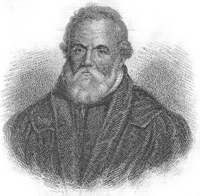
John-Braford-preachingIn the week between the death of Edward VI and the beginning of Mary’s reign, John Bradford edited a sermon for the printer: “A Sermon of Repentance.” The death of Edward was a clear indication, Bradford wrote, that, “great and heavy is God’s anger against us.” If God took the life of their beloved king, what must God think of the sinfulness of the average man and woman? Bradford said, “now I beseech you all, all, all, and every mother’s child, to repent and lament your sin, to trust in God’s mercy, and to amend your lives.”

But that was all just a long intro to get to the sermon excerpt I want to feature today. The language is dated, but it’s worth your time to read it a few times. Toward the end of the sermon, as Bradford is calling sinners to trust in Christ he says the following about the grace and mercy of God in Christ:

O love incomprehensible! Who can otherwise think now but, if the gracious good Lord disdained not to give his own Son, his own heart’s joy, for us his very enemies, before we thought to beg any such thing at his hands, … who, I say, can think otherwise but that with him he will give us all good things? If, when we hated him and fled away from him, he sent his Son to seek us; who can think otherwise than that now we loving him, and lamenting because we love him no more, but that he will forever love us? He that gives the more to his enemies, will not he give the less, to you, to his friends? God hath given his own Son, than which thing nothing is greater, to us his enemies: and, we now being become his friends, will he deny us faith and pardon of our sins, which, though they be great, yet in comparison they are nothing at all? …

Jesus Christ gave his life for our evils, and by his death delivered us. O then, in that he lives now and cannot die, will he forsake us? His heart’s blood was not too dear for us when we asked it not: what can then be now too dear for us asking it? Is he a changeling? Is he mutable as man is? Can he repent him of his gifts? Did he not foresee our falls? Paid not he therefore the price? Because he saw we should fall sore, therefore would he suffer sore.

Yea, if his sufferings had not been enough, he would yet once more come again. God the Father, I am sure, if the death of his Son incarnate would not serve, would himself and the Holy Ghost also become incarnate, and die for us. This death of Christ therefore look on as the very pledge of God’s love towards thee, whosoever thou art, how deep soever thou hast sinned.

See, God’s hands are nailed, they cannot strike thee; his feet also, he cannot run from thee: his arms are wide open to embrace thee; his head hangs down to kiss thee; his very heart is open! So that therein see, search, look, spy; and you shall see nothing therein but love, love, love, love to thee. *

Under Mary’s reign, nearly 300 Protestants would by martyred. Bradford was one of them, burned at the stake in the summer of 1555. But not before Bradford traveled the country, proclaiming repentance and the free grace of our Savior Jesus Christ.

—–

NOTES:
* The Writings of John Bradford (Cambridge 1853), 1:75—76.

Advice on Reading

Some original, famous, and counter-intuitive advice on reading comes to us from the 18th century writer and literary critic Samuel Johnson (1709—1784).

For example: It was never his practice to read books from cover-to-cover. And only a few books were worthy enough to be read completely, meaning, after reading to the end he returned to the beginning to read the first half he originally skipped. Advice like this is uniquely Johnson. So I’ve collected a few choice excerpts, mostly borrowed from James Boswell’s, The Life of Samuel Johnson (Everyman’s Library 1906).

Enjoy:

“Idleness is a disease which must be combated; but I would not advise a rigid adherence to a particular plan of study. I myself have never persisted in any plan for two days together. A man ought to read just as inclination leads him; for what he reads as a task will do him little good.” [Boswell 270]

“What is read with delight is commonly retained, because pleasure always secures attention but the books which are consulted by occasional necessity, and perused with impatience, seldom leave any traces on the mind.” [The Idler #74 (September 15, 1759)]

Mr. Elphinston talked of a new book that was much admired, and asked Dr. Johnson if he had read it. JOHNSON: “I have looked into it.” “What,” said Elphinston, “have you not read it through?” Johnson, offended at being thus pressed, and so obliged to own his cursory mode of reading, answered tartly, “No, Sir, do you read books through?” [Boswell 462]

Friday, April 7, I dined with him at a Tavern, with a numerous company. JOHNSON. “I have been reading Twiss’s Travels in Spain, which are just come out. They are as good as the first book of travels that you will take up. They are as good as those of Keysler or Blainville; nay, as Addison’s, if you except the learning. They are not so good as Brydone’s, but they are better than Pococke’s. I have not, indeed, cut the leaves yet; but I have read in them where the pages are open, and I do not suppose that what is in the pages which are closed is worse than what is in the open pages.” [Boswell 542]

Walter Jackson Bate: “His equivalent of a library was, of course, his father’s bookshop. Balked by the school procedure from reading either for substance or even for style in any genuine sense, his immense curiosity found outlet in independent dipping into books and skimming them. And his habit of instantly ‘relating’ one thing to another, which Mrs. Thrale rightly thought one of the secrets of his mental superiority, enabled him to get a point quickly, to see its ramifications, and to anchor it to a growing corpus of general thought that was imaginatively and fertilely alive. Here, in this kind of reading, simply because it was done without deliberate purpose, and not confined within a conscious program or demand, the inner protest and instinctive mulishness declined, though it did not completely disappear. For this sort of reading could be viewed as a kind of escape. It could hardly be called ‘work.’ Even so, a certain mulishness remained… This appears, for example, in his growing habit of not finishing books. Later, as if to make a virtue of necessity (since the habit was to become thoroughly ingrained in him), he enjoyed starling others—particularly pedestrian and solemn scholars (just as he enjoyed startling snobbery of any kind)—by flaunting his inability to ‘read books through.’” [Samuel Johnson (Counterpoint 1998), 34—35]

He said that for general improvement, a man should read whatever his immediate inclination prompts him to; though, to be sure, if a man has a science to learn, he must regularly and resolutely advance. He added, “what we read with inclination makes a much stronger impression. If we read without inclination, half the mind is employed in fixing the attention; so there is but one half to be employed on what we read.” He told us, he read Fielding’s Amelia through without stopping. He said, ‘if a man begins to read in the middle of a book, and feels an inclination to go on, let him not quit it, to go to the beginning. He may perhaps not feel again the inclination.” [Boswell 656]

Dr. Johnson advised me to-day to have as many books about me as I could; that I might read upon any subject upon which I had a desire for instruction at the time. “What you read then,” (said he,) “you will remember; but if you have not a book immediately ready, and the subject moulds in your mind, it is a chance if you have again a desire to study it.” He added, “If a man never has an eager desire for instruction, he shall prescribe a task for himself. But it is better when a man reads from immediate inclination.” [Boswell 766]

In the morning of Tuesday, June 15, while we sat at Dr. Adams’s, we talked of a printed letter from the Reverend Herbert Croft to a young gentleman who had been his pupil, in which he advised him to read to the end of whatever books he should begin to read. JOHNSON. “This is surely a strange advice; you may as well resolve that whatever men you happen to get acquainted with, you are to keep to them for life. A book may be good for nothing; or there may be only one thing in it worth knowing; are we to read it all through?” [Boswell 1154—1155]

HT:AM

The Marvel of the Cross

“…How amazing that God in Christ should do all this; that the Most High, the Most Holy should be the All Loving too; that the ineffable Majesty should stoop to take upon himself our flesh, subject to hunger and cold, death and desperation. We see him lying in the feedbox of a donkey, laboring in a carpenter’s shop, dying a derelict under the sins of the world. The gospel is not so much a miracle as a marvel, and every line is suffused with wonder.”

—Roland Bainton, Here I Stand: A Life of Martin Luther (Plume 1995), 63.

Spiritual Disciplines of John Bradford (1510—1555)

Bradford…Bradford had his daily exercises and practices of repentance. His manner was, to make to himself a catalogue of all the grossest and most enorme sins, which in his life of ignorance he had committed; and to lay the same before his eyes when he went to private prayer, that by the sight and remembrance of them he might be stirred up to offer to God the sacrifice of a contrite heart, seek assurance of salvation in Christ by faith, thank God for his calling from the ways of wickedness, and pray for increase of grace to be conducted in holy life acceptable and pleasing to God.

Such a continual exercise of conscience he had in private prayer, that he did not count himself to have prayed to his contentation, unless in it he had felt inwardly some smiting of heart for sin, and some healing of that wound by faith, feeling the saving health of Christ, with some change of mind into the detestation of sin, and love of obeying the good will of God. Which things do require that inward entering into the secret parlour of our hearts of which Christ speaketh; and is that smiting of the breast which is noted in the publican …

Let those secure men mark this well, which pray without touch of breast, as the Pharisee did; and so that they have said an ordinary prayer, or heard a common course of prayer, they think they have prayed well, and, as the term is, they have served God well; though they never feel sting for sin, taste of groaning, or broken heart, nor of the sweet saving health of Christ, thereby to be moved to offer the sacrifice of thanksgiving, nor change or renewing of mind: but as they came secure in sin and senseless, so they do depart without any change or affecting of the heart; which is even the cradle in which Satan rocketh the sins of this age asleep, who think they do serve God in these cursory prayers made only of custom, when their heart is as far from God as was the heart of the Pharisee.

—Thomas Sampson in the introduction to The Writings of John Bradford (Cambridge 1853), 1:33—34.