Resolved 2009 Highlights

Each year I anticipate a trio of college conferences—the 20/20 Collegiate Conference (Wake Forest, NC), New Attitude/NEXT (Louisville/Baltimore), and Resolved (Palm Springs, CA). Tuesday I returned from Resolved where about 4,000 students assembled to hear from Rick Holland, Steve Lawson, John MacArthur, John Piper, and C.J. Mahaney. Here are a few highlights from the trip.

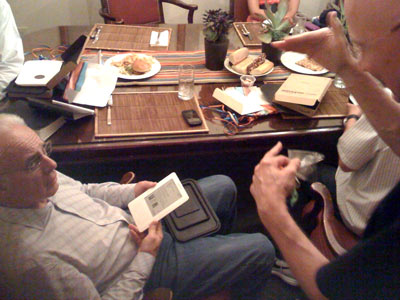
Highlight #1: Sunday night in the hotel watching Steve Lawson and John MacArthur start up new Kindles they received for speaking at the conference and listening in as C.J. provided the technical support. These three guys are more comfortable with a fountain pen than an iPod, so this communion of technological discovery was too funny! How I wish I had video! [BTW, upon starting up the Kindle, the first book automatically suggested on the screen to Dr. MacArthur was The Third Jesus by Deepak Chopra. No sale.]

jmac-cj-2-smaller

Highlight #2: Hearing Rick lead an impromptu interview with Steve Lawson on church history.

Part 1:

Part 2:

Highlight #3: Hearing Rick’s introduction before C.J. spoke for the first time. His intro was moving because of its accuracy. When Rick asked how many students at the conference had never heard C.J. preach live, I would guess somewhere between 1-in-4 to 1-in-3 raised their hands. And they were in for a treat. On the final evening of the conference, C.J.’s version of his Psalm 42 message (“The Troubled Soul”) was one of the best messages I’ve heard him deliver. But back to the intro, very nicely done!

Highlight #4: To close the conference, Dr. Piper delivered a message “How Sin Serves the Glory of Christ.” It was a clear and concise presentation of the cross-centeredness of biblical history and now ranks in my top-10 favorite Piper messages. Both of his conference messages were pulled from his book, Spectacular Sins (Crossway, 2008).

Highlight #5
: Message “A Biblical Strategy For Fighting Sexual Sin” by Rick Holland. Outstanding message!

Highlight #6: Morning devotions on the hotel patio overlooking the empty pool, the palm trees, and the San Jacinto Mountains.

PSprings-sm

It was a great trip, with comfortable highs in the low-90s (last year it topped out at 117°), and plenty of time to hang out with friends (old and new). But it’s always nice to be home again.

The Practical Value of Revelation

“…the churches are to read and reread the book in their assembly so that they may continually be reminded of God’s real, new world, which stands in opposition to the old, fallen system in which they presently live. Such a continual reminder will cause them to realize that their home is not in this old world but in the new world portrayed parabolically in the heavenly visions. Continued reading of the book will encourage genuine saints to realize that what they believe is not strange and odd, but truly normal from God’s perspective. They will not be discouraged by outside worldliness, including what has crept into the churches, which is always making godly standards appear odd and sinful values seem normal. John refers to true unbelievers in the book as ‘earth-dwellers’ because their ultimate home is on this transient earth. They cannot trust in anything except what their eyes see and their physical senses perceive; they are permanently earthbound, trusting only in earthly security, and will perish with this old order at the end of time when the corrupted cosmos finally is judged and passes away. On the other hand, Christians are like pilgrims passing through this world. As such they are to commit themselves to the revelation of God in the new order so as progressively to reflect and imitate his image and increasingly live according to the values of the new world, not being conformed to the fallen system, its idolatrous images, and associated values (cf. Rom. 12:2).”

—G. K. Beale, The Book of Revelation (NIGTC), p. 175.

Duty and Delight

“A perfect man would never act from a sense of duty; he’d always want the right thing more than the wrong one. Duty is only a substitute for love (of God and of other people) like a crutch which is a substitute for a leg. Most of us need the crutch at times; but of course it is idiotic to use the crutch when our own legs (our own loves, tastes, habits, etc.) can do the journey on their own.”

—C.S. Lewis, Letters, 18 July 1957.

Ringwraiths and Industrialized Evil

“Tolkien is a very subtle author, and you can say there is a distinction in his work between what happens to the Wraiths and what happens to the Orcs. They are both images of evil—one being more dangerous than the other—but they seem to operate in different ways. In some ways the idea of a Wraith is a very 20th century one. You feel that Wraiths don’t get much fun out of evil, they are not doing this for simple human motives like anger, or revenge, or bloodthirstiness, or lust, or whatever. The fact is, it’s not at all clear why they are doing it. They seem to have lost their personalities, they have turned into nothing, and yet they are powerful forces. This has a resonance with a century in which you could say that evil has very often been carried out by bureaucrats, by people in nice offices with white collars who listen to the stringed quartet in the evening, who are kind to their kids and dogs. But, just the same, they sign the orders, they put people on the trains, and those people never come back again. It’s all been industrialized.”

—Tom Shippey, in “Maker of Middle-Earth.”

On Reading Revelation

TheAdorationoftheLamb

I suppose one reason I don’t prioritize the book of Revelation in my devotional times—along with its length and its ancient, often mystifying, imagery—is for the fact that I simply forget the book’s purpose. But I should know better, for the purpose is clearly stated at the beginning of the book, and at the end of the book. Those purpose statements form two unifying bookends around all the visions, letters, and dramatic battles in between.

To use the simple terms of Apostle John, in the book of Revelation God beckons us to hear and to heed (vss. 1:3, 22:7). We are blessed to hear, blessed to pay attention, blessed to struggle through page after page of prophetic imagery, blessed to read soberly and carefully. That one I understand. But we are also promised blessing for perpetual state of heeding (τηρέω) the book. And this is the thorny one for me. How exactly am I to apply most of the book to my everyday life?

Revelation provides us with high-def footage of the climactic conclusion of world history, it ties together and consummates all of God’s redemptive purposes in this world, and it delivers us to the doorstep of a glorious eternity. And a conscious awareness of this truth will begin to change our entire perspective of this world. If we listen carefully, this hearing will become heeding.

It appears that one of God’s main purposes in the book of Revelation is simply this–He wants to change us. He wants to change how we live, what we live for, how we treat our spouse and children and friends, how we order our goals, what we prioritize, the zeal with which we kill personal sin, the purity of the local church, our compassion towards the hurting, our counsel for fellow sinners, our love for the lost, our earnestness to obey, our diligence to pray, our disgust of our personal worldliness, our heartfelt earnest longing for the return of Christ. God wants us to be holy like His Son.

But sometimes we don’t view Revelation this way. These two bookend reminders in Revelation—to hear and heed—are not commands to chart the book out with graphics, to estimate the date of the word’s end, or to argue over different millennial views. There is a place for charitable discussion over differing interpretations of Revelation. But we are to heed the book. And as we read carefully, we pray that the Holy Spirit will use the book’s pervasive imagery to change our hearts.

In the future I want to read the book of Revelation more seriously—to allow this breathtaking, earth-scorching, imagination-stretching, sin-defeating, Christ-exalting, God-glorifying book change the way I think, act, and speak. For this, it appears to me, is the immediate purpose of Revelation.

And this leads me to think of any number of implications. For one, it forces me to believe that imagination is important for comprehending large chunks of biblical truth. As C.S. Lewis reminded us, truth and imagination are not mutually exclusive. The imaginative can be non-fictional. In fact, the book Revelation proves that some eternal truth cannot be comprehended apart from a healthy imagination! As we read the visions of Revelation we are changed; scripture passing into our eyes, sparking our imagination, stirring our affections, and settling into our hearts. However, this connection between truth and imagination—and even personal holiness and healthy imagination—is better left for another post.

Have a great weekend! I look forward to seeing a few of you in Palm Springs.

————

Painting: “The Adoration of the Lamb”, Jan Van Eyck, 1432.

Reading Digest #6 (June 10, 2009)

This is my first digest since April, so it’s a bit long. My goal in posting my reading is not to impress you, but to hopefully encourage you to read more, and to point your bibliographic antennae in the direction of books you may find useful, informative, and edifying.

And, as always, I’d love to hear what you’re reading. Let me know in the comments.

SCRIPTURE …

Galatians (personal devotions).

Galatians 5:6 (family devotions). We have been meditating on a single passage that wonderfully boils down the two main components of the Christian life—faith in God (vertical) and love towards others (horizontal). “Faith working through love” has become our mantra in family worship, the theme of our recent conversations, our mutual aspiration. … Also, last night we started reading The Princess and the Goblin by George MacDonald.

RECENTLY READ, CURRENTLY READING …

The Epistle to the Galatians (NICNT) by Ronald Y. K. Fung (Eerdmans, 1998, 342 pgs). Fung’s commentary is the most readable technical work on Galatians, a feast for the mind, and spark for the soul’s meditation. It’s not too much to say that this book models how technical commentaries on Paul’s Epistles should be constructed.

Heart of Darkness by Joseph Conrad (Everyman’s Library, 1993, 110 pgs). Considered to be one of the most unrelenting fiction works. At a recent dinner with biblical counselor, David Powlison told me that here in this book Conrad stares directly into the pit of human heart. Reading this dark realism reminds me of the darkness of this sinful world, darkness the gospel has arrived to redeem sinners from, a darkness that remains the only alternative path apart from faith in Christ.

The Infinite Merit of Christ: The Glory of Christ’s Obedience in the Theology of Jonathan Edwards by Craig Biehl (Reformed Academic, 2009, 2009, 250 pgs). I’ve read so many average books about Edwards’ theology I often wonder why I don’t just read more of Edwards! Not with Biehl. In this monumental synthesis, Biehl weaves together 800 direct quotations into a breathtaking, overarching framework of Edwards’ theology. And at the center of that framework stands the person and work of Jesus Christ. Majestic in scope, clarity, and organization, Biehl has made the center of Edwards’ theological framework more explicable to my little brain. This is one of the most important works published this year and a defining volume in the cottage industry of books on Edwards’ theology.

Smart Choices: A Practical Guide to Making Better Decisions
by John S. Hammond (Broadway, 2002, 256 pgs). Hammond’s book is worthwhile. In it he provides a clear system for digging to the bottom of important questions (a crucial, but often neglected, first step in making decisions) and then works toward assembling multiple creative solutions. I found his principles a bit rigid and sometimes overly structured, but the case study examples are packed with creativity and innovative thinking. These examples keep the book moving at a steady pace.

5 Minds for the Future by Howard Gardner (Harvard Business, 2008, 196 pgs). Gardner, an influential intellectual, argues that successful minds of the future will intermix the following five skills or “minds”—disciplined, synthesizing, creative, respectful, and ethical. I myself am a synthesizer. And from what Gardner says, this is an important skill in the information swamp we now live. A helpful book.

Heralds of God by James S. Stewart (Hodder & Stoughton, 1946, 222 pgs). Cross-centered books on preaching are not numerous, so I appreciate any volume, even an old one like Stewart. He does a fine job connecting the preacher’s priorities to the Cross. A little book now long out of print.

The Preacher: His Life and Work by J. H. Jowett (Harper & Bros, 1912, 239 pgs). Very similar outline and flow to Stewart. Jowett displays a great sense of the splendor and particulars of the preacher’s life and ministry. Also short, worth finding, and now long out of print.

The Life of Alexander Whyte by G. F. Barbour (Hodder & Stoughton, 1924, 675 pgs). Barbour has a gift for locating, extracting, and reproducing many devotional bits from the life and ministry of the famous Scottish preacher. I have enjoyed pouring over the yellow, musty, Deckle-edged pages of this classic biography. Also out of print, unfortunate for such a superb model of Christian biography.

A Geerhardus Vos Anthology edited by Danny E. Olinger (P&R, 2005, 375 pgs). Vos is not remembered as a man of the one-liner, spouting off zingers from the hip to satiate the thronging masses. But he was one of the Church’s greatest biblical theologians. And sadly his pointed wisdom can get lost in the thicket of his dense prose. Olinger rummaged Vos’ writings and excavated hundreds of terse theological quotes on topics ranging from communion with God, the kingdom, pride, etc. His quotes are arranged alphabetically by topic. No student of Reformed theology should be without this collection. Useful, informative, and often devotional.