For Pastors Only: A Prayer by A. W. Tozer

I’m nearing the end of A Passion For God: The Spiritual Journey of A. W. Tozer by Lyle Dorsett (Chicago, IL; Moody, 2008). It’s been a well-researched portrait look at a fascinatingly godly (and isolated) man who, through his popular wittings, has shaped modern Christian spirituality.

Tozer was raised in a blue-collar, non-Christian home, a farmer who followed his family when they moved to the big city for better employment. From the farm Tozer transitioned into a job hand-cutting rubber in a Goodyear tire plant. His gifting for the ministry however became evident to the Christians around him and Tozer was ordained by the Christian and Missionary Alliance on August 18, 1920 at the age of 23. After the ordination service, Tozer prematurely left the fellowship celebration to spend time alone with God in prayer, a priority he would cherish and model throughout his life. Years later the private prayer from his ordination day was written and published, “For Pastors Only.” Here is the text as it later appeared in the Alliance Weekly on May 6, 1950.

——————

For Pastors Only – Prayer of a Minor Prophet

By A. W Tozer

This is the prayer of a man called to be a witness to the nations. This is what he said to his Lord on the day of his ordination. After the elders and ministers had prayed and laid their hands on him he withdrew to meet his Saviour in the secret place and in the silence, farther in than his well-meaning brethren could take him. And he said:

O Lord, I have heard Thy voice and was afraid. Thou hast called me to an awesome task in a grave and perilous hour. Thou are about to shake all nations and the earth and also heaven, that the things that cannot be shaken may remain. O Lord, our Lord, Thou has stopped to honor me to be Thy servant. No man takes this honor upon himself save he that is called of God as was Aaron. Thou has ordained me Thy messenger to them that are stubborn of heart and hard of hearing. They have rejected Thee, the Master, and it is not to be expected that they will receive me, the servant.

My God, I shall not waste time deploring my weakness nor my unfittedness for the work. The responsibility is not mine but Thine. Thou hast said, “I knew thee—I ordained thee—I sanctified thee,” and Thou has also said, “Thou shalt go to all that I shall send thee, and whatsoever I command thee thou shalt speak.” Who am I to argue with Thee or to call into question Thy sovereign choice? The decision is not mine but Thine. So be it, Lord. Thy will, not mine, be done.

Well do I know, Thou God of the prophets and the apostles, that as long as I honor Thee Thou wilt honor me. Help me therefore to take this solemn vow to honor Thee in all my future life and labors, whether by gain or by loss, by life or by death, and then to keep that vow unbroken while I live.

It is time, O God, for Thee to work, for the enemy has entered into Thy pastures and the sheep are torn and scattered. And false shepherds abound who deny the danger and laugh at the perils which surround Thy flock. The sheep are deceived by these hirelings and follow them with touching loyalty while the wolf closes in to kill and destroy. I beseech Thee, give me sharp eyes to detect the presence of the enemy; give me understanding to distinguish the false friend from the true. Give me vision to see and courage to report what I see faithfully. Make my voice so like Thine own that even the sick sheep will recognize it and follow Thee.

Lord Jesus, I come to Thee for spiritual preparation. Lay Thy hand upon me. Anoint me with the oil of the New Testament prophet. Forbid that I should become a religious scribe and thus lose my prophetic calling. Save me from the curse that lies dark across the face of the modern clergy, the curse of compromise, of imitation, of professionalism. Save me from the error of judging a church by its size, its popularity or the amount of its yearly offering. Help me to remember that I am a prophet; not a promoter, not a religious manager—but a prophet. Let me never become a slave to crowds. Heal my soul of carnal ambitions and deliver me from the itch for publicity. Save me from the bondage to things. Let me not waste my days puttering around the house. Lay Thy terror upon me, O God, and drive me to the place of prayer where I may wrestle with principalities and powers and the rulers of the darkness of this world. Deliver me from overeating and late sleeping. Teach me self-discipline that I may be a good soldier of Jesus Christ.

I accept hard work and small rewards in this life. I ask for no easy place. I shall try to be blind to the little ways that I could make my life easier. If others seek the smoother path I shall try to take the hard way without judging them too harshly. I shall expect opposition and try to take it quietly when it comes. Or if, as sometimes it falleth out to Thy servants, I shall have grateful gifts pressed upon me by Thy kindly people, stand by me then and save me from the blight that often follows. Teach me to use whatever I receive in such manner that it will not injure my soul nor diminish my spiritual power. And if in Thy permissive providence honor should come to me from Thy church, let me not forget in that hour that I am unworthy of the least of Thy mercies, and that if men knew me as intimately as I know myself they would withhold their honors or bestow them upon others more worthy to receive them.

And now, O Lord of heaven and earth, I consecrate my remaining days to Thee; let them be many or few, as Thou wilt. Let me stand before the great or minister to the poor and lowly; that choice is not mine, and I would not influence it if I could. I am Thy servant to do Thy will, and that will is sweeter to me than position or riches or fame and I choose it above all things on earth or in heaven. Though I am chosen of Thee and honored by a high and holy calling, let me never forget that I am but a man of dust and ashes, a man with all the natural faults and passions that plague the race of men. I pray Thee therefore, my Lord and Redeemer, save me from myself and from all the injuries I may do myself while trying to be a blessing to others. Fill me with thy power by the Holy Spirit, and I will go in Thy strength and tell of Thy righteousness, even Thine only. I will spread abroad the message of redeeming love while my normal powers endure.

Then, dear Lord, when I am old and weary and too tired to go on, have a place ready for me above, and make me to be numbered with Thy saints in glory everlasting. Amen.

-As quote in A Passion For God: The Spiritual Journey of A. W. Tozer by Lyle Dorsett (Chicago, IL; Moody, 2008), pp. 65-68.

Faith, Reason, and Theology

An excellent selection from Herman Bavinck’s 4-vol magnum opus on the role of faith, reason, and theology.

—————-

Reason Serving Faith

… we must first of all and fundamentally reject the notion that regards faith and reason as two independent powers engaging in a life-and-death struggle with each other. In that way one creates a dualism that does not belong in the Christian domain. In that case faith is always above (supra) or even opposed (contra) to reason. Threatening on the one hand is rationalism and on the other supernaturalism. Faith, the faith by which we believe, is not an organ or faculty next to or above reason but a disposition or habit of reason itself.

Reason, or if people prefer, thinking, is certainly not a source of theology, not a principle by which or through which or from which or on account of which we believe. Reason is a source, not the source of any science; at most it is only for the formal sciences such as logic or mathematics. Still reason is the recipient subject of faith, capable of faith; faith is an act of the human consciousness; an animal is not capable of believing.

Furthermore, faith is not an involuntary but a free act. Christians do not believe on command, out of fear, or in response to violence. Believing has become the natural habit of their mind, not in the sense that there is often not considerable resistance in their soul to that believing, but still in such a way that, though often doing what they do not want to do, they still take delight in God’s law in their inmost self [cf. Rom. 7:22]. Believing is the natural breath of the children of God. Their submission to the Word of God is not slavery but freedom. In that sense faith is not a sacrifice of the intellect but mental health (sanitas mentis). Faith, therefore, does not relieve Christians of the desire to study and reflect; rather it spurs them on to the end. Nature is not destroyed by regeneration but restored.

Believers who want to devote themselves to the study of theology, accordingly, must prepare their minds for the task awaiting them. There is no admission to the temple of theology except by way of the study of the arts. Indispensable to the practitioner of the science of theology is philosophical, historical, and linguistic preparatory training. Philosophy, said Clement of Alexandria, “prepares the way for the most royal teaching.” Emperor Julian knew what he was doing when he deprived Christians of pagan learning; he feared he would be defeated by his own weapons.

This thinking, thus prepared and trained, has, in the main, a threefold task in theology.

First, it offers its services in finding the material. Scripture is the principle of theology. But the Bible is not a book of laws; it is an organic whole. The material for theology, specifically for dogmatics, is distributed throughout Scripture. Like gold from a mine, so the truth of faith has to be extracted from Scripture by the exertion of all available mental powers. Nothing can be done with a handful of proof texts. Dogma has to be built, not on a few isolated texts, but on Scripture in its entirety. It must arise organically from the principles that are everywhere present for that purpose in Scripture. The doctrines of God, of humanity, of sin, of Christ, etc., after all, are not to be found in a few pronouncements but are spread throughout Scripture and are contained, not only in a few proof texts, but also in a wide range of images and parables, ceremonies and histories. No part of Scripture may be neglected. The whole of Scripture must prove the whole system. …

-Herman Bavinck, Reformed Dogmatics: Prolegomena (Baker Academic, 2003) 1:616-617.

Jesus on the Big Screen

A thought-provoking excerpt from Steve Nichols’s new book, Jesus Made In America: A Cultural History from the Puritans to The Passion of the Christ (IVP, 2008). These paragraphs are a nice example of the thoughtful evaluation Nichols uses as he critiques the Christology of American culture.

Nichols closes chapter 6–“Jesus on the Big Screen”–with these words:

“American Jesus films also invite us to use our imagination, even a sanctified imagination, to add to the biblical text. This furthers the trajectory that began in the nineteenth century in which the biblical accounts failed to address contemporary readers’ and viewers’ needs, which in turn legitimized the action of adding to the text (see chap. 3). The additions tend to have a strongly emotional appeal, embedding one’s encounter with Christ in experience, an experience limited by one’s cultural horizons. The Jesus of Scripture comes from outside, not from within, our cultural horizons, standing above, over and even, at times, against those horizons as the Lord and Savior.
The Jesus of American film, however, looks more like a homegrown action hero. At least that’s the conclusion of Stephenson Humphries-Brooks. He sees America’s fixation “to identify with, cast itself as, and become a hero in its own view” as underlying the development of Jesus as the action hero in this wave of Jesus films. Even Gibson’s The Passion speaks to ‘America’s preferred view of itself as a suffering hero.’ This leads Humphries-Brooks to pose the question, ‘Where is the real Jesus? For Hollywood he is no longer to be found in the gospel tradition.’ He continues with an explanation of why the Jesus of the Gospels no longer suffices, ‘We seem to desire a new kind of more heroic and more reassuring Savior,’ adding, ‘Hollywood certainly seems willing to create and to market him to us.’ In the turning from the Christ of Scripture to the cinematic savior, ‘we have lost those limits and questions posed by the individual Gospel portraits of Jesus that have from time to time ameliorated the tendency of all readers, the faithful and the not-so faithful, to see in him what they want to see.’ We have made Jesus a celluloid version of our own image. Maybe, at the end of the day, that is the true controversy of Jesus films.”

-Stephen J. Nichols, Jesus Made In America: A Cultural History from the Puritans to The Passion of the Christ (IVP, 2008), pp. 171-172.

DWELL conference in Manhattan

This week I was honored to attended the Acts 29 DWELL conference in Manhattan. There was a rainy, cold, and foggy theme to my first time in the Big Apple, but that didn’t dampen the experience.

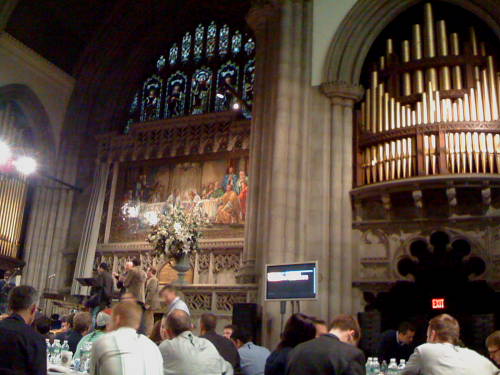
Around 400 church diverse church planters–some wearing suits, others wearing faux-hawks and tattoos–gathered on the edge of Central Park in an 170-year-old, baroque church building owned by the Fourth Universalist Society in upper Manhattan. You get a sense of the impressive architecture, stained glass, paintings, and pipe organ from this photo I took with my phone.

The attendees were seated (by the dozen) around tables where application discussions took place between addresses. It was great to see a few old friends and meet some new one’s, too. It was an impressive lineup and location for a church planting conference.

C.J. Mahaney opened with a message titled, Pastoral Priorities, Watching Your Life and Ministry, centered on 1 Timothy 4:16: “Keep a close watch on yourself and on the teaching. Persist in this, for by so doing you will save both yourself and your hearers.”

C.J. closed his message with these words on the second half of the passage.

Paul is not teaching self-atonement. Instead he is accenting human agency in the experience of salvation. … Calvin comments on this passage, “Although salvation is God’s gift alone, yet human ministry is needed as is here implied.” In this passage we are reminded of the vital importance of human ministry and godly leadership as a means of grace. And in this passage we are assured that if we watch our life and doctrine closely and persist and persevere in these practices, we can expect God to preserve us, and those we serve, for that final day. Here in this passage we find a promise of effective ministry in a most unexpected place.

And, most importantly, what stands behind this profound promise? The reason Paul can make this promise is the one mediator between God and man, the man Christ Jesus (2:5). The mediator stands behind this promise. What stands behind any effective pastoral ministry is the mediator Christ Jesus. What stands behind our watching our life and doctrine, what empowers our watching our life and doctrine, what guarantees the effectiveness of watching our life and doctrine, is the Savior.

Listen, if it were not for the work of the Savior, the burden of this verse would be simply too much to bear! But because of the Savior we have hope this morning for our pastoral ministry and in our pastoral ministry. We have hope that our lives, by the grace of God, will, in ever-increasing ways, faithfully reflect the transforming effect of the gospel. We have hope! We have hope that our preaching will faithfully proclaim our Savior. We have hope that our ministries will contribute to the preservation of ourselves and the congregation we serve. So, brothers, as we watch our lives, as we watch our doctrine, we are confident we will also watch the Savior work.

For me, sitting off to one side, there was dramatic irony in these closing paragraphs. C.J.’s voice rose a few decibels reminding us of the ministry-sustaining power of the gospel. The amplified emphasis of his voice, proclaiming the importance of the gospel, echoed through the old unitarian church built intentionally hollowed of the gospel and doctrine.

As I listened to the echo it was not only a great reminder to persist in watching my life and teaching, but in looking around at the church’s ornamentation it was also a reminder that failing to watch our life and teaching may not mean our churches will empty out for us to see our failures in this lifetime. A very sobering reminder we can take into all areas of life as we walk by faith, seeking to please God.

———

A longer version of this message was delivered in the 2006 Together for the Gospel conference message, “Watch Your Life.” Download here.

Books for Aspiring Patrologists (pt. 2)

In the first post, I passed along a recommendation for a book that serves as an overview of the intellectual and spiritual composition of the patristic authors. Personally, I want to learn enough about patrology to roll up my sleeves and begin excavating for myself gems from the original writings.

So today we turn to a recommendation on original source reading.

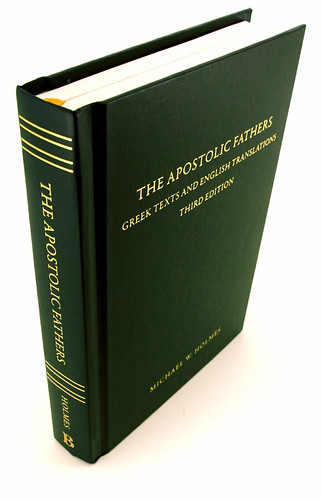
There is widespread agreement on one valuable collection of writings from the apostolic period (ca. AD 70-150), a volume edited by J. B. Lightfoot (1828-1889), compiled by his student J. R. Harmer, and now skillfully updated and edited by Michael W. Holmes titled The Apostolic Fathers: Greek Texts and English Translations, Third Edition (Baker Academic, 2007).

Holmes has done a nice job of keeping the scholarship up to date, adding very helpful book introductions. The 800+ page book includes several short letters preserved from the infancy of the Church. Though academic, the book is well-written and assembled for general readership. In the introduction to the Letters of Ignatius, for example, Holmes writes, “Just as we become aware of a meteor only when, after traveling silently through space for untold millions of miles, it blazes briefly through the atmosphere before dying in a shower of fire, so it is with Ignatius, bishop of Antioch in Syria. We meet him for the first and only time for just a few weeks not long before his death as a martyr in Rome early in the second century” (p. 166).

And Baker should be commended for their work, retypesetting and printing it on nice thin Bible paper. To think of it, The Apostolic Fathers has a similar look and feel to the beautiful NA27 Greek New Testament. Overall, I love the size, feel, and features of this volume. It comes with one of those built-in bookmark ribbons, and the dark green cover with the gold embossing is sharp.

On to a few excerpts.

In my evening reading I’ve been especially impressed with two excerpts from Ignatius’s letter to the Ephesians, written on or before 117 AD (pp. 182-201). Two themes emerge; the centrality of the cross and cautions to cultural adaptation.

1. Centrality of the Cross. This first excerpt has a lot to exegete. Listen to the known dangers of false teaching in this passage, where we see the Pauline warnings of the dangers of false teaching here echoed by a later generation of Christians.

But more specifically, notice the centrality of the cross in building the Church.

9:1 But I have learned that certain people from elsewhere have passed your way with evil doctrine, but you did not allow them to sow it among you. You covered up your ears in order to avoid receiving the things being sown by them, because you are stones of a temple, prepared beforehand for the building of God the Father, hoisted up to the heights by the crane of Jesus Christ, which is the cross, using as a rope the Holy Spirit; your faith is what lifts you up, and love is the way that leads up to God. 2 So you are all participants together in a shared worship, God-bearers and temple-bearers, Christ-bearers, bearers of holy things, adorned in every respect with the commandments of Jesus Christ. I too celebrate with you, since I have been judged worthy to speak with you through this letter, and to rejoice with you because you love nothing in human life, only God.

Ignatius beautifully captures the centrality of the cross in building the church.

2. Darkening lines in cultural engagement. And I find the patristic authors to be stimulating on the issue of cultural engagement. Try and isolate Ignatius’s warning amidst all the commands to relate to those in the world.

10:1 Pray continually for the rest of humankind as well, that they may find God, for there is in them hope for repentance. Therefore allow them to be instructed by you, at least by your deeds. 2 In response to their anger, be gentle; in response to their boasts, be humble; in response to their slander, offer prayers; in response to their errors, be steadfast in the faith; in response to their cruelty, be civilized; do not be eager to imitate them. 3 Let us show by our forbearance that we are their brothers and sisters, and let us be eager to be imitators of the Lord, to see who can be the more wronged, who the more cheated, who the more rejected, in order that no weed of the devil may be found among you, but that with complete purity and self-control you may abide in Christ Jesus physically and spiritually.

In light of the harsh pagan culture, Ignatius reminds the Christian Ephesians, “do not be eager to imitate them.” This is a helpful reminder for us today. Love those in the world? Yes. Love in word and deed? Yes. Respond to sin with kindness? Yes. See them as your equals, as brothers and sisters? Yes. Imitate the rough and crass edges of culture? No.

Be “OK” with not following and imitating their roughness. This excerpt is an interesting warning for early Christians struggling with loving those in the world without inadvertently absorbing the roughness of culture. This balance of engagement without conformity is still a tough question to answer nearly 2,000 years later. It’s helpful to see how these early Christians tried to understand the issues and set their parameters.

I could go on, there are other excellent passages. But my intent here is to recommend these books, stir a desire to read them, and let you spend less time on this blog and more time discerningly reading the patristic authors for yourself.

Please take with you one caution. Although this book looks, smells, and feels like a New Testament—even has verse numbers like a Bible!—it’s not Scripture. I receive emails and comments frequently from folks who say patrology transformed their understanding of Christianity. Statements like these read as though patrology and canonical scripture are equally shaping for these folks. They are not. So if your reading schedule is tight, you should never substitute time in Scripture with reading the early church fathers.

——————

Title: The Apostolic Fathers: Greek Texts and English Translations, Third Edition
Editors: J. B. Lightfoot, J. R. Harmer, and Michael W. Holmes
Boards: hardcover (not cloth)
Pages: 808
Volumes: 1
Dust jacket: no
Binding: sewn
Paper: thin, slightly yellowed, Bible paper
Topical index: yes, a thematic analysis
Scriptural index: no
Text: retypeset
Publisher: Baker Academic
Year: 2007
Price USD: $29.00
ISBNs: 080103468X, 9780801034688