WordPress.com

This morning I received a comment from a reader saying, “In your ‘Possibly related posts’ section at the end of the LotR post includes a vulgar link. You should take it off.”

A vulgar link? What?

Then I followed the permalink to this morning’s LotR post on my blog and noticed WordPress was generating “Possibly related posts” and attaching external links to the end of my post. Then, after a little research, I found that WordPress was automatically adding this little “feature” and turning it “on” without notification.

After some digging, this is the option I discovered on my dashboard: “Hide related links on this blog, which means this blog won’t show up on other’s blogs or get traffic that way.” Notice the presumption–it’s on until you turn it off.

Not only is this unethical from a blog engine, it has the potential to undermine the integrity of a blogger. So if you are considering starting a blog, surprises like this should factor into your consideration.

LotR/Hobbit movie update

Work is progressing on the two “Hobbit” movies. New Line Cinema and Metro-Goldwyn-Mayer Studios have announced that filming on the two films will begin in 2009 with the first movie released in 2010 and the second in 2011. Interestingly, this Reuters article, is saying the 2 films will fill in the 60-year storyline gap leading up to the LotR troilogy, making some predict that parts of the The Silmarilion will be found in the Hobbit movies, too.

Courageous Protestants

Remaining faithfully protestant is no hobby for the spineless, David Wells argues in his new book, The Courage to Be Protestant: Truth-lovers, Marketers, and Emergents in the Postmodern World (Eerdmans, 2008). Remaining faithfully protestant—simultaneously faithful to scripture and and firmly rooted historically—requires vigilant steadfastness.

“The key to the future,” Wells writes, “is not the capitulation that we see in both the marketers and the emergents. It is courage. The courage to be faithful to what Christianity in its biblical forms has always stood for across the ages” (p. 21).

The book title alone inspires me to tattoo Luther on my forearm (restrained by the bruising vanity of such an image when I’m old.)

Here’s why I like the title.

In these few words Wells is calling us to:

(1) Defend protestant Christianity, not just our little denominational sub-branch. What’s at stake is really protestant-wide reaching the broad limits of catholicity. The implications of these new movements are as big as is “protestant” is wide.

(2) Be courageous, not spineless. Don’t fall for the soft-sell marketing and neo-orthodox liberalism offered to our culture’s “perpetual squishitude” (DeYoung + Kluck). Enduring the relentless shifts in theology is not for the fainthearted.

(3) Love the truth of God’s word, don’t sacrifice it. The church’s hope rests in what is unseen, rooted in preaching of ‘the age to come.’ No matter the cultural drifts and currents, keep faithful to the preaching of the gospel. And love it! Don’t just be a truth-defender, be a truth-lover.

Wells–himself a monument of courage–reminds us that the hope the church offers the world flows from the freshwater spring of gospel proclamation.

Wells writes,

———–

“Christian hope is not about wishing things will get better. It is not about hoping that emptiness will go away, meaning return, and life will be stripped of its uncertainties, aches, and anxieties. Nor does it have anything to do with techniques for improving fallen human life, be those therapeutic, spiritual, or even religious. Hope has to do with the knowledge of ‘the age to come.’ This redemption is already penetrating ‘this age.’ The sin, death, and meaninglessness of the one age are being transformed by the righteousness, life, and meaning of the other. What has emptied out life, what has scarred and blackened it, is being displaced by what is rejuvenating and transforming it. More than that, hope is hope because it knows it has become part of a realm, a kingdom, that endures. It knows that evil is doomed, that it will be banished. This kind of hope has left behind it the ship of ‘this age,’ which is sinking. And if this other realm, this place where Christ is even now ruling, did not exist, Christians would be ‘of all people most to be pitied’ (1 Cor. 15:19). Their hope would be groundless and they would have lived out an illusion (cf. Ps. 73:4-14).

Vast, mysterious, and mostly unknown as the universe is, we are neither aliens nor strangers in it. It is our alienation from God that makes us see the world as if we were aliens. It is our estrangement from him that leaves us with this haunting sense that we are alone, strangers in a cold and indifferent universe. So it is that life comes to seem like only a ‘chance collocation of atoms’ destined to disappear beneath the rubble of a universe in ruins, as Bertrand Russell put it. It can all seem so meaningless, so ephemeral, so pointless. And it is meaningless, a vanity of vanities, until we see that fallen life yields up no meaning higher or deeper than its own fallenness. And that is only as high as the spirituality from below can ever ascend.

The only future there actually is, is the one established by God in Christ, the one wrought in time at the cross that alone reached into eternity. But we must receive entry into this future. We cannot seize it. It is not there to be had on our own terms. This is not our self-constructed future. It is God’s. It comes from above, not from below.

This is why those churches that have banished pulpits or are ‘getting beyond’ the truth question are going beyond Christianity itself. The proclamation of the New Testament is about truth, about the truth that Christ who was with the Father from all eternity entered our own time. As such he lived within it, his life, like ours, marked by days and weeks and years. He lived in virtue of his unity with the Father, living for him, living as the representative of his own people before the Father, his very words becoming the means of divine judgment and of divine grace. But in the cross and resurrection the entire spiritual order was upended, his victory reached into and across the universe, and saving grace is now personalized in him. The world with all its pleasures, power, and comforts is fading away. The pall of divine judgment hangs over it. A new order has arisen in Christ. Only in this new order can be found meaning, hope, and acceptance with God. It was truth, not private spirituality, that apostolic Christianity was about. It was Christ, not the self, who offered access into the sacred. It was Christ, with all his painful demands of obedience, not comfortable country clubs, that early Christianity was about. What God had done in space and time when the world was stood on its head was Christianity’s preoccupation, not the multiplication of programs, strobe lights, and slick drama. Images we may want, entertainment we may desire, but it is the proclamation of Christ crucified and risen that is the church’s truth to tell.”

–David F. Wells, The Courage to Be Protestant: Truth-lovers, Marketers, and Emergents in the Postmodern World (Eerdmans, 2008), pp. 203-204.

—————

Wells’s new book is excellent and may tempt you to get inked. Buy it, read it, and—as best as feeble sinners can—seek to walk humbly, faithfully cross-centered, and courageously protestant.

Books for Aspiring Patrologists (pt. 1)

In regards to patristics (i.e. the study of the early church fathers) I’ve been accumulating some excellent book recommendations. Some books were recommended in my interview with Dr. Ligon Duncan (listen here), some books have been resting dust-covered on my shelves from previous recommendations, and some from helpful recommendations by Dr. Michael A. G. Haykin.

So this week on TSS I’ll be sharing with you various titles on my reading list for all you aspiring patrologists.

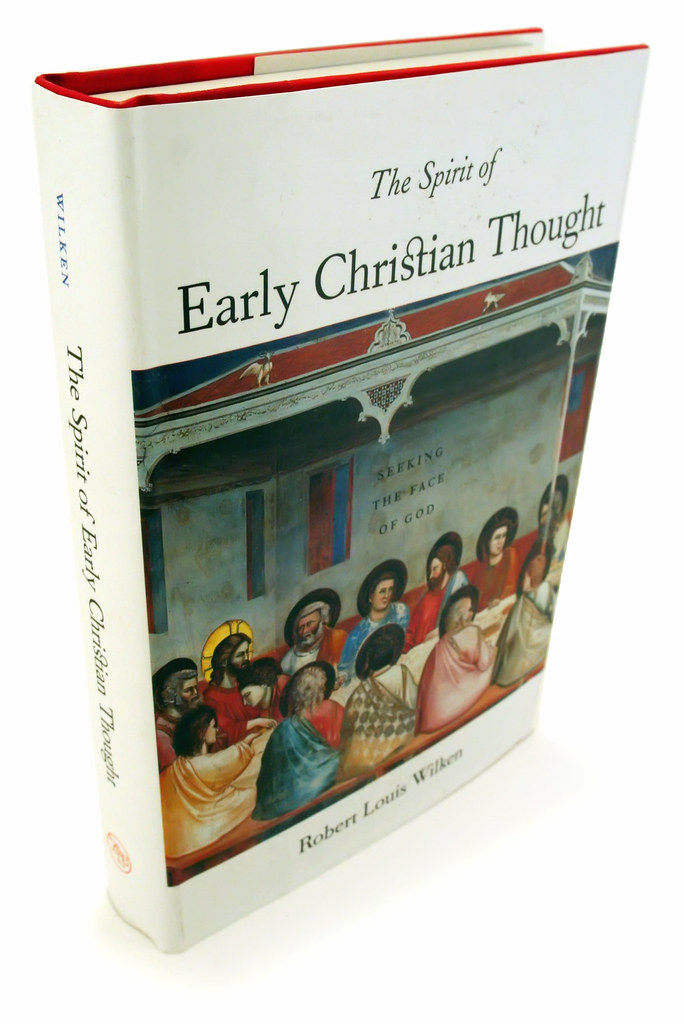
First, Haykin (on his blog) recommends dipping our toes into the pool of patrology with Robert Louis Wilken’s, The Spirit of Early Christian Thought: Seeking the Face of God (New Haven: Yale University Press, 2003). Wilken serves as William R. Kenan, Jr. Professor of the History of Christianity at the University of Virginia.

I have found The Spirit of Early Christian Thought to be a refreshing and stimulating study of the characters and thought of the period. At times spiritually devotional, Wilken is always lucid and engaging. His goal is to draw a connection between the spirit and intellect, between worship and reason, as modeled by the early fathers. As with all books on patrology, this one should be read with careful discernment, the fruit of which, however, will be in the beholding a panorama of patristic intellectual fervor and heartfelt piety. It’s available in hardcover ($35.00) and paperback ($14.00).

Three short excerpts—

“In an essay on the church fathers, Hans Urs von Balthasar once wrote, ‘Greatness, depth, boldness, flexibility, certainty and a flaming love—the virtues of youth, are marks of patristic theology. Perhaps the Church will never again see the likes of such an array of larger-than-life figures that mark the period from Irenaeus to Athanasius, Basil, Cyril, Chrysostom, Ambrose and Augustine—not to mention the army of the lesser fathers. Life and doctrine are immediately one. Of them all it is true what Kierkegaard said of Chrysostom: ‘He gesticulated with his whole existence.’” (p. xviii)

“All the figures portrayed in this book prayed regularly, and their thinking was never far removed from the church’s worship. Whether the task at hand was the defense of Christian belief to an outsider, the refutation of the views of a heretic, or the exposition of a passage from the Bible, their intellectual work was always in service of praise and adoration of the one God. ‘This is the Catholic faith,’ begins an ancient creed, ‘that we worship one God in Trinity and Trinity in Unity.’ Often their treatises ended with a doxology to God, as in Augustine’s On the Spirit and the Letter: ‘to whom be glory forever. Amen.’ They wished not only to understand and express the dazzling truth they had seen in Christ, by thinking and writing they sought to know God more intimately and love him more ardently. The intellectual task was a spiritual undertaking. In the oft-cited words of the desert monk Evagrius, ‘A theologian is one who prays, and one who prays is a theologian.’

The point may seem obvious, yet it is often forgotten. More often than not the church fathers have been interpreted as solitary intellectuals, each working out his own system, beholden chiefly to the world of ideas and arguments, as though they were clandestine members of an ancient philosophical guild. To be sure, many of the best minds in the early church were philosophically astute and moved comfortably within the intellectual traditions of the ancient world. They knew the argot of philosophy, and their books and ideas were taken seriously by Greek and Roman intellectuals. But if one picks up a treatise of Origen or Basil of Caesarea and compares it with the writings of the philosopher Alcinous or the neo-Platonist Plotinus, it is apparent at once that something else is at work.” (pp. 25-26)

“The intellectual tradition that began in the early church was enriched by the philosophical breadth and exactitude of medieval thought. Each period in Christian history makes it own unique contribution to Christian life. The church fathers, however, set in place a foundation that has proven to be irreplaceable. Their writings are more than a stage in the development of Christian thought or an interesting chapter in the history of the interpretation of the Bible. Like an inexhaustible spring, faithful and true, they irrigate the Christian imagination with the life-giving water flowing from the biblical and spiritual sources of the faith. They are still our teachers today.” (p. 321)

Little League and Little Hearts

It’s been a rainy spring here in Maryland, and after some rain outs the little league season began yesterday for our six-year-old son. In his first ever baseball game, he hit a single, two doubles, a triple, and scored three runs. At the plate he looked like a natural (if you didn’t get distracted by the undersized batting helmet that pinched his head and refused to go down all the way). Defensively, he made two put outs from third base in one inning. His team won 20-6.

But more importantly, I was watching to see how my son would respond to mistakes, errors, coaching instruction, the play of his opponents, and the successes of his teammates. We’ve been talking about the manifold temptations he will experience in baseball hoping to capture as many of these as opportunities to train him for life.

C.J. Mahaney has helped me to understand these sports as great opportunities for God-glorifying, character building in our children. And Saturday I was reminded of the very helpful teaching of C.J. as I was watched the young kids kicking the dust, folding their ears over as they squeezed on the small batting helmets, listened to coaches blurt out the most obvious of commands, the chuckles of the parents watching our kids axe hack at pitches over their heads, watching grounders trickle to the outfield past statues of infielders, and the puzzled looks of two teams of players who had never worn a baseball uniform.

In an interview with Steve Shank posted earlier on TSS C.J. explains how he trained his son in humility during the soccer season (see “Interview with C.J. Mahaney on biblical masculinity”). I’m reminded that I want to prepare my son to walk on the field with a theological awareness of what’s happening. But first I need to become a father with this cultivated awareness. And that’s where the growth needs to first happen.

Together for the Gospel 2008

Clunk. Clunk. Wheeeeeeeeeeeee… Dun. Dun. Clunk. Click.

For more than a week now, I’ve been working next to an awkward-looking, loudly-clicking, nonstop-running printer. My desk is conveniently located about 6 inches from R2-D2 (as it’s been affectionately named). It’s a bulky printer, but also hard working, and very, very noisy. It reminds me of the old dot matrix printers that violently slapped back and forth, making that indescribable whining sound, across an endless line of perforated paper. It sounds a lot like that, with a shot of abrupt clanking mixed in.

Clunk. Clunk. Wheeeeeeeeeeeee… Dun. Dun. Clunk. Click.

I’m told the unceasing whine from the printer will be done soon. But for the last week, “R2” has been humming away 24/7, printing out colorful plastic nametags for each of the 5,000+ attendees scheduled to attend Together for the Gospel next week in Louisville.

Click.

As the loud printer slowly births each nametag—delivering one card every few minutes—the newborn falls on top of the other cards in the catch bin. I hear the click of the new card as it drops on the pile. Several times over this past week, at the sound of that click, I’ve paused momentarily to thank God for the person it represents. I don’t see the name, but I know that card represents someone for whom the gospel is precious, someone who prioritizes the gospel. And that is a work of God in their soul. So many works of grace. So many new births.

Click.

In the first couple days of the noise, my first thought at the click of the card was to wonder: is that the card that reads “John Piper, MN”? But separated from a thin screen, I cannot see the names. It’s just as likely the card represents a rural pastor from a farming community in Nebraska.

Listening to this printer has been wonderfully equalizing. When I get up from my desk I can see the long stacks of nametags, all arranged in alphabetical rows. Whether a main speaker, an old pastor, a young pastor, a ruling elder, a deacon, a seminary student, an aspiring seminary student, or a soul who is simply attending out of love for the gospel—each nametag is the same color, the same size, and the same arrangement. Equalized.

God knows our frame, that each of us are dust (Psalm 103:14). Saved. Precious to Him. Blood-bought. But we are all dust, equally dust, from A-Z.

Next week we gather at Together for the Gospel. But we are not coming together to huddle around prominent evangelical figures or to merely collect a stack of free books. We gather to proclaim our allegiance and faithfulness to the unchanging and eternal gospel. We gather to form a picture of God’s compassion, who, rather than destroying us, has compassionately atoned for our sin and redeemed us (Psalm 78:38-39).

Well, back to work.

Clunk. Clunk. Wheeeeeeeeeeeee… Dun. Dun. Clunk. Click.

See you in Louisville.

Tony