Understanding our motives

tsslogo.jpgUnderstanding our motives

One of the deepest questions we can ask of ourselves is very simple: Why do we do what we do? Here are some thoughts on the topic.

Scripture addresses our motives in a profound way. Take James 4 for example: “What causes quarrels and what causes fights among you? Is it not this, that your passions are at war within you?” (v. 1). Our quarrels with others spring from our own hearts because we entertain self-centered desires. James tells us that we fight, not because we have enemies without, rather, we fight because we have a sinful heart within. The conflict problem is me. At some level, I start every fight. And this angry heart rages hot because our sinful motives arise from unmet idolatrous desires: “You desire and do not have, so you murder. You covet and cannot obtain, so you fight and quarrel” (v. 2). In verses 3-10, James says our motives cause conflict because we are worldly, because we fail to ask God for His grace, because we fail to pursue humility and fail to resist Satan’s temptations. Motives are at the root of all conflict. The evil of fighting is not that we land punches. The evil of fighting is that it reveals worldly idols and pridefulness towards God in the heart. Conflict with others is profoundly theological.

In a series of articles comparing modern psychotherapies with the cure of souls, Dr. David Powlison writes, “…the dynamics of human intention and desire cannot be defined in purely psychological terms (or psycho-social terms, or psycho-social-somatic terms). Motivational dynamics do not simply operate within or between persons. The human heart has to do with God. So when the Bible describes the desires that obviously play within our souls and rule our lives, it does not portray them as hard-wired psychological or physiological givens: as needs, instincts, drives, longings, wishes. It speaks of them as morally freighted vis-à-vis God, as moral-covenantal choices: we are ruled either by cravings of the flesh or by repentance-faith-obedience to God’s desires. Our desires are tilted one way or the other, either toward the true God or toward the host of idols we fabricate both collectively and idiosyncratically. Our mastering desires are relationally and morally qualified. … In sum, the human heart – the answer to why we do what we do – must be understood as an active-verb-with-respect-to-God. Climb inside any emotional reaction, any behavioral choice or habit, any cognitive content, any reaction pattern to suffering, and you are meant to hear and see active verbs working out. Love God or anything else. Fear God or anything else. Want God or anything else. Need God or anything else. Hope in God or anything else. Take refuge in God or anything else. Obey God or anything else. Trust God or anything else. Seek God or anything else. Serve God or anything else. The Bible’s motivation theory shouts from every page – but it does not look like a motivation theory to those whose gaze has been bent and blinded by sin’s intellectual logic” [The Journal of Biblical Counseling (Spring 2007, vol. 25, No. 2) p. 24].

It’s no exaggeration to say Instruments in the Hand’s of the Redeemer (P&R: 2002) is on my top ten list of favorite books. Without hesitation, I would consider this book essential reading for pastors, fellowship group leaders, and really any thinking and reading Christian. In it author Paul David Tripp writes, “We must humbly admit we are sinners while we lay hold of the hope of our union with Christ. We don’t simply suffer; we suffer as sinners with a deep propensity to run after god-replacements. And, as believers, we don’t just suffer as sinners, but as those who have been united with Christ and therefore no longer live under the mastery of sin. We bring these two realities to times of blessing as well. Holding onto both truths is the only way to do battle with our own hearts, and the only way to be part of what God is doing in our lives and others’. This is a perspective on life that only those who believe God’s Word will ever embrace. Ist is the heart of biblical personal ministry. It is more than a topical list of problem-solving principles, more than a collection of morals on how to live life, more than an empathetic relationship or a dynamic therapeutic encounter. Biblical personal ministry is rooted in the story of a war and a Savior King. As we place our stories within this great story of the compassion and love of Christ, we will understand who we are and live as we were meant to live” (pp. 93-94).

We act and sin in certain ways because of the idolatrous motives of our hearts. This is our biggest problem: We expect to get what we want and what we naturally (and sinfully) want is an idolatrous replacement for God to steal His glory for ourselves. We are at war. “For the desires of the flesh are against the Spirit, and the desires of the Spirit are against the flesh” (Gal. 5:17). At a very deep level of motive-confrontation God calls us to fight worldliness, ask for more Cross-purchased grace, pursue personal humility and resist Satan’s temptations. Scripture lays for us a profound understanding of our personal motives and — in light of the precious Cross of Christ — what to do about it.

————–
Excellent biblical counseling resources for further study…

*** Paul David Tripp. Instruments in the Redeemer’s Hands: People in Need of Change Helping People in Need of Change (P&R: 2002) 362 pp. More conceptual in nature. One of the most important contemporary Christian books in print. Essential reading for pastors and fellowship group leaders.

*** David Powlison, editor. The Journal of Biblical Counseling. A 60- page journal published quarterly with subscriptions starting at $23/year for new subscribers. Essential reading for pastors and fellowship group leaders. In our church every small group leader receives a subscription.

** Timothy S. Lane and Paul David Tripp. How People Change (New Growth Press: 2006) 258 pp. The text font and layout for this book is simply awful but a very helpful book with excellent illustrations. Written on an easier level and more application-oriented than Instruments.

** David Powlison. Seeing with New Eyes: Counseling and the Human Condition Through the Lens of Scripture (P&R 2003) 274 pp. A conceptual book it “unfolds Scripture’s view of people and problems. It reinterprets common counseling phenomena through God’s eyes, as revealed in Scripture” (p. 7).

** David Powlison. Speaking the Truth in Love: Counsel in Community (Punch Press: 2005) 202 pp. The follow-up to Seeing with New Eyes, this book focuses on the act of counseling. “This second book describes living right. We will glimpse essential dynamics of relationship and sketch the shape of communities that pursue such relationships” (p. 2).

Indulgences Continue

tsslogo.jpgIndulgences Continue

This week the Vatican released a statement saying all non-Roman Catholic churches are “not proper Churches” and that those outside of Rome are of a compromised sort (that’s you, you Reformed rascal). The 16-page statement from the Congregation for the Doctrine of the Faith decrees that Rome is “the one true Church of Christ.” The implication is this: If your church does not bow to the authority of the Pope, it is unfaithful. These divisive statements have whipped the ecumenical community into a froth (though Christianity Today denies the obvious implications).

The biblically discerning (like Al Mohler) are not shocked at these most recent statements. In fact, these conclusions are quite consistent with historical and contemporary Roman Catholic dogma.

Christopher Catherwood, in his new and excellent book Church History: A crash course for the curious (Crossway: 2007) warns us that Rome has not changed. “Theologically, from a biblical point of view, nothing really changed since the key Catholic doctrines to which Protestants have objected since the Reformation did not change” (p. 198). He also shows that false doctrine in Rome is increasingly prominent in the twentieth century. On the false idea that Mary is ‘the mother of God’ he writes, “Mariolatry in the Catholic Church has in fact evolved over centuries, and one can argue that it was not until the twentieth century that much of the false teachings about her became the official dogma of the Roman Catholic Church, as comparatively recently as 1950” (p. 81).

Indulgences

So I should not have been as surprised today when I found myself looking at the website of the Archdiocese of Philadelphia offering indulgences. Indulgences?! I thought indulgences died in the Reformation. After a little research, I was sadly reminded that indulgences were promoted and defended by John Paul II, continue in his successor and — the more closely I looked — are interwoven into statements by Beckwith in his recent move out of Evangelicalism into Catholicism. To my surprise, indulgences flourish in 2007 as they did in 1517.

No doubt embarrassed by Johann Tetzel, Rome is quick to say indulgences are not for sale. At least not for money. But they still come at a cost. The Archdiocese has set the sticker price as follows:

“A Plenary Indulgence is granted by participating in any event, pilgrimage, or visit under these conditions: one must go to Confession, receive Holy Communion, and pray for the intentions of the Holy Father, either on the day of the event or within several days before or after it. The Plenary Indulgence may be obtained by the faithful for themselves or may be applied to the dead by way of suffrage.”

The seeker must perform these conditions at one of the following events:

“Pilgrimage to the Basilica of the National Shrine of the Immaculate Conception in Washington, D.C. on April 28, 2007; Special Youth Event and Mass at Saint Charles Borromeo Seminary on September 29, 2007; Bicentennial celebrations taking place in the Cathedral Basilica of Saints Peter and Paul or in some sacred place within the boundaries of the Archdiocese of Philadelphia presided over by the Cardinal Archbishop, or his designee; A pilgrimage to the Cathedral Basilica, the Shrine of Saint John Neumann, or the Shrine of Saint Katharine Drexel, which includes a solemn communal celebration; The closing Mass of the Bicentennial Year to be held at Villanova Pavilion on April 13, 2008.”

Indulgences are never free.

So what is the purpose of the indulgences? “An indulgence is the remission before God of the temporal punishment due sins already forgiven as far as their guilt is concerned, which the follower of Christ with the proper dispositions and under certain determined conditions acquires through the intervention of the Church which, as minister of the Redemption, authoritatively dispenses and applies the treasury of the satisfaction won by Christ and the saints” (Indulgentiarum Doctrina). To put it in seasonal terms, it will help shorten the purgatorial sunburn.

This admission is obviously blasphemous: Christ’s Atonement applied to the sinner is insufficient. Certain wages for sin remain, and the redeemed are bound under God’s temporal wrath.

Before we go too far, we must stop and learn about the human heart. Even as believers we tend to consider the negative things that happen in life as a result of God’s anger towards us, rather than the discipline of a loving Father. All things work together for our good because the painful experiences of life are not temporal judgments from God, but the purging of sin. He prunes us to bear more fruit and we bear more fruit to experience more of Christ’s joy (John 15). If we are covered in the Blood of Jesus Christ, we are free forever from God’s judgment (both eternal and temporal judgments).

Secondly, indulgences speak to our natural pursuit of self-righteousness. We want to earn the appeasement of God’s judgment, which is to say we want to earn God’s favor. Indulgences hold out this false hope to sinners. The fact is that God’s elect are united to Christ and there is no more divine favor and righteousness necessary before God. There is no such ‘thing’ as grace that can be awarded or won or added to the Christian life. All we have is Christ, and all of Christ is ours (see Sinclair Ferguson post earlier). “Indeed, I count everything [all self-righteousness] as loss because of the surpassing worth of knowing Christ Jesus my Lord. For his sake I have suffered the loss of all things and count them as rubbish, in order that I may gain Christ” (Phil. 3:8).

John Calvin wrote that those who believe God’s grace and deliverance from judgment is distributed by church authorities, “are fit to be treated by drugs for insanity rather than to be argued with” (Institutes, 3.5.1). The insanity abounds to this day.

All-sufficient grace

Remember the old Martin Luther movie? Luther becomes furious when he sees a poor woman with a crippled child on her back going to pay what little money she has for a Tetzel indulgence. Little has changed. Sinners in 2007 who are crippled and poor and naked before their Holy God are walking to a shrine to pay the fee of homage, thinking that earning grace through an indulgence from Rome is their means of escaping God’s temporal wrath for their sin (or the sin of someone now in purgatory). At best, this practice is a manipulation of the weak sinful heart, and at worst an outright blasphemy towards the work of Christ (no matter how superficially connected to the Cross it appears).

In Christ we have freedom from eternal and temporal judgments. In Luke 23 we are told, “One of the criminals who were hanged railed at him, saying, ‘Are you not the Christ? Save yourself and us!’ 40 But the other rebuked him, saying, ‘Do you not fear God, since you are under the same sentence of condemnation? 41 And we indeed justly, for we are receiving the due reward of our deeds; but this man has done nothing wrong.’ 42 And he said, ‘Jesus, remember me when you come into your kingdom.’ 43 And he said to him, ‘Truly, I say to you, today you will be with me in Paradise.’”

There is all-sufficient grace in the Cross to completely cover the most vile of sinners. Without question, there are temporal consequences to sin (like being crucified for a due crime). But for the repentant sinner who trusts in Jesus Christ alone, there is no self-righteousness, no religious acts or pilgrimages or indulgences — only union into Christ! — that frees sinners from their due guilt! “Today you will be with me in Paradise.”

Indulgences undermine the Gospel. Calvin succinctly writes, “Obviously, either the gospel of God or indulgences must be false. Paul testifies that Christ is offered to us through the gospel, with every abundance of heavenly benefits, with all his merits, all his righteousness, wisdom, and grace, without exception” (3.5.5).

Conclusion

As the evidence continues to reveal, Rome – at the very epicenter of its public dogma – was relatively unaffected by the Reformation. This Gospel-distorting reality must never escape the notice of the Cross-centered. In contending against the heresies of the new perspectives, we cannot (and dare not) turn our backs to the heresies of the ancient perspectives still alive today.

—————

Related: Many helpful articles by James White on Catholicism and his books of special note are The Roman Catholic Controversy and The God Who Justifies. Also an excellent sermon by John Piper on justification in Catholicism in light of God’s judgement.

Antidepressants on the rise

CNN is reporting that antidepressants are now the most commonly prescribed drug.

“In its study, the U.S. Centers for Disease Control and Prevention looked at 2.4 billion drugs prescribed in visits to doctors and hospitals in 2005. Of those, 118 million were for antidepressants. … The use of antidepressants and other psychotropic drugs — those that affect brain chemistry — has skyrocketed over the last decade. Adult use of antidepressants almost tripled between the periods 1988-1994 and 1999-2000. Between 1995 and 2002, the most recent year for which statistics are available, the use of these drugs rose 48 percent, the CDC reported. Many psychiatrists see this statistic as good news — a sign that finally Americans feel comfortable asking for help with psychiatric problems.”

What strikes me is that apparently we all know instinctively that we can and should be happier than we really are. We were created to enjoy pleasures forever (Ps. 16:11).

————–

Related: Dr. Peter R. Breggin, the International Director of the Center for Study of Psychiatry and Psychology writes: “In reality, science does not have the ability to measure the levels of any biochemical in the tiny spaces between the nerve cells (the synapses) in the brain of a human being. All the talk about biochemical imbalances is sheer speculation aimed at promoting psychiatric drugs. … Despite decades of research, thousands of research studies, and hundreds of millions of dollars in expense, no marker for depression has been found. To this day, the individual’s personal feelings remain the basis for diagnosing depression” [Peter R. Breggin, The Anti-Depressant Fact Book (Perseus: 2001) pp. 21, 22].

TSS Podcast #1 (July 7, 2007)

TSS Podcast #1 (July 7, 2007)
Interview with Thomas Fluharty

tsspodcast.jpgArtist and blogger Thomas Fluharty is the busiest person I know, so when an opportunity opened to interview him this past Saturday morning I grabbed my microphone and met him at a local restaurant. Fluharty is known around the world for his illustrations and especially his editorial caricatures. His award-winning “Sir Hillary Poised for a Takeover” painting is one example. But my personal favorite will always be “Master and Commander,” a painting that caught my attention as a Weekly Standard subscriber long before I paid any attention to its artist. But more amazing than his illustrations is Tom’s personal testimony of God’s sovereign grace. Saturday was his 23rd anniversary of being saved on a street corner in New York City. Tom reminds us, in his own words, that being a Christian is not synonymous with being an American — but a radical experience where a sinful, idol-worshiping soul is unveiled to the infinite joy in Christ. The interview provided us a great excuse to launch the inaugural TSS podcast.

TSS Podcast #1 (July 7, 2007) 26.5 MB, 46:17

download or listen [you are free to download, burn and share this podcast]

.

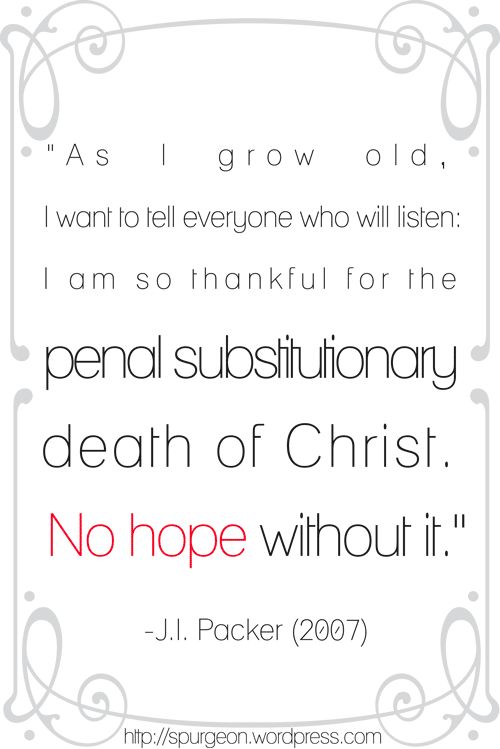
Packer on the Atonement

tsspackeratonement.gif

***********

For more of Packer’s latest comments click here.

 ***********

1. God, in Denney’s phrase, ‘condones nothing’, but judges all sin as it deserves, which Scripture affirms, and my conscience confirms, to be right.

2. My sins merit ultimate penal suffering and rejection from God’s presence (conscience also affirms this), and nothing I do can blot them out.

3. The penalty due to me for my sins, whatever it was, was paid for me by Jesus Christ, the Son of God, in his death on the cross.

4. Because this is so, I through faith in him am made ‘the righteousness of God in him’, i.e. I am justified; pardon, acceptance and sonship (to God) become mine.

5. Christ’s death for me is my sole ground of hope before God. ‘If he fulfilled not justice, I must; if he underwent not wrath, I must to eternity’ (John Owen).

6. My faith in Christ is God’s own gift to me, given in virtue of Christ’s death for me: i.e. the cross procured it.

7. Christ’s death for me guarantees my preservation to glory.

8. Christ’s death for me is the measure and pledge of the love of the Father and Son to me.

9. Christ’s death for me calls and constrains me to trust, to worship, to love and to serve.

Only where these nine truths have taken root and grow in the heart will anyone be fully alive to God.

Was, is and is to come!

[YouTube http://www.youtube.com/watch?v=FObjd5wrgZ8%5D

I am the Alpha and the Omega,’ says the Lord God, ‘who is and who was and who is to come, the Almighty.'”(Rev. 1:8).

————-

“… [lively] faith concerns the person of Christ, his grace, his whole mediatory work, with all its results, and his glory in them all. Therefore the one thing most needed in our recovery and revival is a steady view of the glory of Christ, in his person, grace and office through faith, or a constant, lively exercise of faith in him as he is revealed in Scripture. This is the only way to be revived and to receive such grace as will keep us fresh and flourishing even in old age. … A constant view of the glory of Christ will revive our souls and cause our spiritual lives to flourish and thrive. Our souls will be revived by the transforming power with which beholding Christ is always accompanied. This is what transforms us daily into the likeness of Christ. So let us live in constant contemplation of the glory of Christ, and power will then flow from him to us, healing all our declensions, renewing a right spirit in us and enabling us to abound in all duties that God requires of us. … the more we behold the glory of Christ by faith now, the more spiritual and the more heavenly will be the state of our souls. The reason why the spiritual life in our souls decays and withers is because we fill our minds full of other things, and these things weaken the power of grace. But when the mind is filled with thoughts of Christ and his glory, these things will be expelled (see Col. 3:1-5, Eph. 5:8). When we behold the glory of Christ by faith every grace in us will be stirred up. This is how our spiritual life is revived (see Rom. 5:3-5, 2 Pet. 1:5-8).”

John Owen, The Glory of Christ (Banner of Truth) pp. 166-167.

———

Video HT: (of all people) a group of Puritans that should be studying rather than Tube-ing.