Get out the paste and the rollers, the Reformation21 blog is offering some free Puritan wallpaper for your computer desktop. Click here.
Derek Thomas Lectures on John Owen
John Owen’s Pastoral Theology
Lectures by Dr. Derek Thomas
Here’s a collection of eight valuable lectures by Derek Thomas on the Pastoral Theology of John Owen delivered at the Puritan Reformed Theological Seminary this past Spring. They are here posted with the kind permission of Dr. Thomas and the President of PRTS, Dr. Joel Beeke.
The course description and objectives are below.
Audio
Lecture 1 (1:33:29, 37.5 MB) download
Lecture 2 (1:21:15, 37.3 MB) download
Lecture 3 (1:33:58, 43.1 MB) download
Lecture 4 (1:27:10, 40.0 MB) download
Lecture 5 (1:20:11, 36.8 MB) download
Lecture 6 (1:28:23, 40.5 MB) download
Lecture 7 (1:23:48, 38.4 MB) download
Lecture 8 (1:31:14, 41.8 MB) download
Course Description
“I owe more, I think, to John Owen than to any other theologian, ancient or modern” (J.I. Packer).
John Owen (1616-1683) was perhaps the weightiest of the Puritan theologians, often mentioned in the same breath as John Calvin and Jonathan Edwards as one of three greatest reformed theologians of all time. Remarkable though it is that he lived through the period of the Westminster Assembly without ever having been asked to take part in it, Owen nevertheless towers over this period, rising to the post of Vice-Chancellor of Oxford University.
His thoughts are massive, even intimidating; but a closer reflection reveals a man absorbed by the demands of piety and Christ-likeness, a truly humble man who could say “I hold myself bound in conscience and in honour, not even to imagine that I have attained a proper knowledge of anyone article of truth, much less to publish it, unless through the Holy Spirit I have had such a taste of it, in its spiritual sense, that I may be able, from the heart, to say with the psalmist, ‘I have believed, and therefore have I spoken.'”
The course will focus on those aspects of his theology which relate immediately to concerns of spiritual piety, including Owen’s view of the Christian life and the demands of mortification.
Initially lectures on Owenian theology will be given in order to introduce the student to the finer points of Owenian/Puritan theology and distinctives. At some point (to be determined) the format will assume the form of a seminar where participation (involving some preparation) will be expected.
Course objectives
According to Dr. Martyn Lloyd-Jones, “Owen on the whole is difficult to read” (Preaching and Preachers, London, 1971, p. 175). Similar sentiments are expressed by J. I Packer when he says, “There is no denying that Owen is heavy and hard to read” (Introductory Essay to The Death of Death, London, 1959, p. 25). But this need not be the case. Recalling that Owen wrote for teenagers at Oxford university, and that, in the main, his concerns were pastoral and eminently practical, Owen can be read, if not with ease, then with profit. A rule of thumb here may be to avoid beginning at the beginning! Several volumes contain some of Owen’s sermons (and it needs to be recalled that much of Owen was at one time sermonic in nature before being committed to writing); these might seem an ideal place to start. Choosing volumes for special study for this course has been difficult since there is a desire perhaps to obtain some knowledge of the whole range of Owen’s corpus. But we shall concentrate on a little with a view to the student gaining sufficient skill and interest to make the rest of Owen a lifetime’s study.
In a nutshell, you are to enjoy this course. Owen is one of those figures that will take a lifetime to master (and then some!). My hope is that I will whet your appetite to make him a companion who will accompany you on the journey of service for our Master.
Who said it?
 Here are two quotes from two famous reformed characters (one a theologian and the other a preacher).
(1) In 1905, this famous theologian wrote: “My idea of delight is a Princeton [Seminary dorm] room full of fellows smoking. When I think what a wonderful aid tobacco is to friendship and Christian patience I have sometimes regretted that I never began to smoke.” Who said it? Answer: J. Gresham Machen. Obviously this is not posted to recommend smoking but it’s a quote with great historical significance. Billy Sunday, Machen’s prohibitionist friend, was staunchly against drinking and smoking — neither of which views Machen agreed with. Both Machen and Sunday however are packaged together as “fundamentalists.” In Stephen J. Nichols’ recently published essay, he uses this quote to distinguish Machen and his mentor B.B. Warfield as not-exactly-fundamentalists and certainly not prohibitionists. Machen enjoyed sports, art, alcohol and obviously some secondary smoke to the glory of God. He was doctrinally acute, joyful and culturally aware. A great example for us today. For more on Machen, Warfield and Fundamentalism see Nichols’ excellent essay in B.B. Warfield: Essays on his life and thought (P&R: 2007) pp. 169-194.
(2) This famous preacher said in a sermon: “For myself, as long as I am charged by certain people with being nothing but a Pentecostalist and on the other hand charged by others with being an intellectual, a man who is always preaching doctrine, as long as the two criticisms come, I am very happy. But if one or the other of the two criticisms should ever cease, then, I say, is the time to be careful and to begin to examine the very foundations.” Who said it? Answer: Martyn Lloyd-Jones. It’s one of my favorite quotes. You can read it for yourself on page 403 of Life in The Spirit: Studies in 1 John (Crossway: 2002).
I’ll give the answers early this afternoon! Blessings, Tony. Congratulations to TimK! You win, well, nothing but the sheer joy of victory and my thanks for playing “Who said it?.” Blessings to you my friend!

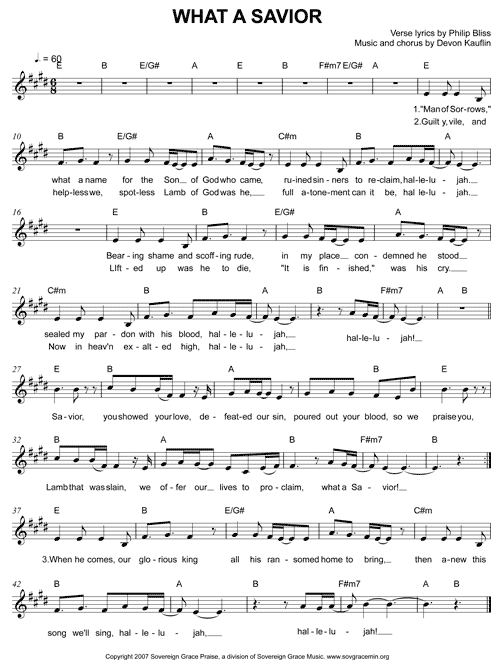
What a Savior!
Bob Kauflin has posted the recording of a new and beautiful rendition of What a Savior. It appears this was recorded at the New Attitude ’07 conference.
Listen:
You can also download the MP3, guitar and lead sheets from Kauflin’s blog, Worship Matters. More music by Kauflin and Sovereign Grace Ministries here.
Spurgeon and Calvinism
Why is Calvinism alive and thriving today? According to Mark Dever the printing of the works of C.H. Spurgeon has a lot to do with it. For more see the post here. And on a related note, my review of Spurgeon’s Autobiography is coming up next Monday at TUAR. Blessings! Tony

Unbelief is Irrational
Unbelief is Irrational
It’s not uncommon today for atheists to rise to their pulpits and boldly preach that belief in some god (let alone a specific god) is simply irrational. Dr. K. Scott Oliphant, professor of apologetics and systematic theology at Westminster Seminary, disagrees. In a recently published essay he points to Paul’s words in the first chapter of Romans to make his case that unbelief is irrational.
Oliphant’s proposition is this: Unbelief is irrational because, at its core, all sin is irrational. He argues, “Sin is essentially, and will remain, deeply unreasonable, utterly irrational … Given that unbelief is at root the quintessential sin, it is therefore, necessarily, quintessentially irrational” (pp. 59-60). He backs up this proposition exegetically from Romans 1:18-32.
Oliphant begins by pointing to Paul’s emphasis in Romans that all people are covenantally bound to Adam or to Christ, walking under condemnation or justification (Rom. 5:12-21). The first two chapters of Romans are devoted to revealing God’s wrath upon those in Adam. Specifically, God’s wrath is kindled against sinners who “suppress the truth” (1:18).
The act of suppressing divine truth is sinful or “unrighteousness” (1:18). So sin is by nature the suppressing of truth. “In other words, God’s wrath is revealed from heaven because, in our wickedness and unrighteousness (in Adam), we hold down (in our souls) that which we know to be the case” (p. 64)
So what knowledge is suppressed? Paul tells us we suppress the universal truths about God — that He exists, He is infinite, eternal, wise, unchanging, glorious and wise. Far from being a mere intellectual knowledge of God, there is included in this a very personal knowledge of God communicated from His Person to our person. So personal that Paul can write, “they know God’s decree that those who practice such things [sins] deserve to die” (Rom. 1:32). Every sinner that suppresses God’s truth and lives on in sin knows that sin is rightfully punished with death. But this and all truth about God is suppressed. The point is clear: God has spoken so openly and so clearly that every sinner knows these universal truths.
How do sinners suppress divine truth? By exchange. We take the glory of our great God and Creator and exchange His glory for superficial images of reality. The next step is to worship and serve the phantoms of reality we create. The truth of the created order becomes twisted into what we think is right. There is an exchange of the natural for the unnatural, like in the case of homosexual relationships (Rom. 1:26-27). Oliphant writes, “All of us, in Adam, are experts in inventing idols” and later he writes “we only retain that [knowledge] which will serve our own idolatrous purposes” (p. 69, 70). Paul tells us this idolatry – worshiping a false reality — is at the center of unbelief.
Paul then goes on to list all sorts of sins, not just homosexuality, but also unrighteousness, evil, covetousness, envy, murder, strife, deceit, maliciousness, gossip, slander, hatred of God, insolence, haughtiness, boastfulness, inventors of evil, disobedient to parents, foolish, faithless, heartless, ruthless (Rom. 1:29-31). Oliphant writes, “All sin, as sin, is rooted in an irrationality that seeks in earnest to deny what is obvious and to create a world that is nothing more than a figment of a sinful imagination” (p. 72).
The sad reality is that for those outside God’s sovereign election, this personal knowledge of God will be drowned out by the noise and passions of the sinful heart. The witness of God’s existence in the heart becomes futile knowledge to an irrational mind. God reveals Himself all around, and blind sinners in Adam respond by suppressing this truth and living in a phantom irrationality.
Conclusion
Paul paints a humbling portrait of all unredeemed sinners. We did not learn Christ because we were more perceptive or less sinfully irrational. God alone opened our eyes. Oliphant says, “The truth that we know – that we retain, possess, and suppress – therefore, is truth that is, fundamentally and essentially, given by God to us. God is the one who ensures that this truth will get through to us. It is his action, not ours, that guarantees our possession of this truth” (p. 66).
This first chapter of Romans is useful to remind believers of our personal sin and irrationality. We are still tempted to live at the feet of a phantom shrine forged in our minds rather than live within reality. And rather than scoffing at the unbeliever, we can look at our own hearts and see where we — as seasoned idolaters! – continue to suppress truth and twist reality in favor of escapism, fantasy and worldly comforts.
But also armed with Paul’s teaching in Romans and brought under the humility of dead sinners raised to life by the power of God, we are prepared to think through apologetics, preaching and personal evangelism. All of our hearers have heard a personal message from a personal God and we are all without excuse (Rom. 1:20). Apparently evidence does not demand a verdict from irrational minds.
Understanding this awful irrationality of the sinful mind will cause us to once again pray like Spurgeon:
“‘Rise up, Lord!’ O God the Father, rise up! Pluck Thy right hand out of Thy bosom, and let Three eternal purposes be accomplished! O God the Son, rise up; show Thy wounds, and plead before Thy Father’s face, and let Thy blood-bought ones be saved! Rise up, O God the Holy Ghost; with solemn reverence, we do invoke Thine aid! Let those who have hitherto resisted Thee, now give way! Come Thou, and melt the ice; dissolve the granite: break the adamantine heart; cut Thou the iron sinew, and bow Thou the stiff neck!”
————
[This exegesis of Romans 1 can be found between pages 59-73 of P&R’s latest release edited by Oliphant and Lane G. Tipton titled, Revelation and Reason: New Essays in Reformed Apologetics (Philipsburg, NJ: P&R) 2007.]

 Tony Reinke