The past week has been full of memories for me and my family. On Sunday afternoon we traveled to the Navy Academy chapel in Annapolis to hear Handel’s Messiah performed. The chapel is stunning and the performance was beautiful. On Wednesday night we traveled to D.C. to Ford’s Theater to see a performance of Charles Dickens’ A Christmas Carol. Ford’s is very small and intimate and the play was incredibly well acted. The empty president’s box elevated above the stage is a reminder that lends further eeriness to Dickens’ haunted intentions.
Both experiences will live long in my memory.
But while I was sitting in Ford’s theater I was struck by the contrasting Christmas messages between Dickens and Handel.
I’ll begin with Dickens.
Dickens
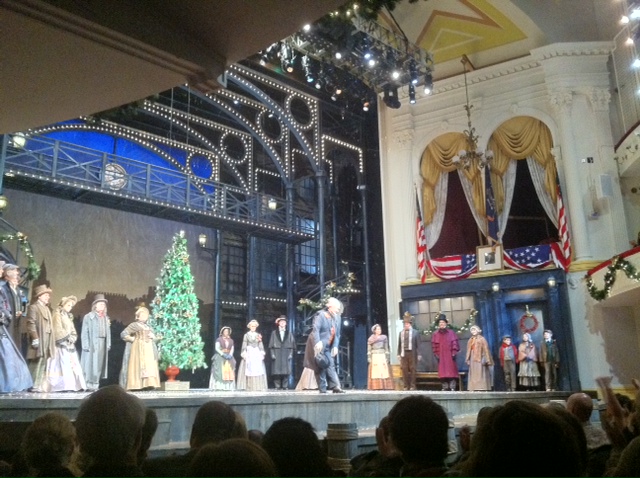 For Dickens, Christmas is about getting unshackled from materialism to appreciate all the blessed relationships we’ve been given. That’s a very good message. And in my attempt to further discover Dickens’ understanding of the meaning of Christmas, I was led to his short book, The Life of Our Lord. He wrote it not primarily to be published but to be read by his children each Christmas, thus giving us a glimpse into the urgency of its annual, seasonal message. The book is Dickens’ retelling of Christ’s birth, life, death on the cross, and resurrection. And quite frankly, most of it is very good.
Yet here is the final paragraph of the book, the punch line, the meaning of Christmas – the meaning of the cross and all of Christianity – in summary:
Remember! — It is Christianity To Do Good always — even to those who do evil to us. It is Christianity to love our neighbour as ourself, and to do to all men as we would have them Do to us. It is Christianity to be gentle, merciful, and forgiving, and to keep those qualities quiet in our own hearts, and never make a boast of them, or of our prayers or of our love of God, but always to shew that we love Him by humbly trying to do right in everything. If we do this, and remember the life and lessons of Our Lord Jesus Christ, and try to act up to them, we may confidently hope that God will forgive us our sins and mistakes, and enable us to live and die in Peace.
For Dickens, the value of Christmas, and the Savior’s life and work it appears to me, is its ability to produce in us moral reform, enabling us to becoming better, do better, and ultimately to appease God, pleasing him with our moral reforms and effecting his forgiveness for our sins so that we can die in peace. You can hear all these theological assumptions echoing in A Christmas Carol, even into the final paragraph where we are assured that Scrooge “lived upon the Total Abstinence Principle, ever afterwards.” Personal reform was the main point.
Handel
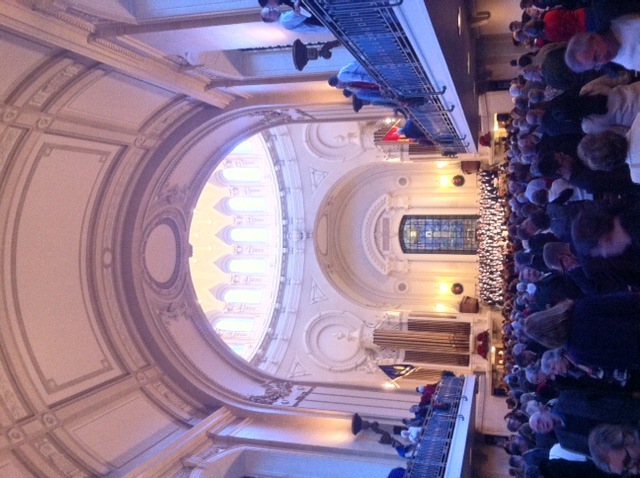 Then there is Handel’s Messiah. Here are some selected lyrics, which are passages drawn directly from the KJV Bible. Hardly any commentary is needed:
Behold the Lamb of God that taketh away the sin of the world. [John 1:29]
He was despised and rejected of men; a man of sorrows and acquainted with grief. He gave His back to the smiters, and His cheeks to them that plucked off the hair: He hid not His face from shame and spitting. [Isaiah 53:3, 50:6]
Surely He hath borne our griefs, and carried our sorrows! He was wounded for our transgressions; He was bruised for our iniquities; the chastisement of our peace was upon Him. And with His stripes we are healed. [Isaiah 53:4-5]
All we like sheep have gone astray; we have turned every one to his own way. And the Lord hath laid on Him the iniquity of us all. [Isaiah 53:6]
He was cut off out of the land of the living; for the transgression of Thy people was He stricken. [Isaiah 53:8]
I know that my Redeemer liveth, and that He shall stand at the latter day upon the earth; and though worms destroy this body yet, in my flesh shall I see God. For now is Christ risen from the dead, the firstfruits of them that sleep. [Job 19:25 and 1 Corinthians 15:20]
Since by man came death, by man came also the resurrection of the dead. [1 Corinthians 15:21]
For as in Adam all die, even so in Christ shall all be made alive. [1 Corinthians 15:22]
O death, where is thy sting? O grave! where is thy victory? The sting of death is sin, and the strength of sin is the law. But thanks be to God, who giveth us the victory through our Lord Jesus Christ. [1 Corinthians 15:55-57]
If God be for us, who can be against us? Who shall lay anything to the charge of God’s elect? It is God that justifieth, who is he that condemneth? It is Christ that died, yea, rather that is risen again, who is at the right hand of God, who makes intercession for us. [Romans 8:31-34]
And then it all closes with this magnificent scene of eternal, angelic worship:
Worthy is the Lamb that was slain, and hath redeemed us to God by His blood, to receive power, and riches, and wisdom, and strength, and honour, and glory and blessing. Blessing and honour, glory and power, be unto Him that sitteth upon the throne, and unto the Lamb, for ever and ever. Amen. [Revelation 5:12-14]
So beautiful!
I’m grateful Handel closed with yet another reference to the finished work of Christ. His entire message is soaked with the substitutionary blood of Christ. Jesus was born to die in our place, and died to be raised from the dead, and was raised to guarantee our bodily resurrection. In Handel’s work our eternal hope gets firmly placed on the shoulders of the Christ-child born in Bethlehem. Messiah is a magnificent work.
Contrast
I don’t know much about the life of Dickens, but clearly he was no mere deist. He pressed his children to see the importance of Christ’s incarnation, his death, his resurrection, his ascension, and even the persecution of the early church. He seems to have a high regard for Scripture, and for this I am thankful. But it also seems that he boils down the meaning of Christmas to say little more than that Christ is our moral pattern to help us live Christianly.
By contrast, for Handel, the birth of the Savior marks the beginning of the fulfillment of the Old Testament prophecies. As that eternal plan begins to unfold on earth, Christ must be born, he must die a bloody death, and he must defeat the grave because we are desperate and helpless sinners. The entire salvific purposes of God begin to unfold in the Incarnation, in the birth of Christ.
For Dickens, Christmas is a reminder that we are all Scrooges, self-centered ungrateful nobs who yet have some hope of appeasing God through our personal reform.
For Handel, Christmas reminds us that we are all sinners, we are “in Adam,” and for that we are helpless to stop God’s righteous judgment towards our sin. Yet there is One who has paid the price to quench God’s wrath on our behalf.
In both A Christmas Carol and Messiah, all our warm and tranquil Hallmark Christmas sentimentality gets blasted by cold reality. Death is coming for us all, and the grave is approaching quickly.
Dickens wants people to die in peace.
Handel wants people raised from the dead.
Dickens’ hope is rooted in the future — in the finished work of moral reform necessary in our lives.
Handel’s hope is rooted in the past — the full and complete work of Christ on our behalf.
Dickens’ message is “do.”
Handel’s message is “done.”
Dickens’ work is good for what it is, a seasonal, warmhearted morality tale. For that I find it agreeable and commendable. But Handel’s work comprehends the scope of the hope-giving and guilt-freeing meaning of Christmas. For that I find eternal comfort, and hope for my ongoing battle against my inner self-centered, thankless Scrooge.

 Tony Reinke