Top 10 P.G. Wodehouse Titles


British humorist P.G. Wodehouse penned close to 100 books in his prolific career. That’s great for him, but it also means I find myself up against the dashed difficult problem of determining where to begin. So to help me navigate the options I contacted the man who introduced me to Wodehouse a number of years back, Douglas Wilson. “As a general rule, the Blandings Castle books and the Jeeves books are the best,” he told me. And then followed that summary with “a rough and ready list” of 10 titles that take the biscuit:

  1. Joy in the Morning
  2. Leave it to Psmith
  3. Galahad at Blandings
  4. Uncle Dynamite
  5. Uncle Fred in the Springtime
  6. The Code of the Woosters
  7. Meet Mr. Mulliner
  8. Right Ho, Jeeves
  9. Lord Emsworth and Others
  10. Heavy Weather

Now that’s a bit more manageable.

Any other Wodehouse fans out there? What are your favorites?

[Note: the character sketches were pinched from this blog.]

More Book Updates

The book is now out and many of you are reading it or have recently completed it. Thank you for all the emails and comments and Twitter encouragements over the last week. Watching pithy quotes from the book spread on Twitter is really neat way to see what statements struck a chord with readers. I appreciate the emails telling me stories of families reading Lit! together, homeschool families looking to incorporate the book into their curriculum, pastors buying up copies to give out to people in their churches who struggle with reading, and college ministry directors leading discipleship reading groups through the book. This is exactly why I wrote it in the first place, so you can imagine how those notes warm my heart! Thank you for them and please keep them coming.

Here are a couple of book updates. On Tuesday two interviews were published online. My written interview with John Starke, “Death to Dostoevsky by Angry Birds,” was published on the TGC website. And my 12-minute video interview recorded with Justin Taylor in June went live as well. You can watch it here:

[vimeo:http://vimeo.com/25778066%5D

As Arthur Krystal wrote, “Like most writers, I seem to be smarter in print than in person.” Yes, and thinner and handsomer, too.

Some other fun interviews are in the works. I’ll let you know when they’re up.

Blessings!

Tony

Lit! Class Audio

Happy October everyone!

As you may recall, back in September I taught a 3-week course on reading at Covenant Life Church and the class content amounted to a very brief adaptation of four chapters from Lit!. There’s never enough time. The audio is now available along with the handout pdfs.

Class 1: A Theology of Books and Reading
58:41 | download mp3 (28.3 MB) | download pdf handout | listen here:

Class 2: Deciding What Book To Read
59:29 | download mp3 (28.7 MB) | download pdf handout | listen here:

Class 3: How To Read A (Nonfiction) Book
52:33 | download mp3 (25.4 MB) | download pdf handout | listen here:

Note: Since teaching this brief class at CovLife I’ve been asked to teach this material in other church settings and at a local college. I’m happy to do that. If you would like to make a request please leave a comment with your email address and I’ll be in touch. Thanks. Tony

What has Herman to do with Homer?

In his excellent essay “Classical Education” Herman Bavinck traces out the long and quite complex history of ancient literature in the life of Christian education. Near the end of his essay he addresses the contemporary value of writings by Plato, Aristotle, Cicero, Virgil, Horace, Homer, Sophocles, and others. The following quote is taken from the end of the essay as it appears in Bavinck’s Essays on Religion, Science, and Society (Baker Academic, 2008), page 242:

The study of antiquity is not only of formal and practical value: for the development of thinking, understanding Greek and Latin terms in our scholarship, understanding citations and allusions in our literature, and so fourth. Its lasting value also lies in the fact that the foundations of modern culture were laid in antiquity. The roots of all our arts and learning — and also, though in lesser degree, the sciences that study nature — are to be found in the soil of antiquity.

It is amazing how the Greeks created all those forms of beauty in which our aesthetic feeling still finds expression and satisfaction today; in their learning they realized and posited all the problems of the world and of life with which we still wrestle in our heads and hearts. They were able to achieve all that, on the one hand, because they rose above folk religion and struggled for the independence of art and learning; but on the other hand, they did not loosen art and learning from those religious and ethical factors that belong to man’s essence. In the midst of distressing reality, they kept the faith in a world of ideas and norms. And that idealism is also indispensable for us today; it cannot be replaced or compensated for by the history of civilization or new literature.

Lit! Sale Online

To celebrate the release of Lit! our friends at Westminster Bookstore in Philadelphia are offering my very special blog readers a very special discount on the book. In fact they’re selling the book for almost 50% off the list price. Very generous!

  • List price: $15.99
  • Regular WTSB price, 40% off: $9.62
  • With an additional 10% discount: $8.66

The generous sale ends in one month (Oct 23).

All you’ll need to do is copy/paste this special offer coupon code into the box when you check out: Lit! – Tony Reinke

And remember that WTSB orders over $49 ship for free in the US (UPS). So what good reason is there for not buying 6 copies?

If interested, go to the Lit! product page here.

Strewn Body Parts

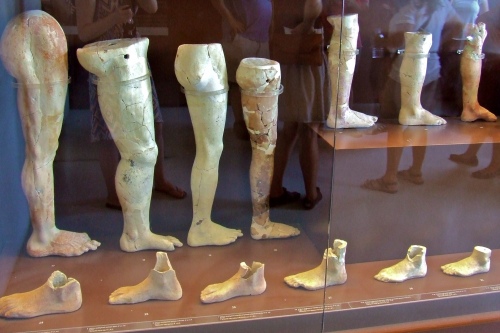
During Paul’s time in Corinth the city boasted of many temples including the Temple of Asklepios, the god of healing. As you can imagine it attracted the sick and the diseased and the injured. Legend says those seeking to be cured were required to offer a clay replica of the body part that was diseased or broken. And according to later archeological discoveries, the temple was littered with such clay terra cotta likenesses of body parts, many of which originated from the 3rd-4th century BC. A large number of these clay replicas are now displayed at the Antiquities Museum at Ancient Corinth [see the picture at the bottom, a picture of the less risqué pieces (STDs were common in Corinth)]. It’s unclear whether Paul saw these clay casts with his own eyes or whether they had already been buried in the rubble under his feet at that point. But it seems safe to say that in various ways the Temple of Asklepios and its approach to healing led to a disjointed image of health. This may very well be behind Paul’s holistic body image in 1 Corinthians 12:12–31, which is a good reminder that Jesus does not settle for a healthy foot or leg, but desires a healthy Body thriving in unity with each other and in union with their Head. So much so that, “if one member suffers, all suffer together; if one member is honored, all rejoice together” (v 26). Such a contrast with the Temple of Asklepios would not have been lost on Corinthian ears.