 Hello everyone! It’s a beautiful Friday but I have nothing to say. The World Series excitement certainly impacts my reading schedule and my blogging. I was considering another John Owen graphic to celebrate the BoSox 2-1 victory in game 2. But I decided against this. An avalanche of work awaits me today and I need to get on it. … If you’re looking for something to read, I would point you to an excellent post by Tim Challies titled, Guarding the Deposit. I love the Antiques Roadshow. What a great illustration, Tim! Well, have a great weekend everyone! Tony
Year: 2007
Celebrate Reformation Day
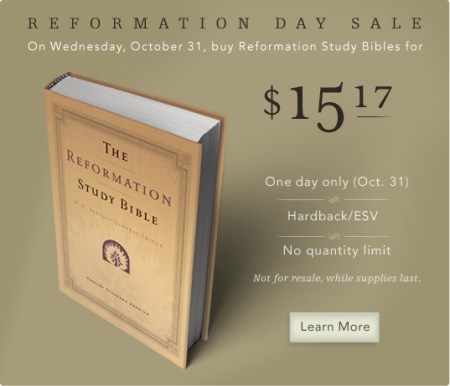
How do you celebrate Reformation Day (Oct. 31st)? In our home we like to grill some papal bull hamburgers, feed the kids a diet of (gummy) worms, and watch the old 1953 movie Martin Luther starring Niall MacGinnis. Ah, yes, the classics … This year Ligonier Ministries is helping Christians celebrate with a special deal on the ESV Reformation Study Bible. For one day only (Oct. 31) you can order the RSB for just $15.17. Get it? More details will be available soon by clicking the picture …
Doctrine and saving faith
 “We must understand that Christianity is not a mood. It is not an emotion. It is not a feeling. It is not an amorphous set of beliefs. It is established by the truth of God’s Word, by the saving reality of God’s deeds in Jesus Christ, around certain definite doctrines without which it is not possible to exercise the kind of faith that saves.”
– Dr. R. Albert Mohler, at the fall convocation at Southern Seminary on August 21st [as quoted in The Tie: Southern Seminary Magazine (Fall 2007), p. 23]. Download magazine PDF here.
The free magazine also features the testimony of Marxist-turned-Christian, Michael A.G. Haykin on pages 18-19. Good stuff.
The Apostles’ Doctrine of the Atonement by George Smeaton
 Last week we played the game, Who is George Smeaton? To be honest, I had not heard of him until recently. Now I know more about the 19th century Scottish theologian and that’s all thanks to the input of TSS readers, the most knowledgeable blog readers on the planet (illustrated by the fact that many of them roast their own coffee beans). Helpful input came flowing from Scottish readers and Brazilian readers and really from readers all over. So thank you!
As you now know, Smeaton’s two books on the atonement serve as the foundation for Jerry Bridges’ new book, The Great Exchange: My Sin for His Righteousness (Crossway: 2007). In the foreword, Sinclair Ferguson says Smeaton’s volumes should be on the shelves of every preacher. “They are treasure troves,” he writes.
 Just yesterday in the mail arrived my copy of Smeaton’s 1870 work, The Apostles’ Doctrine of the Atonement (the second volume, Christ’s Doctrine of the Atonement, is currently out of print). As expected, the Smeaton volume was beautifully bound by the Banner in this 1991 reprint featuring a Smyth-sewn binding and cloth cover (remove the unsightly dust cover to see this delicious goodness). The text is a facsimile reproduction of the 1870 edition (see picture). There are brief Scriptural and topical indexes in the back.
To my pleasant surprise, the volume contains a lengthy appendix covering the history of the atonement from the first century through the Reformation period (pp. 479-544). Smeaton begins his historical study this way, “We find, when we make due allowance for erratic tendencies, either of individuals or of sects, through all this time, one harmonious testimony to divine justice and the judicial aspect of Christianity” (p. 480).
As time allows, I plan to write a fuller review, but this quote from the introduction to Apostles’ is a great one, illustrating the ever-present tendency within the church to neglect the doctrine of the penal substitutionary atonement of Christ. The quote stresses our need to linger often at the Cross in our studies, never assuming the importance of the Cross. Written 130 years ago, it’s ever fresh today.
“The design of this work is mainly to demonstrate, in the only way in which this is to be done, the pure biblical doctrine of the atonement. But polemical references are by no means withheld; that is, applications, necessarily brief, of ascertained truth to germinant errors, especially to those subtle forms of error which, in an evangelical guise, and not seldom with exegetical appliances, tend wholly to subvert the elements of substitution and penal visitation, which constitute the very essence of the atonement. It is a remarkable fact that since the Reformation no article has been so much impugned in every variety of form. Till recently this was uniformly done by a class of men who had forfeited all claim to be regarded as either evangelical in sentiment or biblical in doctrine. Within recent memory, however, a new phenomenon has presented itself to the attention of Christendom — a sort of spiritual religion or mystic piety, whose watchword is, spiritual life, divine love, and moral redemption, by a great teacher and ideal man, and absolute forgiveness, as contrasted with everything forensic. It is a Christianity without an atonement; avoiding, whether consciously or unconsciously, the offence of the cross, and bearing plain marks of the Rationalistic soil from which it sprung; and it has found a wide response in every Protestant land.”
– George Smeaton, The Apostles’ Doctrine of the Atonement (Banner of Truth: 1870/1991), vi.
BoSox win game one
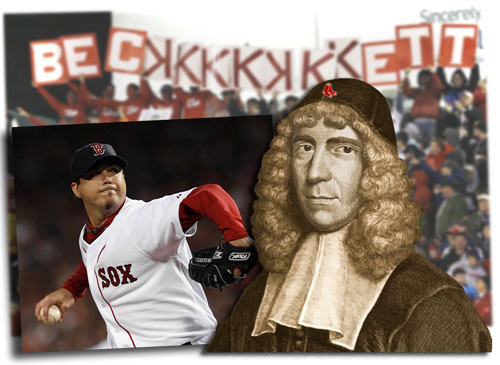
Puritan John Owen was noticeably pleased after his BoSox had their way with the Colorado Rockies in game one of the World Series, winning 13-1 at Fenway last night. Such sweet victory.
On writing book reviews
 One of the fan-favorite features of TSS is our book reviews. Sometimes I get questions from readers who want tips about how I write book reviews.
Well, I certainly don’t consider myself an expert on writing them so I can only offer general thoughts on the process that come to mind.
Also, since I only review non-fiction works some of these thoughts may be more or less useful to reviewing fictional literature. I’ll try to go back to my old Liberal Arts education tools to recall what I learned about works of fiction and see if I can look at reviews both the perspective of a non-fictional work and a fictional one.
Here are some thoughts …
1. Setting standards. Book reviews are an act of literary criticism whereby a specific book is assessed and evaluated from a standard set by the reviewer and the reviewer’s audience. So, for example, the theological works I typically review are first compared to their biblical accuracy, then compared to other works by the same author, and finally compared to other works covering the same themes.
In the past month I’ve read 5 books on evangelism — one was very poor, two were okay, one was very good, and one was excellent. I came to this conclusion by comparing all five to Scripture, and each to one another. Reviewing any literature (and especially fiction) will require standards of evaluation just the same. A work of fictional literature may be compared to other works covering the same themes, compared to the works of other authors in the same era, or compared to a specific work of the author’s other works.
At some level you will need to answer the fundamental question, What am I comparing this book to?
2. Cultivating critical thinking. I love writing book reviews because it forces me to cultivate the rigorous discipline of critical thinking. By critical thinking, I don’t mean that I want to be a critical person. Rather, it means I am forced to ask and answer several discerning questions like the following:
(1) What is the overall purpose of the author?
(2) What question, ethical standard, social custom or problem is being confronted, questioned or solved by the author?
(3) What assumptions do the authors bring into the discussion? Are they writing from a Christian or non-Christian worldview? What is assumed without argument? What worldview do they champion? What school of thought do they represent?
(4) What is the author’s point of view? Is the book written from the perspective of an adult or child? Rich or poor? Preacher, evangelist, or scholar? Where did the author live and what did they experience in life? For me, determining where the author serves as a professor or pastor helps me to understand the individual and the perspective.
(5) What events, information, and evidence does the author use to make her case? Is it strong and clear information, or weak and assumed? Every conclusion must be backed by a series of events and dialogues (fiction) or facts and evidences (non-fictional).
(6) What are the implications and consequences of the author’s arguments? Assuming the author is right, what must change?
These questions help me unlock even the most subtle messages embedded in literature and art. And one great way to put these six questions into action is by looking at an advertisement in a magazine. Every ad has a target audience, a worldview, and a means to persuade. Who is the target audience, what worldview does it embrace, and what is the basis of the persuasion?
It’s only because we are made in God’s image that we have the self-conscious awareness to bring literature under critical thinking and discernment. A true gift from God Himself.
3. Getting at the main point. Let me revisit this point a bit further. I believe every author, painter, advertiser, sculptor, commentary writer, songwriter, and poet is trying to convince you of something. That’s the nature of communication — someone taking a message he is passionate about and seeking to convince others of that message. The big question is, what is that individual trying to communicate?
In literature this may be on the surface. For example, C.S. Lewis in The Lion, the Witch and the Wardrobe makes fairly obvious points — sinful greed corrupts our hearts, this sin negatively impacts our family and those closest to us, and Christ is our sufficient substitute — the One who breaks the power of sin and Satan. However in Lewis’ novel Till We Have Faces, the meaning is much harder to discern (I’m still scratching my head over this one). J.R.R. Tolkien’s Lord of the Rings is another really tough (but rewarding) adventure to attempt to ‘crack.’
Or consider, say, an adventurous novel written about a boy’s hitchhiking travels across the country one summer. It may be a fun adventure filled with surprises, threats, and interesting characters, but it may also have a much deeper intention. Perhaps it was written by a man who was born and raised in New York City and written as a criticism of the way large cities impair childhood development?
You get the idea.
The goal is to understand the author behind the work. Did they live through a world war? (To think of it, perhaps Aslan’s victory in the battle for Narnia is Lewis’ way to comfort children in a time of world war?) So get to know the author, and get to know the world of the author.
But don’t assume that fictional works are disconnected from reality. The truth is that authors with strong convictions have frequently chosen fictional literature to get their messages out. Some consider fiction the best means to communicate reality.
4. Getting at a biblical worldview. Christians are perched on a distinct view of reality because our worldview is informed by God’s eternal revelation in Scripture. We are therefore at a great advantage to evaluate every work of literature as it correlates or contradicts this eternal reality. Finding where themes, worldviews, attitudes, and ethics correlate or contradict Scripture is one of the most interesting disciplines (and downright addictive!).
Centering everything around Scripture also helps me interpret popular literature I disagree with. For example, I obviously don’t agree with existentialism, but I am surprised how fully their writers can communicate the hopelessness and despair of the human condition.
Holding a biblical worldview makes literature reviews quite interesting!
5. Read more than you review. Typically, of all the books I receive in the mail only about half are interesting enough to read. And of those books I read, only half get reviewed. Reviewing half (or even less) of the total number of books I read gives me tremendous freedom to review and invest time thinking through the very best books. There is value to reviewing books you don’t like, but I’ve tried to isolate the books I love and spend my time reviewing those titles. So read much more than you expect to review.
6. Now write. Every review will look differently. Don’t try and force your review into a grid or pattern, just write about what most strikes you about the particular book. After asking all of the questions above, you should have a lot to talk about.
Finally, I cannot help but be reminded of my Liberal Arts prof that impacted my life to a great degree on these things. And since Dr. Joseph Wydeven recently retired, this is a great opportunity to thank him for his work at Bellevue University in Nebraska. He was a tremendous blessing in my intellectual development and growth in critical thinking. Thank you, Dr. Wydeven!
Blessings, TSS readers! Tony
—————–
Related: More on critical thinking here.
Related: Here are my top five favorite books on writing:
- The Elements of Style by Strunk and White
- On Writing Well by Zinsser
- Keys to Great Writing by Wilbers
- Hypnotic Writing by Vitale
- How to Write a Paragraph by Paul and Elder
 Tony Reinke