 Book review
ESV The Literary Study Bible
edited by Leland Ryken and Philip Graham Ryken
Some of the best Christian scholarship aims to unfold the beauty of Scripture for general readers. The new ESV Literary Study Bible is one excellent example.
Editor Dr. Leland Ryken is a top-notch literary scholar, noted for his many books (like a personal favorite The Word of God in English) and his work as literary stylist for the ESV. His son, Dr. Philip Graham Ryken, is a noted author and preacher known for excellent books like The Doctrines of Grace.
Together, their work has produced a masterful study Bible.
Size, price, purpose
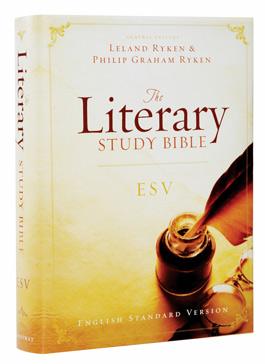 The printed ESV LSB will be available on Sept.
 14th 23rd in a hardcover format, 6×9 inches in size (slightly smaller than the reverse interlinear and slightly larger than the classic reference edition) and nearly 2,000 pages in length (700 pages longer than the reverse interlinear and classic reference edition). The LSB will retail for about $50.00.
The twofold goal of the ESV Literary Study Bible is clearly stated, “(1) to make the Bible reader friendly and (2) to show how application of literary tools of analysis helps in reading and understanding the Bible” (xvii).
We’ll look at each goal individually.
Scripture as Literature
The premiere benefit of the LSB is viewing Scripture as literature, without reducing Scripture to the level of mere literature. In Leland Ryken fashion, rebuttals are given to show that viewing Scripture as literature (1) does not show a liberal bias, (2) reinforces Scripture’s view of itself as literature, (3) does not reduce Scripture to fiction, (4) does not reduce Scripture to another mere piece of literature, (5) nor deny the inspiration of Scripture. In fact, the editors argue that an accurate interpretation of Scripture first requires an understanding of the many literary features of Scripture.
“To approach the Bible as literature as this literary Bible does is not like dessert — something pleasurable to add to more important aspects of the Bible. The literary approach is the first item on the agenda — the starting point for other approaches to the Bible. This has been a point of neglect among Bible readers and Bible scholars that this literary Bible aims to correct” (ix).
Because, the editors make clear, “meaning is conveyed through form, starting with language itself but moving beyond that to a whole range of literary forms and genres” and “There is no meaning without the form in which a piece of writing is expressed” (vii). Forms directly impact interpretation.
The number of identifiable biblical genres in Scripture “readily exceeds one hundred” and that does not include archetypes, motifs, styles, rhetoric, and artistry (x). Scripture is a wonderfully diverse collection of literature with great variety. None are better qualified to bring these to the surface than Leland Ryken.
But this study Bible does not require an advanced degree in literature. Every term from “antithetic parallelism” to “dramatic monologue” to “theophany” is defined in the 17-page glossary of genres and literary terms.
Perhaps, like the Self-Interpreting Bible by John Brown of Haddington in the 18th century, this ESV LSB will become a primary literature text in homeschool education? Something to consider.
Reader-friendly
The goal is not to weigh the reader down in definitions and genres, but to provide helpful guidance for the reader to comprehend large swoops of biblical text. Many features make this an excellent reader’s Bible.
1. Format. The ESV text is single-column, black text set in 8.5-point Veritas font. Very clean and easy to read.
2. Introductions and overviews. Each book of Scripture receives a detailed introduction and content overviews. The overall literary genres and styles are summarized at the beginning. Ryken and Ryken bring great balance between the literary context and the content/outline of Scripture. We’ll see this later.
3. Subsection prenotes. Before each subsection of Scripture (normally one chapter in OT and every half chapter in NT), the editors provide important literary notes and an overall snapshot of the upcoming content. These are like prenotes, compared to the footnotes common in study Bibles. These prenotes peak interest and drive the reader into the text. “This literary Bible is a guide to the Bible that pushes the reader into the text instead of providing mere summaries of the content that readily become substitutes for reading the Bible” (xvii). These chapter notes reinforce the literary styles mentioned in the book introductions, provide overviews of upcoming Scripture content, and function well in helping the reader chomp through large sections of Scripture in single settings.
4. New reading plan. The annual reading plan of the LSB is quite innovative. The daily readings include one section from each of the four categories: Psalms and Wisdom Literature; Pentateuch and the History of Israel; Chronicles and Prophets; and Gospels and Epistles. But four important books – the Psalms, Isaiah, Luke and Romans – are read twice annually! The readings through the OT are arranged chronologically, and the NT readings by author. For example, readers progress from the Gospel of John to 1 John, 2 John, 3 John and conclude with Revelation.
5. Designed for group study. The LSB was designed purposefully for group studies. As stated in the introduction, the editors intend to help discussion leaders formulate application questions. The reading schedule, literary notes, and outlines are very thoughtful and will foster fruitful group study.
Example
The value of this LSB can be illustrated with one chapter prenote from the Psalms. First, take up a favorite Bible and read Psalm 38. Now read the prenote and see how the literary backdrop changes your interpretation of Psalm 38:
“I confess my iniquity [Psalm 38]. This is the third of the church’s traditional penitential psalms. Penitential psalms are a variation on the conventional lament psalm. In them, the poet defines a dire crisis and asks for God’s deliverance. But the twists on the lament form are these: the speaker’s antagonist is not an external enemy but himself; the threat is not physical threat or slander but spiritual guilt; the petition is to be delivered not from a threat to life or political oppression but from peril of soul. The outline is as follows: introductory cry to God (v. 1); definition of the crisis, a highly metaphoric portrayal of the effects of guilt, including physical symptoms (vv. 2–10); as an extension of the crisis, a picture of the isolation of the speaker from others, in a manner reminiscent of the more customary lament psalms (vv. 11–14); statement of confidence in God (vv. 15–16); confession of sin (vv. 17–18); a return to the portrait of the speaker’s enemies (vv. 19–20); prayer to God for deliverance (vv. 21–22)” (p. 787).
You can see that both the genre and general outline of the contents are mixed together well (as you would expect from a literary scholar/pastor team). Phrases like “My wounds stink and fester, because of my foolishness” (v. 5) take on new spiritual meaning in light of the genre. The reader is now well equipped to read the Psalm for herself and glean valuable wisdom. Without any open application questions, the LSB note has brought the reader to the brink of rich application.
If you’re like me, you want more than one excerpt and a review before investing in a new Bible. Here’s a suggestion: In a few weeks, find a local bookstore that carries the Bible and set aside 1-2 hours some weekend to read the book of Job, notes and all (pp. 684-743). Start at the beginning and read it through. Don’t stop to understand every detail in the text, just keep reading to catch the overall flow and direction. Here in Job, the features and strengths of the LSB are on full display.
Literature as Experience
Which brings me to a final point. I am aware of my personal tendency to reduce passages Scripture to nice, indexed, systematic categories (no wonder I personally struggle through Job!). Systematizing ideas is easier for me, compared to reading narrative literature and poetry. By viewing Scripture first as literature (and secondarily as theological content to fill a systematic outline), something important surfaces. Scripture is experienced.
“The goal of literature is to prompt a reader to share or relive an experience. The truth that literature imparts is not simply ideas that are true but truthfulness to human experience. The implication for interpretation is that Bible readers, teachers, and expositors need to be active in re-creating experiences in their imagination, identifying the recognizable human experiences in a text (thereby building bridges to life in the modern world), and resisting the impulse immediately to reduce a biblical passage to a set of theological ideas” (xi).
It occurs to me that once we experience literature, literature becomes integrated into our experience. For example, Augustine’s Confessions are saturated with the Psalms because the Psalms saturated Augustine’s experience. The LSB encourages me to further experience Scripture by using the literary composition as a door into experiencing the text for myself. If you read Job, you’ll likely experience this firsthand (as I did).
Conclusion
If the boom in abridged Bibles and contemporary dynamic equivalence translations tell us anything, it’s this: Our church culture is noticeably uncomfortable with the literal text of Scripture. With the ESV LSB, Ryken and Ryken highlight the beautiful intricacies of Scripture and preview content to help readers navigate through the literal, unabridged text of the ESV. The product of their scholarship is both a study Bible and reading Bible, centering around a literal translation that accents the literary beauty of the Bible and invites readers to experience Scripture firsthand.
In a word, the ESV Literary Study Bible is masterful and will serve those who seek daily nourishment from the pure milk of God’s Word.
 I love sermon jams, the place where sermonic highlight meets background music. Sermon jams are excellent for the gym, excellent for personal devotion, excellent to share with other listeners less likely to listen to entire sermons, and overall just an excellent way to reach the lost and share the faith. Sermon jams are very common online, but few are as well constructed as those produced by 10:31 Sermon Jams. Many of their jams are available online for free download.
 The Puritans wrote beautiful poetry and Anne Bradstreet, a faithful Puritan wife and mother of several children, wrote some of the most compelling.
 Tony Reinke