Book review
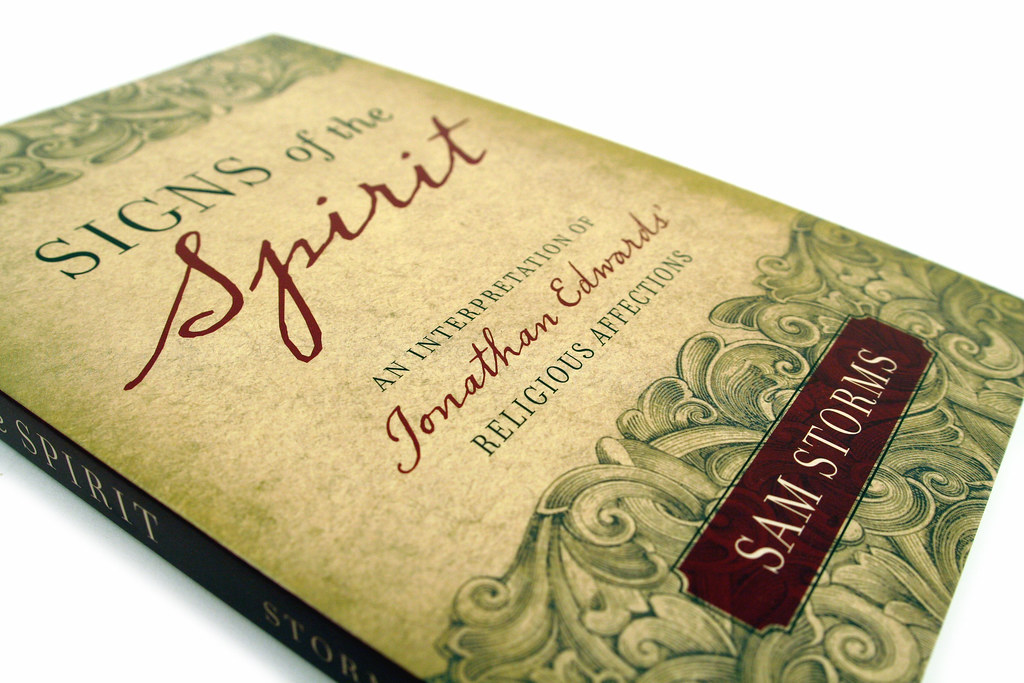
Signs of the Spirit by Sam Storms
Published in 1746, Jonathan Edwards’ Religious Affections remains the great masterpiece on biblical discernment. Edwards exposes the inner workings of the soul, using Scripture to make concrete the contrast between the fleeting affections of a hard hypocritical heart  and the enduring affections of a softened and converted heart. The precise dissection of the soul in Religious Affections is one of the enduring characteristics of Edwards intellectual brilliance and a precision warranted from such delicate matters. But many contemporary readers (like this one) have found Edwards’ intellectual precision difficult to read.
In his new release, Signs of the Spirit: An Interpretation of Jonathan Edwards’ ‘Religious Affections’ (Crossway: 2007), Sam Storms has written an excellent guide through Edwards’ rich arguments. Storms is noted for his study of Edwards and has worked through the Religious Affections at least 10 times (p. 12).
But Storms is not enthralled with the genius of Edwards. He begins the book with clear, foundational biblical exposition and carries biblical proof throughout the entire work. Genuine discernment of the true work of God finds its basis in God’s Word, not Edwards. Storms’ careful biblical development deserves applause.
From here Storms builds a historical backdrop to Religious Affections and then defines affections, finally concluding that affections are the “warm and fervid inclinations that reveal the fundamental orientation of the human heart” (p. 44). Storms follows the design of Edwards in explaining the 12 signs that don’t necessarily authenticate the work of God in the soul and the 12 signs that do authenticate the genuine work of God in the soul. Genuine God-given affections are lit by the flame of God Himself, an enduring flame that displays itself in genuine love and admiration of God as He exists in His spectacular beauty. True religious affections will reveal themselves by causing us to hate sin and pursue Christ-likeness, driving our appetite for more of God and to pursue the sweetness in the Person and Work of Christ.
Edwards’ personal testimony of these religious affections comprise the final 80 pages.
Religious Affections is always relevant but especially in our day when “Christianity” is often defined by outward affiliations, church strategies, and cultural relevance. Edwards’ reminder to our era is that genuine Christianity is marked by a radical soul transformation. Christianity is not defined pragmatically by what it offers and what we get. More important than marketing Christianity as a list of exclusive benefits, Edwards understands that a true work of God begins with a vision of God in His unspotted glory and supreme majesty.
“We must, therefore, be careful that our primary joy is in God, as he is in and of himself, and not in our experience of God. That we have been made recipients of his grace and are enabled to behold his beauty is a marvelous thing indeed. But it is secondary and consequential to a recognition of God’s inherent excellency. What brings you greatest and most immediate delight: your experience of a revelation of Christ, or Christ revealed?” (p. 92)
Discerning this genuine work of God is essential for every generation of Christians, and Edwards’ timeless truth has now been made more accessible. But don’t misunderstand. If reading Religious Affections is climbing the face of Mount Everest, reading Sam Storms’ interpretation is climbing the rock wall at REI. There is a harness, air conditioning, engineered footholds and an attendant holding the rope, but you’ll still sweat.
Storms’ timing is excellent. Our generation needs Edwards to help us ground our discernment between the facade of inauthentic Christian profession and the genuine work of God in the soul.
“I doubt if there is a more pressing and urgent issue for the church today than determining ‘what are the distinguishing qualifications of those that are in favor with God, and entitled to his eternal rewards.’ Or to put it in other words, what is the nature of true spirituality and those features in the human soul that are acceptable in the sight of God?” (p. 37)
I think he’s right.

Title: Signs of the Spirit: An Interpretation of Jonathan Edwards’ ‘Religious Affections’
Author: Sam Storms
Reading level: 3.5/5.0 > moderately difficult
Boards: paperback
Pages: 238
Volumes: 1
Dust jacket: none
Binding: glue
Paper: normal
Topical index: yes
Scriptural index: yes
Text: perfect type
Publisher: Crossway
Year: 2007
Price USD: $15.99 from Crossway (includes free PDF)
ISBNs: 9781581349320, 1581349327
 The Twin Cities and the surrounding communities are coming out of a tragic week. In John 15 the disciples were heading into tragedy. Jesus’ words of comfort in John 15:1-11 provided the content for a sermon I delivered on this past Sunday (Aug. 5) at Trinity Bible Church in North Branch, MN. Abiding in Christ is a call for Christians to press into the vine and find our spiritual vitality in Christ and Him crucified. Jesus reminds us that we are both saved and sustained by the Cross.





 Puritan fashion is hot! No kidding. A
 If you’ve ever walked through a cemetery with a small group, you know the unwritten rules that dominate; speak quietly, don’t laugh and respect the hollowed ground. This is the same feeling I got walking around downtown Minneapolis and St. Paul this morning. Today, the local officials recover bodies and, with such a gruesome scene unfolding, a huge perimeter has been cordoned off by the police stretching upstream and downstream along the river and well into downtown St. Paul and Minneapolis. Public vantage points like five-story parking garages are closed. Every media outlet imaginable is represented, each having their own satellite truck, a reporter with a microphone, a camera on a tripod and a producer on a mobile phone. It was the lead story this morning on the BBC. Students from the University of Minnesota walk around the St. Paul side of the river. Downtown Minneapolis is equally busy. Bicycles zip around. Cars are stacked in traffic. But amidst the tremendous saturation of people, the scene is quiet. Cars don’t honk or boom loud music. The emergency lights flash silently. Even those walking around with friends are speechless. The scene is quiet as people reflect on the obvious: death is inevitable and unpredictable. As onlookers search the cemetery perimeter for the best view, I cannot help but wonder if these souls are looking at a fallen bridge or something more eternal. I came downtown to watch them.
 Tony Reinke