Watch a QuickTime preview of the Chronicles of Narnia: Prince Caspian here. Looks like they are doing an excellent job at producing it. But don’t get too excited, it won’t open in theaters for another 196 days … Get this Apple widget if you especially want the wait to drag on…
Year: 2007
Contest: Who is she?
 Last night we celebrated Reformation Day with some friends in Minneapolis. A half-eaten “Diet of Worms” still sits on the kitchen counter.
In the days preceding the sacred day, my precious wife took the initiative to chase down the threads for our son and daughter’s costumes. Our son sported a German lederhosen, a monk wig and a copy of the 95 theses in hand (see picture). It’s obvious who he was dressed to be.
Our sweet little 2-year old daughter also dressed up and went as a famous Puritan (picture 1 and picture 2).
Who is she?
Leave your guesses in the comments. The winner can come over and grab a handful of worms.
Tony
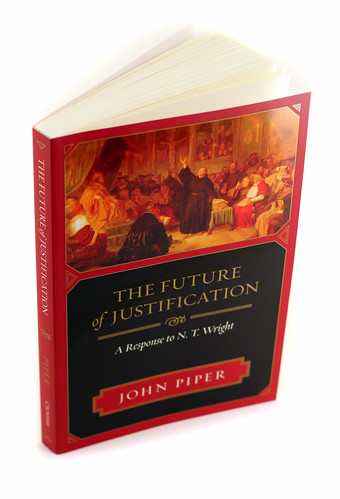
The Future of Justification by John Piper
Book review
The Future of Justification: A Response to N.T. Wright
by John Piper
 N.T. Wright is a British New Testament scholar and the Anglican Bishop of Durham, England. He’s become known for his controversial teaching on justification and for his statements like: “The discussions of justification in much of the history of the church, certainly since Augustine, got off on the wrong foot – at least in terms of understanding Paul – and they have stayed there ever since.”
Enter pastor and scholar John Piper.
Piper’s highly anticipated new book The Future of Justification: A Response to N.T. Wright (Crossway: 2007) is framed around eight fundamental questions raised in the theology of Wright:
- The gospel is not about how to get saved? (ch. 5)
- Justification is not how you become a Christian? (ch. 6)
- Justification is not the gospel? (ch. 6)
- We are not justified by believing in justification? (ch. 5)
- The imputation of God’s own righteousness makes no sense at all? (ch. 8 )
- Future justification is on the basis of the complete life lived? (ch. 7)
- First-century Judaism had nothing of the alleged self-righteous and boastful legalism? (chs. 9, 10)
- God’s righteousness is the same as His covenant faithfulness? (ch. 11)
Obviously these are monumental questions, bearing heavy consequences for the Church.
As expected, Piper walks slowly through these questions raised in Wright’s theology and returns frequently to biblical exegesis for his responses. Piper remarks in the intro that he dialogued with Wright during the process of writing the volume, even receiving an 11,000-word response on the first draft to clarify and prevent distortions (p. 10).
Before engaging
But before jumping into the debate, Piper opens the book with very humble words. He is too close to glory to waste his time winning debates and scoring publicity points. It’s a beginning that we can all learn from (see p. 13). This humble introduction is followed by an entire chapter – “On Controversy” – to explain why true Christian unity is not to be found in avoiding disagreements. Taking his cue from Machen, the Church has risen to new heights when celebrating truth within the context of controversy (p. 29).
Where Wright is right
Piper is clear and quick to point out areas of agreement. These include mutual convictions of Scriptural authority, the resurrection of Christ, the deity of Christ, the virgin birth of Christ, the opposition to homosexuality, and a big-picture understanding of the Abrahamic Covenant (pp. 15-16). And even in elements more closely related to the Gospel, Piper points out continuity. Piper writes, “There is nothing unclear about Wright’s commitment to penal substitution” (p. 48). And later, “Wright’s own words concerning penal substitution seem clear and strong” (p. 52).
Where Wright is wrong
The debate may appear to some as a trifle between one pastor/scholar and another pastor/scholar. But the implications run deep for all Christians. “This book took its origin from the countless conversations and e-mails with those who are losing their grip in this great gospel” (p. 10). Piper’s overriding argument is not that the gospel is being lost by outright dismissal, but in a gradual, incremental relaxing of the gospel due to a blurring of the biblical understanding of justification. So dangerous is this blurring, according to Piper, that at the end of the day, Wright may in fact be reinforcing Roman Catholic soteriology (p. 183)!
Piper is concerned that Wright’s biblical theology has become a grid that brings in too many extra-biblical resources to make interpretive decisions. Piper believes this approach, when it comes to understanding justification, “has not been as illuminating as it has been misleading, or perhaps, confusing” (p. 38).
Wright’s removal of justification from the gospel is also a big problem. Piper writes, “I find it perplexing that Wright is so eager not to let the message of justification be part of the gospel” (p. 82) and “Wright’s zeal to remove justification from the event of becoming a Christian” is “remarkable” (p. 95). Later, Piper highlights the missing element of Christ’s imputed righteousness in Wright’s theology.
Piper takes time clarifying the nature of legalism and the careful distinction of works and justification, a distinction not easily seen in Wright’s writings. In the end, Piper is forced to make the following clarification:
“If we make the mistake of thinking that our works of love (the fruit of God’s Spirit) secure or increase God’s commitment to be completely for us, now and in the last judgment, we compromise the very reason that these works of love exist, namely, to display the infinite worth of Christ and his work as our all-sufficient obedience and all-sufficient sacrifice.
Our mind-set toward our own good works must always be: these works depend on God being totally for us. That’s what the blood and righteousness of Christ have secured and guaranteed forever. Therefore, we must resist every tendency to think of our works as establishing or securing the fact that God is for us forever. It is always the other way around. Because he is for us, he sustains our faith. And through that faith-sustaining work, the Holy Spirit bears the fruit of love” (p. 186).
Piper devotes many pages to the Law-Court theme in justification, where great disparity between Piper and Wright becomes obvious. The book gives the reader a great overview of the most important features of the biblical gospel. A series of six related and helpful appendices conclude the book (pp. 189-225).
I’m thankful for the care taken by Piper to stay close to the issues that directly impact the clarity of the gospel message.
‘Paralyzing perplexity’
The overriding concern for Piper is not that Wright has evil intentions or is viciously dangerous. The problem is that Wright’s message confuses the gospel and breeds confusion where the Church needs to be strongest.
“I am not optimistic that the biblical doctrine of justification will flourish where N. T. Wright’s portrayal holds sway. I do not see his vision as a compelling retelling of what Saint Paul really said. And I think, as it stands now, it will bring great confusion to the church at a point where she desperately needs clarity. I don’t think this confusion is the necessary dust that must settle when great new discoveries have been made. Instead, if I read the situation correctly, the confusion is owing to the ambiguities in Wright’s own expressions, and to the fact that, unlike his treatment of some subjects, his paradigm for justification does not fit well with the ordinary reading of many texts and leaves many ordinary folk not with the rewarding ‘ah-ha’ experience of illumination, but with a paralyzing sense of perplexity” (p. 24).
Later Piper writes, “This book exists because of my own concern that, specifically in the matter of justification by faith, Wright’s approach has not been as illuminating as it has been misleading, or perhaps, confusing.” (p. 38). Even the most straightforward passages on imputation (like 2 Corinthians 5:21) are “shrouded in Wright’s misleading comments” (p. 178).
And most notably, the gospel in its application to sinners becomes vague.
“But there is a misleading ambiguity in Wright’s statement that we are saved not by believing in justification by faith but by believing in Jesus’ death and resurrection. The ambiguity is that it leaves undefined what we believe in Jesus’ death and resurrection for. It is not saving faith to believe in Jesus merely for prosperity or health or a better marriage. In Wright’s passion to liberate the gospel from mere individualism and to make it historical and global, he leaves it vague for individual sinners” (pp. 85-86).
Piper is rightly concerned that this vagueness will spread into the pulpit. “Following N.T. Wright in his understanding of justification will result in a kind of preaching that will at best be confusing to the church” (p. 165).
A fitting summary of Piper’s entire case is found early in the book.
“My conviction concerning N.T. Wright is not that he is under the curse of Galatians 1:8-9, but that his portrayal of the gospel – and of the doctrine of justification in particular – is so disfigured that is becomes difficult to recognize as biblically faithful. It may be that in his own mind and heart Wright has a clear and firm grasp on the gospel of Christ and the biblical meaning of justification. But in my judgment, what he has written will lead to a kind of preaching that will not announce clearly what makes the lordship of Christ good news for guilty sinners or show those who are overwhelmed with sin how they may stand righteous in the presence of God” (p. 15).
Conclusion
It’s right for the Church to jealously guard the clear and biblical understanding of how sinners are brought into a right relationship with God. And it’s at this critical place, over the battle for our understanding of justification as the personal application of Christ’s work to a sinner’s soul, where Wright’s theology simply falls apart. This is an error the Church cannot afford to entertain.
Whether Piper has clearly and fairly represented Wright at every detail is a conclusion I’ll leave for those more connected to the discussion. What is certain is that The Future of Justification: A Response to N.T. Wright is a book thoroughly centered on clear exegesis of Scripture on the topic of justification. You don’t need a background in the Wright/Piper debate to gain a better appreciation of – and a firmer hold on – the biblical message of the gospel.

Title: The Future of Justification: A Response to N.T. Wright
Author: John Piper
Reading level: 3.0/5.0 > moderately difficult at times
Boards: paperback
Pages: 239
Volumes: 1
Dust jacket: no
Binding: glue
Paper: white and clean
Topical index: yes
Scriptural index: yes
Text: perfect type
Publisher: Crossway
Year: 2007
Price USD: $11.99 from Monergism
ISBN: 9781581349641, 1581349645
Critical but gracious
 Adrian Warnock has an excellent post modeling how Mark Driscoll publicly pointed out theological error and the gracious and humble manner in which he did it. Very helpful.
————–
Related: Grace and the Adventure of Leadership message by C.J. Mahaney. Correction must be done in deep humility and thankfulness. The book of 1 Corinthians — where Paul is about to correct the great errors of the Corinthians — begins with these (almost unbelievable) words: “I give thanks to my God always for you because of the grace of God that was given you in Christ Jesus” (1 Cor. 1:4). “Paul was more aware of evidences of grace than areas in need of growth.” One of Mahaney’s most important messages and a must-listen for pastors.
The Reformation and the Cross
“… we need to realize that the Reformers saw nothing less than the gospel at stake. We sometimes forget what Luther, Calvin, Zwingli, and others risked in taking a stand for the gospel. They risked their very lives. Regarding the Reformers’ work as nothing more than sowing seeds of unfortunate division shows both little knowledge of and little respect for what they did. They were human, and they had their faults and shortcomings. They sinned, sometimes greatly. But they also, like the imperfect characters of the Bible, were used greatly by God. In other words, the church should be grateful for the Reformation. And in this age of religious pluralism, theological laxity, and biblical illiteracy, perhaps the Reformation is needed more than ever before.”
– Stephen J. Nichols, The Reformation: How a monk and a mallet changed the world (Crossway: 2007) p. 21

Is the Reformation over? ‘Absolutely not’
Happy Reformation Day everyone!
What better way to celebrate this sacred day than to listen to Carl Trueman being interviewed by Al Mohler over the question: Is the Reformation Over?
The interview can be heard between the 11:02-19:40 mark.
 Tony Reinke