Indexing Books (Paper/E-/Audio)

Two things I wanted to accomplish this weekend—lay a new wood floor in our main level living room and, secondly, finish the novel The Betrayal. This meant my weekend was going to be filled with the sound of carbide teeth scraping through hard wood planks and the complete solemnity of reading. If I ever write an autobiography it will be titled My Life of Books and Saw Dust. So overall it was a loud weekend and I finished the floor this afternoon. The novel will take another day.

As I opened up my computer this evening to dig out of a pile of weekend emails, I opened an email question from blog reader Alyona. It’s a good question and one I thought I would answer publicly. She writes:

I’ve been reading your blog, and after seeing a post on organizing a library, I decided to ask you a related question. How do you read (listen) to the electronic books you’ve got? I mean, while reading paper book you can underline it, write in the margins etc, but what to do with electronic ones? Since I’m living in a country with no public libraries, all my books are borrowed or digital. Can you give any advice on how to read them more productively, retain information and be able to refer to selected passages in them more efficiently? Thanks a lot and God bless you!

Wonderful question, Alyona.

Currently I archive about 2,000 e-books on my computer that are searchable and readily available whenever I need them for research. I enjoy reading books on my computer and Kindle device, but you are right, e-books and audio books pose a problem for indexing, and that’s bad news for a quote-collecting-junkie like me.

The answer to your question is yes, I do have a process. And I hope to develop my process in further detail in the near future. For now let me say I use a simple Excel database on my computer that provides me with endless empty boxes that I can fill with references. I’m aware there are computer programs that will do the same thing, but I prefer a database. It has worked well for me over the years and I have no plans to change.

I use a four-column approach. This allows me to type in relevant information for each individual quote. In the first column I type the broad category (lets say, “Grace”), then I type in the secondary and more precise category (“definition of”), and the author in the third (“Jerry Bridges”). In the fourth column I type the quote out in the box (if I will not have access to the original source) or I simply add the book title and page numbers for easy reference in the future (for print books or e-books I own).

This simple Excel database provides me with a lot of needed flexibility to archive insights, quotes, and random info I want to keep on hand. My simple four-column approach makes it possible for me to categorize various sources of media. I can archive the text from blog posts, copy-and-paste from websites, record notes on audio podcasts, note YouTube videos, capture song lyrics, file away an audio book excerpt transcript, make notes on an MP3 file that can be found in my iTunes folder, reference both electronic and print books, cite the content from pages and paragraphs and individual sentences, and I can archive even down to individual Twitter lines.

As you can see, my process allows me the flexibility to capture broadly differing sizes of information in one place. Here in the columns I will archive a reference to an entire book, a podcast, a paragraph, or a single sentence. It really does not matter the size of length of the media.

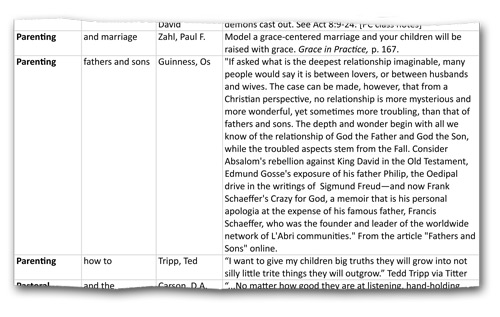
Maybe it would help to show you a picture of what a few references in my database look like when I sort them alphabetically. I’ll show you three references to parenting that I captured in the past 3 weeks.
excel-database

The first is a reference to a book in my library. I merely need a general paraphrase of the point and the page number to find it again. The second reference points to an online article. I can easily find the entire article using the excerpt I’ve copied but likely this excerpt is what I found most helpful from the article. The third reference was a Tweet published a few weeks back by biblical counselor Ted Tripp.

The challenge is to develop your own list of categories and sub-categories to provide the framework for your archive of quotes and references. This will be different for every person.

Two benefits of this system come to mind.

First, when I print the full list I can review substantial points that I never want to forget. That 20-page document of quotes contains some of the most important things I need to remember and being able to print them out and to re-read them for review is very helpful.

Secondly, this method of organizing information frees our books from the badgering questions of where to shelve them, as if books are to be shelved in a single topic. Some books—like J.I. Packer’s Knowing God—contain as many topics as there are chapters. Where would you shelve it? The four-column approach provides me the flexibility to electronically shelve it in as many topics as I wish and unburdens me from this age-old question. And I’m kicking around the idea of organizing my library by author name and keeping an extensive record of the topics in my electronic database. Pre-database I would never have considered organizing my library by author.

Well I have strayed off the path a bit in my random answer, Alyona. But is it helpful? Do you have any further questions? Thanks for reading!

The Betrayal

2009 marks the 500th birthday of Jean Cauvin. You may have noticed a lot of buzz around the reformer this year, as evidenced by the stack of new books published on Calvin in 2009. Included in that stack of new releases is one creative historical novel of the life of Calvin, The Betrayal (P&R 2009). The novel is written from the perspective of a (fictional) confidant, turned betrayer of Calvin, named Jean-Louis Mourin. But much of the book’s detail and dialog is taken straight from the letters and sermons of Calvin. The book is well written and the author pulls you into life during the period of the reformation. I hope to have it read by the end of the long weekend.

Today I’ll share an excerpt from the book that provides us a peek into how the reformation affected the average person. When I read this it reminded me of the scenes in the modern Luther movie featuring the young mom with her crippled daughter. Or the scene of the masses praying up the stairs in Rome on their knees. These little snapshots are reminders that the reformation was more than academic kerfuffle over doctrine. The doctrinal debates were vital to the reformation because they made the gospel clear, prioritized the preaching of the Word of God, and sharpened the practices of the church. And these changes directly influenced the lives of commoners. I find my appreciation for the reformation deepens when I am invited into the story to brush shoulders with fellow commoners and to view the reformation changes from their eyes.

An excerpt from The Betrayal:

——–

That evening, with torches burning, Calvin stepped before a peasant band of illiterates, who reeked of the hayfields, of laboring sweat, and of chickens. Standing before a rough stone for a pulpit, opening his Gospels, he read therein to the people. I studied their faces as they listened. For many it must have been the first time they had ever heard and understood the words they were hearing in their own language. Hence, there was wonder glowing in the cheeks of a fair maiden, there were tears of joy in the eyes of an old man, there was hunger and attention on the faces of fathers and mothers and ruddy-cheeked youths.

When he completed his sermon, I observed him—nay, I was drawn into assisting him—as he offered the bread of the Lord’s Supper to these poor folks. Scowling, I rendered up our last loaf into Calvin’s waiting hands, wondering what we would eat that night. He proceeded to break it.

“From the physical things set forth in the sacrament we are led by analogy to spiritual things. This bread is given as a symbol of Christ’s body, and as bread nourishes, sustains, and keeps the body, so Christ’s body is the only food to invigorate and enliven our soul.”

He paused, then continued. “Christ said, ‘This is my body which is given for you.’ All those here who genuinely hope in Christ alone for their eternal salvation, freely take and eat.”

When our last loaf had been mangled by the coarse hands of the attending peasants, and not a crumb remained, Calvin continued.

“When they had eaten, our Lord took up the cup and said, ‘This is the blood of the covenant shed for many. Drink all of it.'”

Beckoning me to him, he whispered in my ear for me to bring to him a bottle of wine and a cup. When I had fetched these from our cart and handed these to him, I expected Calvin to do what every priest in Christendom always did: while the peasant masses looked on in thirst, the priest quaffed the wine to the dregs. So it had, in my experience, always been. But not so John Calvin. He did the remarkable, the unthinkable.

Pouring wine into the cup, he held it in both hands and said, “When Christ sets wine before us as a symbol of his blood, we must reflect on the benefits which wine imparts to the body, and so realize that the same are spiritually imparted to us by Christ’s blood. These benefits are to nourish, refresh, and gladden our hearts. So Christ, by the mystery of his secret union with the devout, does with his blood for our souls. All you who trust alone in Christ’s blood and imputed righteousness for your salvation, take and drink.”

He extended the cup of wine to the one nearest him. The poor soul stared blankly back at Calvin. Never before in the Roman Mass had the priest so extended the cup to him. Never before had the elements in both kinds been offered to the common man. Not one of them made a move to receive the cup. Wine was for the priests, but here, for the first time in centuries, Calvin was extending the cup of wine to the peasants.

“Take and drink,” he said again. This time he took hold of the man’s hand and placed the cup in it. “Now drink,” he said kindly.

—Douglas Bond, The Betrayal (P&R 2009), pp. 251-253.

The ♥-Trust-Worthy Wife

Proverbs 31:11 says of the godly wife, “The heart of her husband trusts in her, and he will have no lack of gain.”

The passage is remarkable, writes Bruce Waltke.

“The statement, his heart trusts in her, which entails that his well-being stands or falls on her reliability, is remarkable. Outside of this text and Judg. 20:36, Scripture condemns trust in anyone or anything apart from God/the LORD (cf. 2 K. 18:21; Ps. 118:8-9; Isa. 36:5; Jer. 5:17; 12:52; 18:10; 48:7; Ezek. 33:13; Mic. 7:5). As E. Gerstenberger observed, ‘One can successfully place confidence only in Yahweh,… no other entity can be an ultimate object of trust.’ The present exception elevates the valiant wife, who herself fears the LORD, to the highest level of spiritual and physical competence. … Verset B presents the cause of his trust: he does not lack anything necessary. The surprising object, spoil, a military metaphor, implies that the woman has to win essentials like food and clothing through strategy, timely strength, and risk in this fallen world.”

Bruce K. Waltke, The Book of Proverbs: Chapters 15-31 (Eerdmans 2005), pp. 521-522.

Quite a remarkable passage indeed.

Husbands, do you trust your wife so much that you can say, with the writer of Proverbs, that you trust your wife with your heart? Yes? Let her know. Today. Right now.

Wives, are you tired from all the coupons and waiting for the right sale because money is tight? Press on with your God-glorifying strategy, strength, and risk.

Faith in Jesus. Sight of Jesus.

Through his works, Puritan John Owen has become for me a reminder of the glorious person of Jesus Christ. Whatever we comprehend of Christ by faith now is but a mere outline of the glory of His person. Owen’s subtle reminders—and sometimes not-so-subtle reminders—turn my eyes to gaze upon the glorious person of Jesus Christ and to anticipate the day I’ll see him face-to-face. In other words, the cross should point our gaze heavenward, to set our minds above, where Christ is.

In the 12th chapter of Meditations and Discourses on the Glory of Christ, Owen argues that the gospel message is a telescope that makes Christ visible, but provides us only with an imperfect outline of the glory of the person of Christ. This obscurity is due, not to the gospel’s lack of clarity, but due to the limits of faith and due to our personal sin and weakness. Owen uses this to stoke anticipation in us for the day when our faith in Jesus will be replaced by the sight of Jesus’ pure glory.

If I understand him correctly, Owen is telling us that to if we rightly understand the gospel, it will fuel in us a heartfelt desire to see Jesus. Owen seems to be saying to me, “Tony, don’t merely rejoice in justification and the wonderful doctrines of the gospel and all the benefits of Christ’s death. Look in closer. Look for Jesus. Rejoice in Him, and anticipate the day you will see Him with your own eyes.”

Hear directly from Owen:

———-

John Owen:

The view which we have of the glory of Christ by faith in this world is obscure, dark, and reflexive. So the apostle says in 1 Corinthians 13:12, “now we see in a mirror dimly,”—“through” or by “a glass, in a riddle,” a parable, a dark saying. …

The shadow or image of this glory of Christ is drawn in the gospel, and therein we behold it as the likeness of a man represented unto us in a glass; and although it be obscure and imperfect in comparison of his own real, substantial glory, which is the object of vision in heaven, yet is it the only image and representation of himself which he has left, and given unto us in this world. But by this figurative expression of seeing in a glass, the apostle declares the comparative imperfection of our present view of the glory of Christ.

But the allusion may be taken from a telescope, whereby the sight of the eye is helped in beholding things at a great distance. By the aid of such glasses, men will discover stars or heavenly lights, which, by reason of their distance from us, the eye of itself is no way able to discern.

And those which we do see are more fully represented, though remote enough from being so perfectly. Such a glass is the gospel, without which we can make no discovery of Christ at all; but in the use of it we are far enough from beholding him in the just dimensions of his glory. …

But here it must be observed, that the description and representation of the Lord Christ and his glory in the gospel is not absolutely or in itself either dark or obscure; yea, it is perspicuous, plain, and direct. Christ is therein evidently set forth crucified, exalted, glorified. But the apostle does not here discourse concerning the way or means of the revelation of it unto us, but of the means or instrument whereby we comprehend that revelation. This is our faith, which, as it is in us, being weak and imperfect, we comprehend the representation that is made unto us of the glory of Christ as men do the sense of a dark saying, a riddle, a parable; that is imperfectly, and with difficulty.

On the account hereof we may say at present, how little a portion is it that we know of him! How imperfect are our conceptions of him! How weak are our minds in their management! There is no part of his glory that we can fully comprehend. And what we do comprehend,—there is a comprehension in faith, Ephesians 3:18,—we cannot abide in the steady contemplation of. For ever blessed be that sovereign grace, whence it is that He who “commanded light to shine out of darkness has shined into our hearts, to give us the light of the knowledge of his own glory in the face of Jesus Christ,” and therein of the glory of Christ himself;—that he has so revealed him unto us, as that we may love him, admire him, and obey him: but constantly, steadily, and clearly to behold his glory in this life we are not able; “for we walk by faith, and not by sight.”

Hence our sight of him here is as it were by glances, liable to be clouded and blocked. “Behold, there he stands behind our wall, gazing through the windows, looking through the lattice” (Song of Solomon 2:9). There is a great interposition between him and us, as a wall; and the means of the discovery of himself unto us, as through a window and lattice, include a great instability and imperfection in our view and apprehension of him. There is a wall between him and us, which yet he standeth behind. Our present mortal state is this wall, which must be demolished before we can see him as he is.

In the meantime he looketh through the windows of the ordinances of the Gospel. He gives us sometimes, when he is pleased to stand in those windows, a view of himself; but it is imperfect, as is our sight of a man through a window. The appearances of him at these windows are full of refreshment unto the souls of them that do believe. But our view of them is imperfect, transient, and does not abide—we are for the most part quickly left to bemoan what we have lost. And then our best is but to cry, “the heart panteth after the waterbrooks, so panteth my soul after thee, O God. My soul thirsteth for God, for the living God: when shall I come and appear before thee?” When wilt thou again give me to see thee, though but as through the windows alas! What distress do we ofttimes sit down in, after these views of Christ and his glory! But he proceeds farther yet; and flourishes himself through the lattices. This displaying of the glory of Christ, called the flourishing of himself, is by the promises of the Gospel, as they are explained in the ministry of the Word. In them are represented unto us the desirable beauties and glories of Christ. How precious, how amiable is he, as represented in them! How are the souls of believers ravished with the views of them! Yet is this discovery of him also but as through a lattice. We see him but by parts, unsteadily and unevenly.

Such, I say, is the sight of the glory of Christ which we have in this world by faith. It is dark, it is but in part. It is but weak, transient, imperfect, partial.

—John Owen, Meditations and Discourses on the Glory of Christ. Chapter 12. Works 1:374-389.

Review: Notes from the Tilt-A-Whirl

I don’t recall the last time I sprinted to Barnes and Noble to shell out full price for a book. Come to think of it, I can’t remember sprinting for much of anything.

But that’s exactly what I did when I heard N.D. Wilson’s new book had been published early and was stocked in stores earlier than expected. I jumped in the car, drove to the nearest B+N, jogged over to the Christian / Inspiration section, scanned past Osteen’s big smiley cover shot, and down until I found the “W”s. There, out of sight on the floor-level shelf, was the store’s one copy of Notes From The Tilt-A-Whirl: Wide-Eyed Wonder in God’s Spoken World (Thomas Nelson 2009). Happy Father’s Day to me!

Wilson is a Fellow of Literature at New Saint Andrews College and the managing editor for Credenda/Agenda magazine. He’s the son of Douglas Wilson. And of all the children’s fiction authors my family reads, Wilson is one of our recent favorites. His books are a gift for families who enjoy reading together (Leepike Ridge and 100 Cupboards). [Although Notes From The Tilt-A-Whirl is not for children. I kinda guessed from the table of contents that it wasn’t, and this suspicion was confirmed by one or two vulgarities.]

The framework for the book is mixed metaphor, and Wilson piles on the metaphors with each page. Life is a bit like a carnival, a serious carnival. Or life is like the four seasons. Readers who seek a literary buzz of metaphorical intoxication will find it hard to put this book down, and once they do, may find it impossible to touch their nose with their fingertips.

Notes reads like C.S. Lewis. Like Lewis, Wilson pries our sleepy eyes open to the marvelous work of God all around us—in the snowflakes, leaves, galaxies, laughter, sunshine, ants, thunder. Wilson stops us to appreciate God’s creative handiwork one molecule and one insect at a time.

But like Lewis, Wilson nudges us into deeper waters to discuss the origin of evil, God’s purposes behind personal tragedy, the vanity of human philosophy, and the absurdity of evolution. As I have already shown you on this blog, Wilson is quick to slap philosophers around like Kip Dynamite in a Rex Kwon Do (see the post Nietzsche’s Pity for an example).

Notes is interesting as an autobiographical sketch, capturing the complexity of the inner life in short and clean sentences.

Notes is good as Theology, singing a song of praise to our sovereign God who created the wonder and majesty before our eyes.

Notes is very good as literature, featuring stunning metaphors that pile and build as the book develops.

Notes is a good example of how to develop from general revelation towards the substitutionary death of Jesus for sinners.

Notes is a very good apologetic. It may be, in the words of my friend Justin Taylor, a gospel tract for postmodern times. It will prove valuable when discussing the gospel with skeptics, atheists, or even Christians who are not running barefoot through fields of God’s creative wonder.

But unlike so many contemporary apologetic works, Wilson is careful to preserve God’s active judgment in the condemnation of sinners (see p. 179). Far too often, followers of C.S. Lewis have followed him in his ambiguity here. Wilson is careful and clear.

I suppose if I could suggest one disappointment it would be this. I kept waiting for Wilson to turn his attention to the spectacular, awe-inspiring, work of God’s voice captured in two words spoken over the blood-bought sinner—”Not guilty!” Luther rightly teaches us that justification is God’s spoken declaration. His “Not guilty!” judgment is as real as the phrase “Let there be light!” This God-spoken, reality-making, “legal fiction”-shattering, voice of God over the sinner is one of the most wonderful acts of God. Yet it was a wide-eyed wonder in God’s spoken world that seemed to go missing.

All said, Wilson’s Notes from the Tilt-A-Whirl is a rare treasure. Few living writers I’ve read match N.D. Wilson in imagination, creative articulation of orthodox theology, and ability to write in a simple prose style. That his attention has turned—however briefly—to an adult audience has resulted in a wonderfully modern, C.S. Lewis-like treasure.

Enjoy it, but beware. The book’s conclusion may leave a bad taste in your mouth.

(LOL!)

Happy reading.

———–

Title: Notes From The Tilt-A-Whirl: Wide-Eyed Wonder in God’s Spoken World
Author: N.D. Wilson
Boards: paper
Pages: 203
Topical index: no
Scriptural index: no
Text: perfect type
Publisher: Thomas Nelson
Year: 2009
Price USD: $14.99 / $10.19 from Amazon
ISBN: 9780849920073

N.D. Wilson on Writing

N.D. Wilson on writing:

“This is simplistic, but it is a starting point. Aim for the whole person. Aim for the downy hair between the shoulder blades and the grinding joints. Aim for the throat and the diaphram and the stomach. Make people nervous, breathless, and hungry. Or just mad.”

This quote was published by Wilson in a blog posts on writing. He wrote a 5-part series—“So You Wanna Be a Writer”—that will appeal largely to fiction writers, but I think these are lessons that will benefit the non-fictional writers out there, too. Here’s his series:

So You Wanna Be a Writer, Pt. 1 (Don’ts)

So You Wanna Be a Writer, Pt. 2 (For the Critics, These Pearls . . .)

So You Wanna Be a Writer, Pt. 3 (Prose for Body and Brain)

So You Wanna Be a Writer, Pt. 4 (An Exercise)

So You Wanna Be a Writer, Pt. 5 (Found Dialog)

So You Wanna Be a Writer, Pt. 6 (The Obstacle Course) NEW!