Building a Blank Bible (part 2): The Failure

The impending arrival of my precious wife’s birthday in April is what started this all. I had been kicking around the idea of the “Karalee’s Blank Bible” for the special occasion.

Since my wife and I are in the process of transitioning into a Sovereign Grace Ministries church, I decided the blank bible would need to be an English Standard Version. I chose the hardcover version with fairly thick paper.

The first step was to cut the cover off with a utility knife so all that was left were the pages and a thick line of plastic glue on the binding.

Cutting off the binding is the next step is really the key to the entire project. For a carpenter, I chose to use my table saw. I sandwiched the pages of the ESV bible tightly between two boards and set the guide on the table saw to take just 1/8th of an inch off the binding. This was enough to get the glue off completely. Without the boards pressing the binding tight, the saw would mangle the binding edge pretty badly. So it’s critical to tighten the binding down when it’s being cut off.

You can see from the following picture what the binding looked like when I was done cutting (bottom stack – bible; top stack – blank pages).


I have also tried bringing books to Kinko’s to have them cut the binding with a knife. This does not work because the knife only works with paper that freely moves (like a ream of paper). The binding of a book holds and binds in the knife causing the knife to stair-step cut the book. Sadly, I had a Greek interlinear mangled this way.

Okay, once the binding is off I go to a local office supply store. I pick out a ream of acid-free paper and show them the exact size of my bible (now cut and with loose pages). The smiley attendant behind the counter uses a big paper knife to cut the new blank pages to the exact dimensions of my bible. Then I go home and in about 45-minutes insert blank pages where I wanted them in the bible. (It does take a little concentration to keep the pages in order.)

Be careful not to forget pages or you will end up with a Jefferson Bible and not an Edwards Bible. Big difference. More about how and where I inserted blank pages tomorrow.

For “Karalee’s Blank Bible” I clamped all the pages together so the binding edge was easy to work with. Here is where my regret begins.

I chose to work with a 2-part epoxy mix that would glue the binding of the pages together. It’s a very strong mix and for a few days did a great job holding the binding together. Two days after the birthday I noticed a few cracks beginning to develop and after four days, the bible had completely split in two areas.
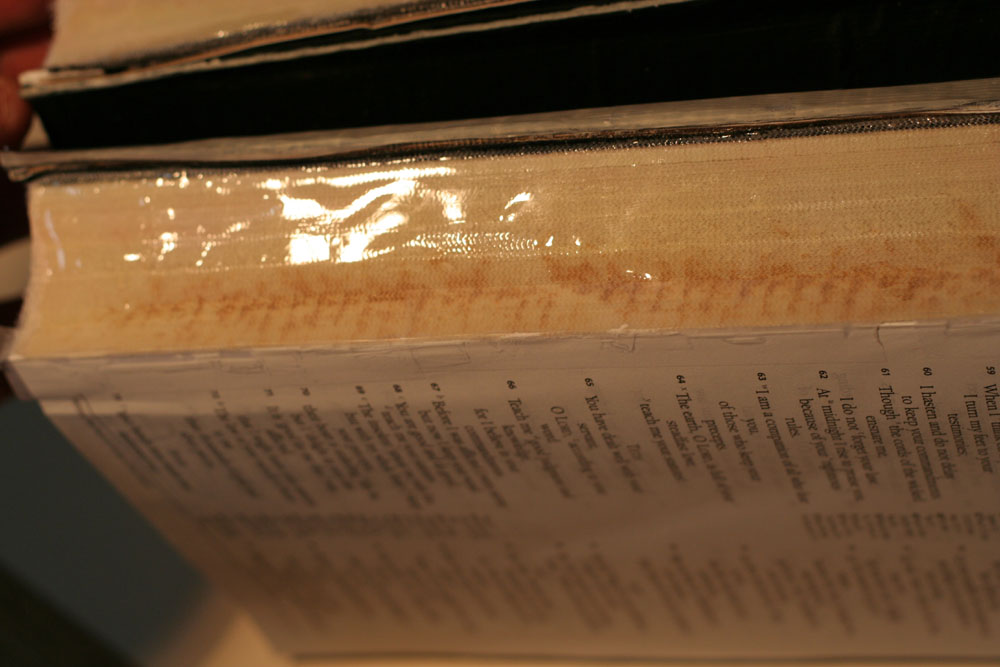
There were two prominent problems:

1. The binding was too stiff and the bible was simply not comfortable to use.

2. The binding was too risky. The bible could crack at any place depending upon how well each piece of paper was glued. Most books are bound as several little books and then bound into one big book so the demands from each page are minimal. With this binding each page must be glued well and must hold well over time. Too much to ask from paper.

I was certain I had figured out the best way to remove the binding and a good process to get blank pages cut and a good plan for where to insert blank pages in the bible. But the “Karalee’ Blank Bible” was not an heirloom-worthy project.

So back to the drawing board I went …

Building a Blank Bible (part 1)

As promised, this week I’ll be showing you how to build your very own Blank Bible. But first, why would you want one? I don’t know of any publishers who make them and it’s a little time consuming to build. So why go through the work?

Well, there are several reasons actually.

The most important reason being you can keep those precious biblical insights close to the texts they originate. I have a drawer full of notes I’ve scratched out while listening to sermons over the years. And even at times I’ve used a Moleskine notebook for the same purpose. However, notecards and notebooks are scattered and disorganized. Unless I specifically recall a sermon on a certain text, the notes are largely forgotten in a large stack.

Owning one Bible with enough room to hold your personal notes close to the Biblical texts means the next time you study Ephesians you will have the notes from a Bible study on Ephesians five years ago.

Second, a Blank Bible is a great place to collect the fruit of your own meditation. Don’t fill the Blank Bible with notes you can find in any commentary. Make the notes in this bible flow from your own personal reflection and let the commentaries point out the exegetical and technical stuff.

Third, it’s a simple fact that we remember things better if we think about them and write our recollections down. Journaling is a good example of this and the Blank Bible affords enough space.

Fourth, just as Jonathan Edward’s Blank Bible is now a national treasure, your insights may also be treasured by someone else. Whether you leave the Bible to your spouse or children or grandchildren, when you are gone your Bible will continue to speak. So think and write clearly.

Tomorrow … the first attempt at the Blank Bible. And since there will be a second I’ll assume you already know the first was a failure.

Reaching our cities with the Gospel


I think most pastors would admit that our churches can improve when it comes to reaching our community. Some of the most community-centered and creative ideas I see originate from the Acts 29 Network. Here in my home city of Omaha, NE the Acts 29 network planted a church East of 108th street, where Gospel-centered churches are quite rare (Core Community Church). Core ministers to the unfortunate, homeless and those wanting to learn English. They are doing tremendous work in the Eastern half of Omaha often neglected.

Recently I came across another impressive Acts 29 church: Oikos Fellowship in Washington. The church is producing an excellent monthly magazine for the lost of their city. As you will see the magazine is a creative way to gauge the local thoughts about Christianity and communicate the message culture needs (like Sinners in the Hands of an Angry God). The magazine also highlights local ministries. It appears all their writings, photos and graphics originated from their own people, too. You can download the August magazine here.

In a church culture often centered around programs for Christians, this ministry philosophy goes a long way, I think, in pressing the church from its comfortable weekly activities out and into the community.

Anyways, grace-centered props to Oikos Fellowship.

The church’s great danger: Wrong thoughts about God

“Wrong ideas about God are not only the fountain from which the polluted waters of idolatry flow; they are themselves idolatrous. The idolater simply imagines things about God and acts as if they were true.

Perverted notions about God soon rot the religion in which they appear. The long career of Israel demonstrates this clearly enough, and the history of the Church confirms it. So necessary to the Church is a lofty concept of God that when that concept in any measure declines, the Church with her worship and her moral standards decline along with it. The first step down for any church is taken when it surrenders its high opinion of God.

Before the Church goes into eclipse anywhere there must first be a corrupting of her simple basic theology. She simply gets a wrong answer to the question, ‘What is God like?’ and goes on from there. Though she may continue to cling to a sound nominal creed, her practical working creed has become false. The masses of her adherents come to believe that God is different from what He actually is, and that is heresy of the most insidious and deadly kind.”

– A.W. Tozer, The Knowledge of the Holy (HarperCollins: San Francisco), 1961, p. 4.

Jonathan Edwards and his blank Bible

This marks an exciting time in the study of Jonathan Edwards. The Jonathan Edwards Center at Yale University is preparing Edwards’ famous “blank Bible” for print (see video here). It will be very useful because the thoughts of Edwards will be organized exegetically. Though these volumes will be quite expensive they should also be quite valuable for the preacher of God’s Word.

(BTW, the Edwards Yale edition of his works very expensive. However, they are common in large university libraries. Here in Omaha I frequent a library with the entire set to date and many of the volumes published in the past 8 years have only been checked out once or twice!)

Anyone who spends much time in Edwards has a great respect for his ability to draw themes out of texts and cross-reference the same theme in the rest of Scripture. Every time I study Edwards I come away with a web of connections I otherwise would have never found.

I don’t have to tell you that I am no Edwards (and no Spurgeon either, while I’m thinking of it), but I do have my own blank Bible. Next week I will show you how to make a blank Bible similar to Edwards. It’s the best way to keep those Biblical insights close to the biblical texts they originate.

Have a great weekend!

Packing a small library

For me packing my library of books is the most delicate and time-consuming task in moving. Certainly it’s a pain in the neck (literally) to move their weight. But for an organization nut like myself the aches can be compounded.

Thankfully the process has been eased by using Booxter, a cheap program for my Mac OS X. I just connect my webcam (in my case a Sony digital video recorder with streaming Firewire) and the camera automatically scans the ISBN bar off the back of each book. Once the ISBN is entered, Booxter does its work, collecting a picture of the cover, author’s name, title and all types of information off the internet automatically. Entering about 20 books a minute is a real blessing!

Then I make my own genre categories to organize the library exactly the way I need it. I can even mark which packing boxes each book goes into.

You can see what I have scanned over the past few days (and take a glimpse at my book collection) here.

So if you want to organize your library and you own a Mac, look into Booxter.