Tony’s Book Club pick #4: The Knowledge of the Holy by A.W. Tozer (0060684127, book review)

Weighing in at just 3.4 ounces, Tozer’s Knowledge of the Holy is a tiny book with a heavyweight hook! Of all the great works out there on the attributes of God, this is my favorite.

I was first introduced to Tozer when I led a group of local college students through the book, The Pursuit of God (another excellent, must-read). I was drawn especially to Tozer’s simplicity, biblical depth and straight talk. In articulating the sweet communion the believer enjoys with God, Tozer communicates with a clarity no author (except maybe Martyn Lloyd-Jones) can match. Pound-for-pound, no writer provides the preacher more quotes than Tozer!

The Knowledge of the Holy is a 23-chapter, 120-page study of the attributes of God. It is the perfect size for group studies or to recommend to readers who have trouble with larger books.

Tozer covers the attributes you would expect (immutability, omniscience, transcendence, omnipresence, faithfulness, goodness, justice, mercy, grace, love and sovereignty of God). But he throws in some chapters that often are forgotten in short attribute studies, like the Self-sufficiency and Self-existence of God.

Tozer writes out of a burden that each generation holds tightly to an accurate view of God.

“Before the Christian Church goes into eclipse anywhere there must first be a corrupting of her simple basic theology. She simply gets a wrong answer to the question, ‘What is God like?’ and goes on from there. Though she may continue to cling to a sound nominal creed, her practical working creed has become false. The masses of her adherents come to believe that God is different from what He actually is; and that is heresy of the most insidious and deadly kind” (p. 4). And on the page earlier he wrote, “Low views of God destroy the gospel for all who hold them.”

Tozer’s presentation of the attributes of God is passionate because a wrong understanding of God is (as he writes) ‘deadly.’ Our generation must look beyond the creedal affirmations we inherited and ask the honest question: Who do I believe God is? And since each Christian comprises the Church, this self-examination is necessary for everyone in the church (see p. 114).

Tozer properly shows that an accurate understanding of God flows first from faith in God and the accuracy of His Word. Without faith in the impossible (the resurrection, for example) there will never be a clear understanding of who God is. In the eternal, revelation must precede reason.

The danger for our generation (and every generation) comes when we fashion God into our own golden-calf-image. God is who He is and remains who He is. And, “were every man on earth to become an atheist, it could not affect God in any way. He is what He is in Himself without regard to any other. To believe in Him adds nothing to His perfections; to doubt Him takes nothing away” (p. 33).

It is the Christian’s duty and joy to pursue this God and Tozer proves himself to be a reliable guide in the journey.

Tony’s Book Club pick #5: The Glory of Christ by John Owen (volume 1 of complete works, 0851511236)


I probably don’t need to remind you that I’m not Oprah. But if I had my own book club these would be my top picks. Yesterday I gave you a quick glimpse into my top 20. In the coming days I will give more details on my top five picks. Here then is the first installment…

————————————–

#5: The Glory of Christ by John Owen

In a pop-Christian publishing world, it is difficult to find great books exalting the beauty and excellency of Jesus Christ. Yet a study of the person and work of Christ is the most beautiful, rewarding and life-changing study for our souls.

I cherish the writings of Puritan John Owen because he forces me to love what God loves, to cherish what He cherishes and delight in what He delights. It may sound simple, but really the demands here are quite high and the product is very rare.

Owen himself gives us a good summary of the book:

“That which at present I design to demonstrate is, that the beholding of the glory of Christ is one of the greatest privileges and advancements that believers are capable of in this world, or that which is to come. It is that whereby they are first gradually conformed unto it, and then fixed in the eternal enjoyment of it. For here in this life, beholding his glory, they are changed or transformed into the likeness of it, 2 Cor. 3:18; and hereafter they shall be ‘for ever like unto him,’ because they ‘shall see him as he is,’ 1 John 3:1, 2. Hereon do our present comforts and future blessedness depend. This is the life and reward of our souls. ‘He that has seen him has seen the Father also,’ John 14:9. For we discern the ‘light of the knowledge of the glory of God only in the face of Jesus Christ,’ 2 Cor. 4:6” (pp. 287-288).

And this is the theme Owen develops for the reader.

Now, as you saw from the quote above, Owen is not easy to read. But if you are patient and willing to rephrase his concepts into contemporary language, this volume is loaded with a lifetime of sermon quotes and insights on the person and work of Christ. Even worship leaders will find much usefulness in Owen.

The volume concludes with a great and passionate plea for the glory of Christ to be applied to the reader’s heart. A study of Christology is incomplete until the invitation is offered because “wherever there is a declaration of the excellencies of Christ, in his person, grace, or office, it should be accompanied with an invitation and exhortation unto sinners to come unto him” (p. 419).

This is what sets John Owen apart from other books written on the same subject: He calls for a response. John Owen is not content to paint a biblical picture of Christ’s glory and then leave the reader alone to get the point herself. Owen closes with clear, real-life application.

Owen’s understanding of Christology demands a response from the sinner. For Owen, to continue in unbelief is to despise the glory of Christ. Standing on the sidelines and thinking you see the beauty of Christ but do not hold Christ as your own, is to despise Christ’s person and office and the wisdom of God (p. 424). In other words, the more beautiful Christ is, the more important personal faith becomes and the more heinous the sin of personal unbelief.

I love Owen because he cuts it straight. He is an expert biblical exegete but he is a compassionate shepherd of souls, too. If your soul is dry and you need to feed upon the beauty of Christ, pick up a copy of The Glory of Christ and let its truth percolate down through your heart and fuel your Christian life.

——————————–

Finding The Glory of Christ by John Owen… Over at the CCEL you can download this book for free. Or you can purchase the clothbound volume published by The Banner of Truth.

——————————–

The Glory of Christ, John Owen, Banner of Truth, complete works, 0851511236

Favorite books

I am often asked to list my favorite books. So this week I’m going to give you my top 20 and reviews of my top 5. Drum roll, please. Here are my (ever changing) top 20 favorites …

————————-

1. Holy Bible, English Standard Version. Newer translation that is excellent in many ways.

2. The Precious Things of God, by Octavius Winslow. No book more relishes in the preciousness of the eternal things. I’ll give a fuller recommendation later in the week.

3. The Everlasting Righteousness, by Horatius Bonar. Many great books have been written on justification (how sinners are made right with God). But this one, written over a century ago, is my favorite, the most passionate and the most quotable.

4. The Knowledge of the Holy, by A.W. Tozer. “Low views of God destroy the gospel for all who hold them.” Fabulous book for those who want a grand view of God. A tiny book with a heavy message.

5. The Glory of Christ (Vol. 1 of Works), by John Owen. Few things are better than to look at the depth of Christ’s beauty. Though Owen is not easy to read he is very valuable.

6. George Whitefield, 2 vols., by Arnold Dallimore. This is my favorite biography ever. Very readable. This set of books will inflame a desire to be extinguished for Christ.

7. The New Park Street Pulpit (1855-1860), 6 vols., by C.H. Spurgeon. The early sermons of the greatest preacher in church history. All of his books and sermons are recommended but these volumes are especially precious. There is a youthful zeal to the early sermons.

8. The Works of John Bunyan, 3 vols., by John Bunyan. Bunyan was an uneducated man who was imprisoned for his non-conformist preaching of the gospel. Few have plumbed the depths of the human heart deeper than him. He remains one of the greatest preachers and maybe the most famous writer (The Pilgrims Progress) in church history. These three volumes contain all of his works and require diligence and patience. To the patient these volumes contain a lifetime of treasures!

9. The Letters of Samuel Rutherford, by Samuel Rutherford. Rutherford, in my opinion, is one of the most overlooked Puritan authors. He wrote so many beautiful books and preached so many Christ-exalting sermons yet few are in print. This collection of beautiful letters was written with great spiritual insight. The Banner of Truth just released an unabridged version unavailable for many years. It will be of great use for pastors wondering how to address the Cross to specific pastoral situations.

10. Spurgeon by Arnold Dallimore. My favorite biographer (Dallimore) + my Christian “hero” (Spurgeon) = a classic! Spurgeon focused on preaching, caring for widows and orphans, training pastors for the future, etc. A man who extinguished himself for the gospel!

11. Communion with God (Vol. 2 of Works), by John Owen. Deep scholarship with a burning affection for Christ. How do we relate and respond to God personally? This is the question that he answers thoroughly.

12. The Works of Jonathan Edwards, 2 vols., by Jonathan Edwards. The greatest American theologian. These two works contain many of his best sermons and books. A lifetime of eternal gems are here contained for the patient reader. Though I also recommend preachers purchase a few of the Yale edition volumes (Donald Whitney especially suggests vol. 14).

13. Jonathan Edwards: A Life by George M. Marsden. A fabulous biography whose author shows tremendous spiritual sensitivity while looking at the life of America’s great theologian/preacher.

14. God’s Passion for His Glory by John Piper and Jonathan Edwards. Not one of Edward’s easiest books to work through but a very powerful one. God does everything for Himself. Gets to the heart of the most important reality we can ever comprehend – that God loves nothing more than Himself. (A special thanks to my friend Rick Gamache for his editing of the book).

15. The Holiness of God by R.C. Sproul. A classic book that allows the heaviness of God to come down upon the reader.

16. Transforming Grace by Jerry Bridges. A transforming book.

17. The Message of the Old Testament: Promises Made by Mark Dever. A new book of Dever’s sermon manuscripts covering a broad and sweeping overview of the Old Testament. This book has drawn the Old Testament together for me in great ways. I now see the cohesive big picture like never before!

18. The Confessions by Augustine (Maria Boulding translation). Great classic and from what I am told this is the first true autobiography in history. In this book a sinner’s soul is honestly opened for all to see.

19. Systematic Theology by Wayne Grudem. I like Reymond, Erickson and others, but this is my favorite systematic. I also really like what Jeff Purswell did in editing it into the book Bible Doctrine.

20. Lectures to My Students by C.H. Spurgeon. No pastor should be allowed to lead a church who has not read it at least 10 times.

Now you tell me. What are your top 5 favorite books ???

Why be Cross-centered?

Near the end of His earthly life, Jesus gave His perplexed disciples the precious words now synonymous with the Lord’s Supper: “And He took bread, and when He had given thanks, He broke it and gave it to them, saying, ‘This is My body, which is given for you. Do this in remembrance of Me.’ And likewise the cup after they had eaten, saying, ‘This cup that is poured out for you is the new covenant in My blood’” (Luke 22:19-20).

For the disciples, Jesus’ anticipation of an impending Cross was as comprehensible to them as a toddler flipping through a microbiology textbook. For them the importance of the Cross will remain shrouded until after the Resurrection.

In these words, Jesus reveals the prominence of the Cross in His thinking. The disciples may have been confused but Jesus was fully aware that He would soon be forsaken by earth, forsaken by heaven, and hang alone between them both.

In other words, Jesus had a full awareness of the coming Cross. His consciousness included a detailed appreciation of His own death and an expectation of its painful details. His lonely ‘quiet times’ must have certainly been filled with meditations on Isaiah 53, as His own prophetic biography was laid out in the ancient Hebrew words. “Crushed” and “stricken” were in his immediate future.

So let’s pause right here and ask the question: Why are we Cross-centered? Why are the greatest songs we sing filled with the crucifixion event? Why do our sermons drip with the blood of the Lamb who was slain? Why do we exult in the foolishness of God and endure the rebuke of the world? Simply stated, we are Cross-centered because Christ was Cross-centered.

John Stott in his magnum opus The Cross of Christ (IVP: Downers Grove, IL) writes: “Why do we ‘cling to the old rugged cross’ (in the words of a rather sentimental, popular hymn), and insist on its centrality, refusing to let it be pushed to the circumference of our message? Why must we proclaim the scandalous, and glory in the shameful? The answer lies in the single word ‘integrity.’ Christian integrity consists partly in a resolve to unmask the caricatures, but mostly in personal loyalty to Jesus, in Whose mind the saving cross was central” (p. 43).

Living the Cross-centered life is to strike the dart squarely on the bull’s-eye upon which Christ focused His life, ministry and death. Loyalty to Jesus demands that we see the centrality of the Cross in everything because He saw the Cross as central to everything.

This, according to Stott, is the loyalty expected from all Christians and churches whether or not we fully understand the implications right now and whether or not the Cross-centered life is easy or hard. To aim at anything else is to hit a mere caricature of our purpose in life.

So live Cross-centered with confidence:

– Teach the forgiveness and grace of the Cross when disciplining your children.
– Preach the Cross to yourself when condemnation and personal sin haunt your heart.
– Love your wife as Christ loved the church, modeling the sacrifice of the Cross.
– Build friendships with believers and unbelievers with the Cross as the ultimate purpose.
– Boast and rejoice in the Cross as the heartbeat of your life as its lifeblood flows to warm the lukewarm heart.

Whether we can or cannot understand the full plan of God right now, we can rest assured that living a Cross-centered life is the purpose driving the Christian life!

Simply put: Live the Cross-centered life. It’s what Jesus would do.

tsr

Bob Kauflin on the spiritual gifts

An excellent and humble blog post from Bob Kauflin over the issue of spiritual gifts (he has a list of excellent resources as well). If for no other reason, just watch as he makes the main thing the main thing in a conversation where everything but the main thing often becomes the main thing.

And speaking of gifts and Bob Kauflin, grace-centered props on the excellent new CD, Valley of Vision.

“Only Jesus!”

Building a Blank Bible (part 3): The Blank Bible

… So here I was with three cut up ESVs. One is now lost, two remain and no successful blank bible. I needed a bible with a more comfortable binding and maybe even the option of adding more pages this time.

I made several calls to binding experts around town but none of them responded in confidence that a 2,100 page bible could be rebound without pages falling out and other future problems.

The future of the “Karalee’s/Jonathan Edwards’ Blank Bible” was looking doubtful. But maybe I was overlooking the simple solutions?

I could use a 3-hole binding system, but three-hole binders can get very big, bulky and awkward and the rings are always in the way of notetaking. The goal here is compact. And I don’t think the bible paper would last long with such a simple binding.

After one week of deliberation I decided to pursue one very common solution for my next attempt: Spiral binding. This was not a new option to me. Being someone who enjoys reading at the gym while doing cardio, I have cut bindings off and spiral bound several books so they lay flat (‘Industrious’ some would say. ‘Nerdy’ others would say).

So I took another cut ESV and had blank pages made. Then I inserted the blank pages. Here was my strategy …

Gen-Lev = 1 blank page between each page
Josh-Job = 1 blank page between each page
Ps-SS = 1 blank page between each page
Isa 40-66 = 1 blank page between each page
Jer-Eze = 1 blank page between each page
Matt-Acts = 1 blank page between each page
Rom = 2 blank pages between each page
1 Cor – 2 Cor = 1 blank page between each page
Gal – Eph = 2 blank pages between each page
Phil – Rev = 1 blank page between each page
Each OT book has at least 2 pages at the beginning of the book.

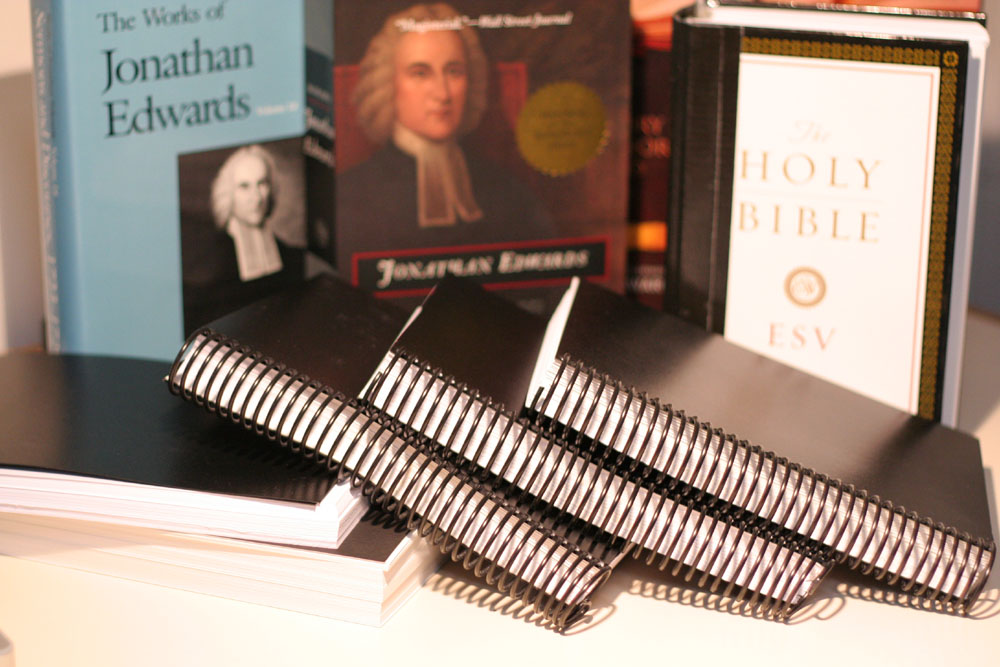
Then back to the office supply store. It took me about 90 minutes to spiral binding punch my Blank Bible (not to be confused with comb binding). Although I searched online and found some 3” spiral binding coils, they were expensive and required a bulk purchase. So I decided to stick with the 1-1/4” coils, the largest common size. This split the growing bible into three volumes (a perfect separation into Gen-Job, Pss-Mal, Matt-Rev). I now appreciate the three-volume format more than at the time.

It was simple to punch and coil the volumes. The final dimensions: 3” thick weighing 3 lbs. 13 oz (I used this ESV bible in all attempts – excellent paper for a project like this).

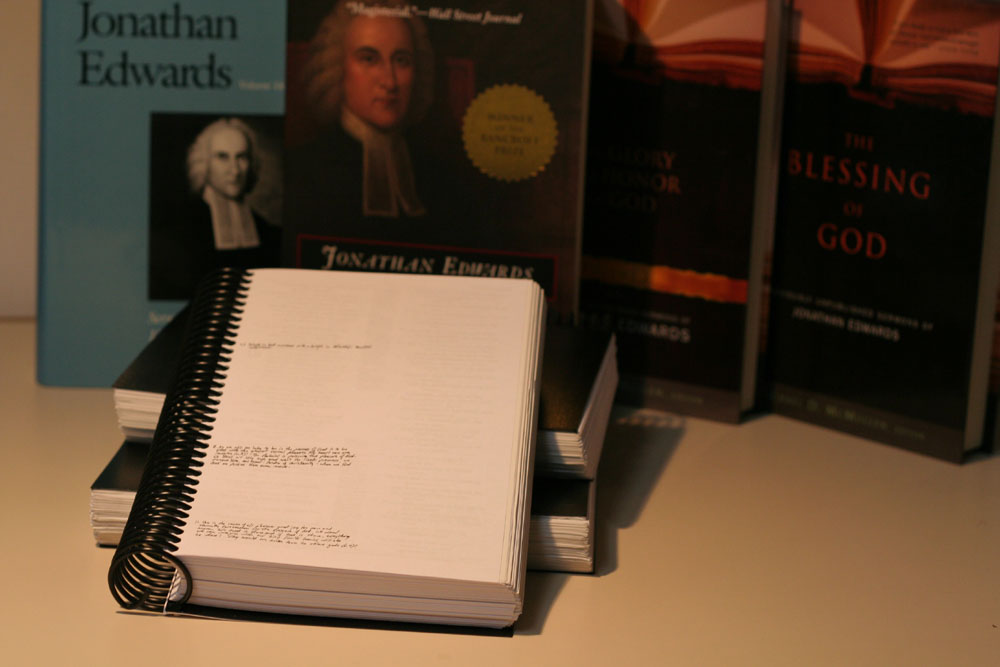
Here is a picture of my first successful “Blank Bible.”

The spiral coils handle very well with the thin bible paper, and they allow the bible great freedom in movement. In general, the bible is very comfy. Taking notes in this bible is graceful, as opposed to the last attempted Blank Bible and even 3-ring bound bibles. I can completely open the bible, giving me full use of each blank page. Because the binding is removable, I can add/replace/subtract pages in the future. Overall, this bible is a good fit for me.


Speaking of note taking (which is really what this bible is all about), I use a special Pigma Micron 005 pen. They come in several colors, are not expensive and available at most art and scrapbook stores.

So this is the story of my Blank Bible. I’m not done, though. In the future I want to try a 3” binding coil to see how the bible feels as a single volume. And I am working with a local university claiming they can bind the bible using an old sewing technique. I’m not sold yet, but it seems to me that even with all these options I will probably return to my 3-volume coil bound bible.

Your turn. What would Edwards say? (Besides the fact that I used a lot of very nice, clean paper). Let me know below. How can the Blank Bible be improved? Why would this fit or not fit your needs? Any ideas or suggestions?