Morning Thoughts and Evening Thoughts by Octavius Winslow

Book review (from 2007)
Morning Thoughts and Evening Thoughts
by Octavius Winslow

Over the past five years, Reformation Heritage Books (Grand Rapids, MI) has become a household name in reformed publishing. It was RHB, under the direction of Dr. Joel Beeke, that brought us the Works of Thomas Goodwin 12 volume reprint (2006), The Inner Sanctum of Puritan Piety by J. Stephen Yuille (2007), Jeremiah Burrough’s commentary on Hosea (2006), The Path of True Godliness by William Teellinck (2003), A Sweet Flame: Piety in the Letters of Jonathan Edwards (2007) and the other ‘Profiles in Reformed Spirituality.’ RHB produced the 2006 TSS book of the year, Meet the Puritans, by Beeke and Randall Peterson.

Another noteworthy achievement from this five-year span is the re-typeset and newly reissued devotionals written by Octavius Winslow — Morning Thoughts (2003) and Evening Thoughts (2005). These two volumes, first published 150 years ago, should be considered some of the best devotional literature in print today.

Octavius Winslow (1808-1878)

Winslow enjoyed a lengthy ministry as a pastor and writer. His many books all rise to peak expressions of the beauty of our Savior. Rich reformed spirituality saturates each page and few authors have risen to his levels of sustained doxological expression of thanks for the Cross, of sobering real-life reminders of living under the Cross, and helping the reader draw spiritual strength from the Cross.

Several years ago, at a time when I needed to learn how to affectionately respond to my growing theology, I was told to read The Precious Things of God (incredibly it remains out-of-print). This was my introduction to Winslow and it made a significant impact on my soul. became, from that point onward, one of my favorite books apart from Scripture. It continues to be–I think–Winslow’s greatest achievement although it’s one of the most difficult of his books to find in printed form [although it is available as online text, at Google books, the Internet Archive, and now on the Kindle].

Morning Thoughts and Evening Thoughts both capture this same warm spirituality of Winslow. It’s no surprise his many works are accessible online for free. Thankfully this has not prevented many of his works to be reprinted by multiple publishers like Banner of Truth and Tentmaker. Just recently RHB has edited, re-typset and reprinted The Fullness of Christ (2006) and Our God (2007). Both are classics!

Morning and Evening

A morning with Christ is the best way to begin a day with Christ. But the evening devotions – oftentimes overlooked – play an important role as well. Winslow begins the second volume by looking to the evening temple lamb sacrifice as our pattern. “The one lamb shalt thou offer in the morning, and the other lamb shalt thou offer at even” (Num. 28:4 KJV).

“The devout Israelite was thus taught to close the day as he began it: with a sacrifice for sin” Winslow writes in the preface to Evening Thoughts. “Jesus, the sacrificial Lamb of God, meets this new and depressed condition of the believer. To Him how blessed, before slumber seals the eyelid, to take all the sins, the imperfections, the wanderings of the day, and with a fresh believing view of the cross lie down peacefully and repose beneath a loving, forgiving Father’s care!”

Specs

These two devotionals were originally published in 1856 and 1858. The selections are hand-picked by Winslow from his pre-existing works. They begin with a passage (KJV) and then expound one or two principles from the text at hand. The text has been re-typeset and slightly edited to increase the readability of Winslow’s writing.

Morning Thoughts was originally published in a larger print to accommodate an elderly audience (approximately 14 pt font). The text in the second volume, Evening Thoughts, was shrunk because of space limitations (approximately 12 pt font). The sharp re-typeset editions make them easy to read in either size.

The readings are short (2+/- pages each) and I normally read them slowly, and always I read them twice.

Both volumes are similar in size and construction. Morning Thoughts is 788 pages and Evening Thoughts is 733 pages in length. Both are hardcover and feature durable Smyth-sewn binding and very clean white paper. An index to all main Scripture citations is found at the end of the second volume. There is no topical index, which would have been helpful for preachers and readers using the devotionals as a reference.

Editing

The text is only slightly edited and eliminates minor hindrances to readability. One example will highlight this. Here is the original text from the morning of January 7th:

“The Atonement itself precludes all idea of human merit, and, from its very nature, proclaims that it is free. Consider the grandeur of the Atonement- contemplate its costliness: incarnate Deity- perfect obedience- spotless purity- unparalleled grace and love- acute and mysterious sufferings- wondrous death, resurrection, ascension, and intercession of the Savior, all conspire to constitute it the most august sacrifice that could possibly be offered.”

And here is the edited RHB text:

“The atonement itself precludes all idea of human merit, and, from its very nature, proclaims that it is free. Consider the grandeur of the atonement, contemplate its costliness: incarnate Deity, perfect obedience, spotless purity, unparalleled grace and love, acute and mysterious sufferings, wondrous death, resurrection, ascension, and intercession of the Savior. All conspire to constitute it the most noble sacrifice that could possibly be offered.”

Notice the many dashes are removed for commas and “august” is replaced with a more contemporary word “noble.” On the whole, the editing is minimal but effective.

Benefits

Winslow was particularly skilled at broad application to hit each reader. He would apply one theme across a wide spectrum of saints in various life situations – the joyful, the suffering, the lazy, the struggling, the young and the old. These volumes will appeal to a broad readership and will make great general gifts for Christian friends. The choice selections are easy-to-read and will suit family reading times. Even small children can easily follow the beautiful selections. And family prayer will be compelled from these powerful readings. Pastors will find here a wealth of quotable material.

It’s with great joy I recommend Morning Thoughts and Evening Thoughts.

——————

Title: Morning Thoughts (1856) / Evening Thoughts (1858)
Author: Octavius Winslow (1808-1878)
Editors: Joel R. Beeke and Kate DeVries
Reading level: 1.5/5.0 > excellent editing makes them very readable
Boards: hardcover (not cloth)
Pages: 788 / 733 = 1,521
Volumes: 2
Dust jacket: no
Binding: Smyth-sewn
Paper: very white and clean
Topical index: no (would be helpful)
Scriptural index: yes (for both volumes at end of Evening Thoughts)
Text: perfect type, re-typeset
Publisher: Reformation Heritage Books
Year: 1856 and 2003 / 1858 and 2005
Price USD: $20.00 from RHB / $20.00 from RHB
ISBNs: 1892777290 / 1892777452
The Inner Sanctum of Puritan Piety: John Flavel’s Doctrine of Mystical Union with Christ

tsslogo.jpgBook Review
The Inner Sanctum of Puritan Piety: John Flavel’s Doctrine of Mystical Union with Christ
by J. Stephen Yuille

At the very heart of Puritanism is the saints’ mystical union with Christ. We are in Christ! He is our wisdom, our righteousness, our sanctification, our redemption. From this union to Christ we experience all the blessings and delights of communion with God and find spiritual vitality for obedience, prayer, ministry and sacrificial love. This powerful union is mystical because we cannot see it with our eyes. It is a spiritually-revealed truth.

Puritan John Flavel is certainly one of the most valuable (and perhaps one of the more overlooked) of the Puritans. The theme of mystical union with Christ is threaded throughout his entire ministry. A study of Flavel on this theme has become one of my favorite books of the year: The Inner Sanctum of Puritan Piety: John Flavel’s Doctrine of Mystical Union with Christ by J. Stephen Yuille (Reformation Heritage, 2007).

John Flavel (1628-1691) had an eventful life on the run as a nonconformist preacher (see Beeke’s bio of Flavel here). He is remembered for his books The Mystery of Providence, The Method of Grace, Christ Knocking at the Door of the Heart, The Fountain of Life, and Keeping the Heart. His complete works are still in print and available from the Banner of Truth in six volumes. These works remain strikingly valuable for contemporary readers. Almost a year ago I wrote this review.

Back to our specific theme. Martyn Lloyd-Jones wrote, “If you have got hold of this idea [i.e., mystical union with Christ] you will have discovered the most glorious truth you will ever know in your life.” It is glorious because it reminds us that in all things, at all times, Christ is central to our lives. All of our spiritual vitality and life comes through Christ. Christ is the “Head” from whom the whole Body is nourished, knit together and grows (Col. 2:19). Paul’s phrase for Christ is simply “who is your life” (3:4) and says our lives are hidden in Christ (3:3). This glorious truth of being united to Christ is at the core of the Christian life.

And Flavel “got hold” of this idea. It became central to his ministry and from this center flowed his understanding of pursuing obedience, prayer and communion with God. Now, Yuille has taken the highlights of Flavel’s teaching on this theme and systematized them into one short volume (128 pages).

Yuille covers the full spectrum of the doctrine in this book. I have taken the index and provided it to the right (click for larger image). The comprehensiveness of this volume does not make it unreadable or overly academic. Yuille is a professor at Toronto Baptist Seminary, but he is also a pastor and this book shows the intellectual awareness of a scholar and the experiential sensitivities of a pastor.

Whether this is your introduction to the full scope of the mystical union with Christ, or your introduction to John Flavel (or both!) this short work will richly bless your soul. Yuille has well-captured the precious truth of our union with Christ through the ministry of a first-rate Puritan. The result is a contender for the 2007 TSS book of the year award.

———–

Title: The Inner Sanctum of Puritan Piety: John Flavel’s Doctrine of Mystical Union with Christ
Author: J. Stephen Yuille (forward by Michael A. G. Haykin)
Table of Contents: scanned and posted online by TSS [click here]
Reading level: 2.75/5.0 > moderate
Boards: paperback
Pages: 128
Volumes: 1
Dust jacket: no
Binding: glue
Paper: normal
Topical index: yes
Scriptural index: no
Text: perfect type
Publisher: Reformation Heritage Books
Year: 2007
Price USD: $12.00/$9.00 from RHB
ISBNs: 9781601780171

Signs of the Spirit by Sam Storms

Book review
Signs of the Spirit by Sam Storms

Published in 1746, Jonathan Edwards’ Religious Affections remains the great masterpiece on biblical discernment. Edwards exposes the inner workings of the soul, using Scripture to make concrete the contrast between the fleeting affections of a hard hypocritical heart and the enduring affections of a softened and converted heart. The precise dissection of the soul in Religious Affections is one of the enduring characteristics of Edwards intellectual brilliance and a precision warranted from such delicate matters. But many contemporary readers (like this one) have found Edwards’ intellectual precision difficult to read.
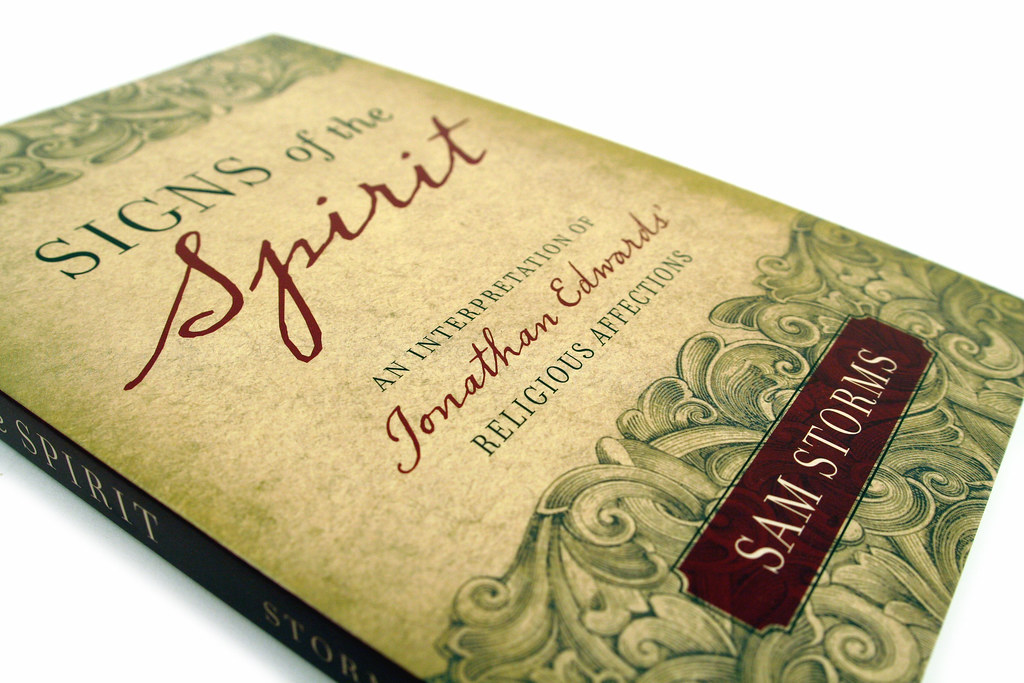

In his new release, Signs of the Spirit: An Interpretation of Jonathan Edwards’ ‘Religious Affections’ (Crossway: 2007), Sam Storms has written an excellent guide through Edwards’ rich arguments. Storms is noted for his study of Edwards and has worked through the Religious Affections at least 10 times (p. 12).

But Storms is not enthralled with the genius of Edwards. He begins the book with clear, foundational biblical exposition and carries biblical proof throughout the entire work. Genuine discernment of the true work of God finds its basis in God’s Word, not Edwards. Storms’ careful biblical development deserves applause.

From here Storms builds a historical backdrop to Religious Affections and then defines affections, finally concluding that affections are the “warm and fervid inclinations that reveal the fundamental orientation of the human heart” (p. 44). Storms follows the design of Edwards in explaining the 12 signs that don’t necessarily authenticate the work of God in the soul and the 12 signs that do authenticate the genuine work of God in the soul. Genuine God-given affections are lit by the flame of God Himself, an enduring flame that displays itself in genuine love and admiration of God as He exists in His spectacular beauty. True religious affections will reveal themselves by causing us to hate sin and pursue Christ-likeness, driving our appetite for more of God and to pursue the sweetness in the Person and Work of Christ.

Edwards’ personal testimony of these religious affections comprise the final 80 pages.

Religious Affections is always relevant but especially in our day when “Christianity” is often defined by outward affiliations, church strategies, and cultural relevance. Edwards’ reminder to our era is that genuine Christianity is marked by a radical soul transformation. Christianity is not defined pragmatically by what it offers and what we get. More important than marketing Christianity as a list of exclusive benefits, Edwards understands that a true work of God begins with a vision of God in His unspotted glory and supreme majesty.

“We must, therefore, be careful that our primary joy is in God, as he is in and of himself, and not in our experience of God. That we have been made recipients of his grace and are enabled to behold his beauty is a marvelous thing indeed. But it is secondary and consequential to a recognition of God’s inherent excellency. What brings you greatest and most immediate delight: your experience of a revelation of Christ, or Christ revealed?” (p. 92)

Discerning this genuine work of God is essential for every generation of Christians, and Edwards’ timeless truth has now been made more accessible. But don’t misunderstand. If reading Religious Affections is climbing the face of Mount Everest, reading Sam Storms’ interpretation is climbing the rock wall at REI. There is a harness, air conditioning, engineered footholds and an attendant holding the rope, but you’ll still sweat.

Storms’ timing is excellent. Our generation needs Edwards to help us ground our discernment between the facade of inauthentic Christian profession and the genuine work of God in the soul.

“I doubt if there is a more pressing and urgent issue for the church today than determining ‘what are the distinguishing qualifications of those that are in favor with God, and entitled to his eternal rewards.’ Or to put it in other words, what is the nature of true spirituality and those features in the human soul that are acceptable in the sight of God?” (p. 37)

I think he’s right.

Title: Signs of the Spirit: An Interpretation of Jonathan Edwards’ ‘Religious Affections’
Author: Sam Storms
Reading level: 3.5/5.0 > moderately difficult
Boards: paperback
Pages: 238
Volumes: 1
Dust jacket: none
Binding: glue
Paper: normal
Topical index: yes
Scriptural index: yes
Text: perfect type
Publisher: Crossway
Year: 2007
Price USD: $15.99 from Crossway (includes free PDF)
ISBNs: 9781581349320, 1581349327

Book Review: The Truth of the Cross by R.C. Sproul

tsscertified.jpgBook Review
The Truth of the Cross by R.C. Sproul

[CCC: This book has been certified “Cross Centered” by The Shepherd’s Scrapbook meaning a substantial amount of its content directly relates to the perfect work of Christ as our Atoning sacrifice.]

————-

For me there is no redundancy with the message of the Cross because I am personally aware of my propensity to meander from the Cross rather than marvel in the Cross. To this end, R.C. Sproul’s latest book – The Truth of the Cross (Reformation Trust: 2007) – is a welcomed addition to the releases of 2007. Sproul explicitly states the centrality of the Cross at the outset:

“Within that field of study, when we want to get at the aspect that is most crucial, the aspect that we may call the ‘crux’ of the matter of Jesus’ person and work, we go immediately to the cross. The words crucial and crux both have their root in the Latin word for ‘cross,’ crux, and they have come into the English language with their current meanings because the concept of the cross is at the very center and core of biblical Christianity. In a very real sense, the cross crystallizes the essence of the ministry of Jesus … I doubt there has been a period in the two thousand years of Christian history when the significance, the centrality, and even the necessity of the cross have been more controversial than now. There have been other periods in church history when theologies emerged that regarded the cross of Christ as an unnecessary event, but never before in Christian history has the need for an atonement been as widely challenged as it is today” (pp. 2-3, 6).

Sproul makes no mention of the New Perspectives of Paul, N.T. Wright or others in the contemporary debate over the Atonement. The Truth of the Cross was intended as a lay-level reinforcement against modern attacks.

As expected, references to Christian giants like Anselm, Calvin, Luther, Aquinas and Augustine abound in this little volume, bringing Sproul’s keen historical perspective to the central matters of the Cross. Chapters focus on the justice of God, the ‘cosmic treason’ of our sin, our captivity to sin and need of redemption, the substitutionary work of Christ on the Cross, the Old Testament pointers to the Suffering Servant, a chapter defending Limited Atonement and then closes with a chapter of various questions and answers. Not surprising Sproul illuminates his subject with fresh illustrations and pointed personal applications of the Cross.

Good books challenge conventional thinking and at one place I was especially challenged. Late in the book Sproul is asks if God can die, a question prompted by the hymn lyrics, “How can it be that thou, my God, shouldst die for me?” To this question Sproul offered an argument in denial: “We should shrink in horror from the idea that God actually died on the cross. The atonement was made by the human nature of Christ” (p. 160). This caused me to stop and think for a while because I personally have no problem with the hymn lyrics. Paul tells us that “the Lord of glory” was crucified (1 Cor. 2:8). And in Acts 20:28 Paul tells us God has shed His own blood in the act of redemption. On this exegetical basis Calvin rightly warns us from peeling apart the two natures of Christ on the Cross (see Calvin’s commentary on Acts 20:28). That the God-man died for sinners is horrific, but not for its probability.

Where Sproul shines is by reminding us of the incomprehensible value of God’s holiness and justice. At the end of a chapter devoted the destruction of Sodom in Genesis 18:22-19:29, Sproul writes, “The Bible tells us that God couldn’t find ten righteous people among all the inhabitants of these cities. As a result, God’s judgment fell. It fell not because God is cruel, harsh, or lacking in love. It happened because God is just and righteous” (p. 28).

As we have seen recently, the penal substitutionary Atonement of Christ will only be questioned if we fail to grasp the pristine holiness of God and His perfect righteousness. “Because He is holy and righteous, He cannot excuse sin. Rather, He must pass judgment on it. The Judge of all the earth must do right. Therefore, He must punish sinners — or provide a way to atone for their sin” (p. 29). Sproul especially excels here.

Conclusion

The Truth of the Cross is an excellent overview of the Gospel. God is holy, sinners are in need of salvation from the guilt of their sin found only in the death of Christ, displaying the wisdom of God to the world. We need more books like this one — books that step into the heart of contemporary debate on the Atonement to clarify the most pristine truth at the heart of everything we cherish!

Sproul is known for his chalkboard and a passion to educate laypeople. He wants you to understand expiation, ransom, redemption, reconciliation, appeasement, substitutionary atonement, and propitiation because these are central to understanding the gospel. In Sproul’s newest book – The Truth of the Cross – you will discover the beauty of the crux like never before. But even more importantly, Sproul understands the implications to our faith if we don’t get it.

“A Substitute has appeared in space and time, appointed by God Himself, to bear the weight and the burden of our transgressions, to make expiation for our guilt, and to propitiate the wrath of God on our behalf. This is the gospel. Therefore, if you take away the substitutionary atonement, you empty the cross of its meaning and drain all the significance out of the passion of our Lord Himself. If you do that, you take away Christianity itself” (p. 81).

———–
[Related: Another “TSS Certified Cross Centered” book by Sproul — Saved from What? (Crossway: 2002) – is worth the investment.]
———–

Title: The Truth of the Cross
Author: R.C. Sproul
Reading level: 2.25/5.0 > moderate
Boards: hardcover
Pages: 178
Volumes: 1
Dust jacket: unknown (reviewed electronically)
Binding: unknown
Paper: unknown
Topical index: no
Scriptural index: no
Text: perfect type
Publisher: Reformation Trust
Year: 2007
Price USD: $15.00 from Ligonier
ISBN: 1567690874

Review: John Brown of Haddington

My review of The Systematic Theology of John Brown of Haddington was published today at takeupandread.com. Brown’s theology is best remembered under the title A Compendious View of Natural and Revealed Religion. Read more here: takeupandread.com.


I found the Banner of Truth autobiography/biography very useful in my research. The Life of John Brown (1856/2004) was edited by his son William Brown (the same man who slightly abridged Richard Baxter’s Reformed Pastor now published by the Banner of Truth). It provides useful historical information about Brown’s extraordinary life and several rich letters and meditation essays written by John Brown. If the life of John Brown interests you, I recommend this volume (ISBN: 0851518575).


Review: Church History by Christopher Catherwood

Book Review
Church History: A Crash Course for the Curious
by Christopher Catherwood

Christopher Catherwood is a tutor for the Cambridge University Institute of Continuing Education and the maternal grandson of preacher Martyn Lloyd-Jones (1899-1981). You may own more of Catherwood’s books than you realize because while being recognized for his own authored books, he has edited a number of his grandfather’s sermons into printed volumes (Life in Christ: Studies in 1 John being one example of his editorial work). His latest book is titled Church History: A Crash Course for the Curious (Crossway: 2007) and I recommend it for several reasons.

As you can tell from its title, this book is a very easy-to-read history of the developments of the church from Christ until today. It is useful as a brief but engaging overview of church history and will fit well into a home schooling curriculum.

In Church History, he paints an engaging picture of the contemporary, global Christian church. For example, he lets the reader peak into Chinese Christian culture and the struggle between the underground church and the state-approved “Three-Self Patriotic Church.” Are Christians compromising their beliefs to be in the state-approved church? Questions like this specifically, and the state of the church in the East generally, are very interesting and worldview broadening.

Catherwood carefully explains the ever-changing contours of global Christianity. For example he reminds us of the North Africa town of Hippo – which was once an “overwhelmingly Christian” town made famous by Augustine – is now “overwhelmingly Muslim.” “We are so used to thinking of places such as Iraq (then called Mesopotamia), Egypt, and Syria as Muslim, we forget that they were once the heartland of the Christian world” (50). The shifting contours of the global Christian community are directly tied to waves of Islamic invasions that began in the seventh century. The influence of Islam upon church development is reiterated throughout.

Catherwood pinpoints key events in church history and lets them run out into contemporary lessons. For example, in 312 Constantine legalized Christianity in the Roman empire, making it both safe and publicly fashionable to be Christian. However, negatively this act wed politics to the church. This danger continues to hold when (as in the United States) the church is regularly identified by its political clout (41-42). The reader may not agree with all the conclusions but there is no question Catherwood excels at tying key events in the long history of the church with contemporary events. He will make you think.

Being a reformed historian, Catherwood is theologically careful. He clearly defines the continuing doctrinal dangers of Roman Catholicism especially its “hagiolatry” (worship of saints) and its “Mariolatry” the teaching that Mary was the Mother of God, something that has only recently — since 1950 — become official dogma in Roman Catholicism (81). And, to my knowledge, this is the first Christian history that accurately categorizes Mother Theresa as a universalist (202). Even in light of Vatican II (1962-1965), “Theologically, from a biblical point of view, nothing really changed since the key Catholic doctrines to which Protestants have objected since the Reformation did not change” (198). But Catherwood also reminds us that each and every heart is susceptible to giving undue honor and worship to someone other than God. He calls us to search our own hearts, lest we be committing hagiolatry with St. Spurgeon or St. Calvin (80).

But for me this book is most helpful because it understands Christian history from a reformed perspective, making God’s sovereign grace central to the development of the church. While some historians point to the printing press or German nationalism for the spread of the Protestant Reformation, Catherwood understands “they are all secondary to the main reason – the work of God” (89). And later, “the return to biblical truth in the reformation was a wonderful act of God” (105). The reader comes away from this book with a deeper sense that God’s hands have shaped the church into what she is today.

Call me curious, but once I picked this book up I couldn’t put it down. Catherwood is downright engaging. You will not agree at every turn, but he will make you think as he broadens your perspective of the global church and how God has shaped the church by key events and people over the past 2,000 years.

———-

Title: Church History: A Crash Course for the Curious
Author: Christopher Catherwood
Reading level: 1.75/5.0 > easy
Boards: paper
Pages: 224
Volumes: 1
Dust jacket: no
Binding: glue
Paper: normal
Topical index: yes
Scriptural index: no (unnecessary)
Text: perfect type
Publisher: Crossway
Year: 2007
Price USD: $12.99 from Crossway
ISBNs: 9781581348415, 158134841x