Holy Subversion

The Christian life is a journey to the patria, our eternal homeland. It is a journey to a place that will astound us like nothing we have ever seen and it will welcome us like an old familiar home at the end of a long journey.

But we are not home. We are pilgrims hitchhiking across this life, walking by faith and not by sight. And we are seeking to live holy lives, lives that contradict the world’s unholy desires that we have ingested from birth.
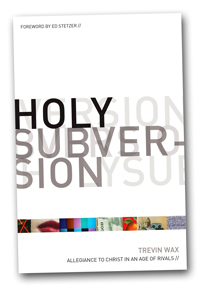
This pilgrimage of subversion is the theme of Trevin Wax’s new book Holy Subversion: Allegiance to Christ in an Age of Rivals (Crossway, 2010). It is a book about subverting the worldly temptations in relation to power, sex, leisure, money, success, and even the self. It is a book that challenges assumptions. It is a bold book. It is a prophetic book. It is a call for God’s people to be alert to the spiritual dangers lurking in the commonly approved social priorities of this world and to rejoice in the holy provisions of God. You should check it out.

But you don’t have to take my word for it (LeVar Burton). Here are three endorsements:

Albert Mohler: “Trevin Wax faithfully sounds the call for world-changing, Christ-exalting Christian practice. By unmasking contemporary ‘Caesars,’ he reveals real dangers and points to pitfalls of which many believers are completely unaware. This book serves as a helpful reminder and competent guide to draw out the implications of true allegiance to Jesus Christ.”

J. I. Packer: “How should God’s American people put the lordship of Jesus Christ on display in their lives? Wax’s searching answer is biblical, basic, businesslike, and blunt.”

Russell Moore: “Christianity is all about paradox. We lose our lives to gain them. We find life in crucifixion. We serve in order to reign. In his book, Holy Subversion, Trevin Wax takes up the question of how to be both a rebel—against the false authorities of this time—while simultaneously being submissive—to the divine authority of the God and Father of our Lord Jesus Christ. This book is a helpful warning against both nihilism and cynicism.”


Looking for a read-through-the-Bible Bible?


Each January Christians renew their commitment to read the Bible from cover-to-cover. It’s an admirable goal for such a large and ancient book.

For my money, the best suited Bible for this goal is the ESV Literary Study Bible (Crossway, 2007). I appreciate this Bible because the editors–Leland and Philip Graham Ryken–have written brief notes to help the reader along at a pace of about one note per chapter of Scripture. Those little notes set the stage for what the reader is about to encounter in their reading. And a daily reading plan in the back of the book provides readers with a thoughtful annual reading plan. Readers are encouraged to read daily from four different portions of the Bible: (1) the Psalms and Wisdom Literature, (2) the Pentateuch and History of Israel, (3) Chronicles and Prophets, and (4) the Gospels and Epistles. And in the plan, four major books are read twice in the year (Psalms, Isaiah, Luke, and Romans). Added to this, the wealth of information you will learn about the literary features of the Bible is also quite stunning.

So if you are looking for the kind of a Bible you can read from cover to cover, I recommend the ESV Literary Study Bible. It is available in two editions: hardcover ($30) and TruTone ($39).

Back in 2007 I sat down with Leland Ryken in his office at Wheaton to discuss the ESVLSB. You can learn more about the Bible in my interview with Dr. Ryken here.

Freud’s Flub re: the Fear of God

“…In trying to explain the universality of religion, Sigmund Freud asked why it is that people are so incurably religious. He claimed that we have invented God to deal with things in nature that we find frightening. He explained that by inventing God we personalize or sacralize nature. We feel deeply threatened by hurricanes, fires, tornadoes, pestilence, and armies, but we do not have the same terror concerning our personal relationships. If someone is hostile toward us, there are many ways we can try to defuse that anger. We can try to appease the angry person with words or gifts or flattery. We learn how to get around human anger, but how do we negotiate with a hurricane? How do we mollify an earthquake? How do we persuade cancer not to visit our house?

Freud thought that we do it by personalizing nature, and we do that by inventing a god to put over the hurricane, the earthquake, and the disease, and then we talk to that god to try to appease him.

Obviously, Freud was not on the Sea of Galilee when the storm arose and threatened to capsize the boat in which Jesus and his disciples were sitting. The disciples were afraid. Jesus was asleep, and so they went to him and shook him awake, and they said, ‘”Teacher, do You not care that we are perishing?’ Then He arose and rebuked the wind, and said to the sea, ‘Peace, be still!’ And the wind ceased and there was a great calm” (Mark 4:38–39).

There was not a zephyr in the air. You would think the disciples’ gratitude would have led them to say, “Thank you, Jesus, for removing the cause of our fear.” Instead, they became very much afraid. Their fears were intensified, and they said to one another, “Who can this be, that even the wind and the sea obey Him!” (v. 41). They were dealing with something transcendent.

What we see in the disciples is xenophobia, fear of the stranger. The holiness of Christ was made manifest in that boat, and suddenly the disciples’ fear escalated. This is where Freud missed the point. If people are going to invent religion to protect them from the fear of nature, why would they invent a god who is more terrifying than nature itself? Why would they invent a holy god? Fallen creatures, when they make idols, do not make holy idols. We prefer the unholy, the profane, the secular—a god we can control.”

—R. C. Sproul, Romans: The Righteous Shall Live By Faith, St. Andrew’s Expositional Commentary (Crossway, 2009) p. 45. Paragraph breaks mine {gasp}.

Introducing John Owen

Sinclair Ferguson once said that when he reads the works of Puritan John Owen he wonders why he reads anyone else. High praise. And today I stumbled upon a video of Carl Trueman on the value of John Owen, structured around four points. The 10-minute video provides a nice introduction to Owen’s theology:

(1) Owen’s thinking was catholic [broad].
(2) Owen’s theology was Church-focused.
(3) Owen’s theology follows the Calvinist tradition.
(4) Owen’s theology was thoroughly Trinitarian.

If you’re not familiar with Owen, here are 4 book recommendations:

Beginners: Mortification of Sin (Banner of Truth)
Beginners: The Glory of Christ (Banner of Truth)
Advanced: Overcoming Sin And Temptation (Crossway)
Advanced: Communion with the Triune God (Crossway)

The Pilgrim’s Progress (now in living color)

I named my second son after John Bunyan (1628—1688). Bunyan is a literary giant from the Puritan era. His classic book, The Pilgrim’s Progress, is one of the best selling books of all time and has undergone dozens of editions and translations over the centuries. The newest version is set to hit bookstores at the end of September in a deluxe, updated, 240-page, colorfully illustrated version from Crossway ($16.49 over at Amazon).

The book’s text has been edited and updated by C. J. Lovik and the book’s 30 illustrations were contributed by award winning painter Michael Wimmer. As the release date approaches for this book I’ll have a full review. But for now, I wanted to post two illustrations. Crossway permitted me a sneak peak into the book a few days ago. Here is an exclusive look at two of the paintings.

Pilgrim's-Progress-18

Illustration copyright © 2009 by Michael Wimmer. Posted by permission of the publisher. The Pilgrim’s Progress: From This World to That Which Is to Come (Crossway 2009), p. 18.

Pilgrim's-Progress-129

Illustration copyright © 2009 by Michael Wimmer. Posted by permission of the publisher. The Pilgrim’s Progress: From This World to That Which Is to Come (Crossway 2009), p. 129.

Nice illustrations! … I’ll have more for you in a later review.

Fool Moon Rising

If you were a reader of this blog back in 2007, Tom Fluharty needs no introduction. You’ve already heard about my love and respect for this man. While my family and I lived in Minneapolis we met Tom, his wife Kristi, and their wonderful family and I doubt our lives have been the same since.

Tom is a world-class painter/illustrator and the only thing more amazing than his family and his artistic skill and his passion to lead worship in his local church is the story of how God broke into his life and converted him. I sat down with Tom two years ago in Minneapolis to record his testimony.

Today I’m honored to announce that Tom and Kristi have completed their first children’s book, Fool Moon Rising (Crossway 2009). The book is now available for pre-order and will be available at the end of September. Parents and grandparents now have at their fingertips an attractive book that will help them explain to their children the stark contrast between a self-glorifying life and a God-glorifying life. This distinction is a very critical lesson in life, but it’s not always a spiritual lesson that parents find easy to articulate to children, and especially in a way that highlights the importance of our Savior. This book does it!

I’ve read this book 20 times and I love it! My kids love it! I think any reader of Fool Moon Rising will be compelled by the lively illustrations and hear the unmistakable urgency of its message.

To help you get a feel for the book’s storyline, development, its purpose, authors, and to see examples of Tom’s illustrations, see the following website:

foolmoonrising.com

Here is the publisher’s description:

This rhyming, rollicking tale tells of a crime of cosmic proportions: the moon, blinded by pride, fails to see the true source of his abilities—the light provided by the sun. He boasts of his ability to shine, to change shape throughout each month, and to swell the tides. One day, overwhelmed by a piercing ray of sunshine, the moon repents of his pride and changes his ways, and from that point on he is happy to reflect the sun’s light.

This beautifully illustrated book introduces the concept of humility to children. Readers will be reminded that everything we have, including our gifts and talents, is from God. Just as the moon learns to boast only of the sun, children—and their parents—learn that to boast of anything other than the Son is utter foolishness.