Warning …

… The quote you are about to enjoy is extremely hot!


markdriscoll2.jpg

————

Propitiation? What’s that all about? … This blend was hand picked from the mountain peaks of the 2006 Desiring God National Conference: The Supremacy of Christ and the Church in a Postmodern World.

.

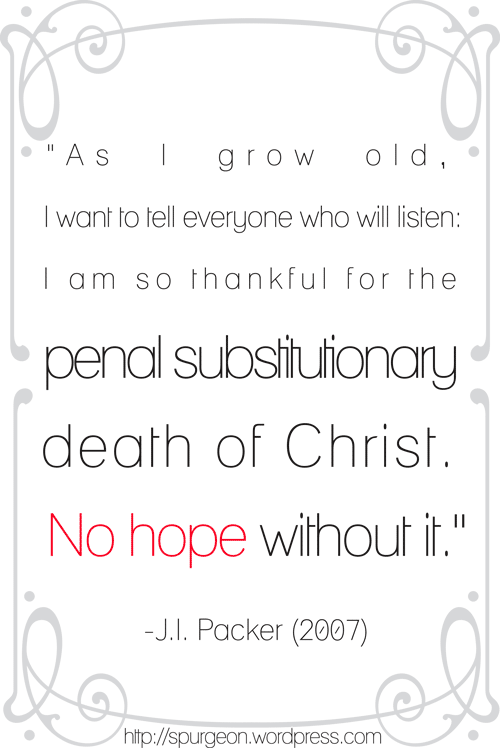
Packer on the Atonement

tsspackeratonement.gif

***********

For more of Packer’s latest comments click here.

 ***********

1. God, in Denney’s phrase, ‘condones nothing’, but judges all sin as it deserves, which Scripture affirms, and my conscience confirms, to be right.

2. My sins merit ultimate penal suffering and rejection from God’s presence (conscience also affirms this), and nothing I do can blot them out.

3. The penalty due to me for my sins, whatever it was, was paid for me by Jesus Christ, the Son of God, in his death on the cross.

4. Because this is so, I through faith in him am made ‘the righteousness of God in him’, i.e. I am justified; pardon, acceptance and sonship (to God) become mine.

5. Christ’s death for me is my sole ground of hope before God. ‘If he fulfilled not justice, I must; if he underwent not wrath, I must to eternity’ (John Owen).

6. My faith in Christ is God’s own gift to me, given in virtue of Christ’s death for me: i.e. the cross procured it.

7. Christ’s death for me guarantees my preservation to glory.

8. Christ’s death for me is the measure and pledge of the love of the Father and Son to me.

9. Christ’s death for me calls and constrains me to trust, to worship, to love and to serve.

Only where these nine truths have taken root and grow in the heart will anyone be fully alive to God.

BoT > Session 5 > Derek Thomas on John Calvin

2007-banner-of-truth-confer.jpg
Session 5 – (Wed. 7:00 PM)
“Mortification and Vivification: The Shape of Holiness in Calvin’s Institutes”
Derek Thomas

GRANTHAM, PA – Thomas returned to the Institutes to look at the shape of holiness according to John Calvin, but he began the session with a reference to his current study of John Bunyan (for a future biography). Referring to his own personal friendships with the men in the chapel, Thomas noted that in reading The Pilgrim’s Progress he was struck by how Bunyan weaves friendships into Christians’ sharing of the joy, temptations and losses of the Christian life.

Thomas would especially draw attention to mortification rather than vivification [mortification is dying to self and sin, vivification is coming alive to righteousness in Christ]. The focus in this session would be on the struggle against sin, bearing the Cross in affliction and self-denial.

Thomas opened by reading Colossians 3 with a special emphasis on verse 5: “Put to death therefore what is earthly in you: sexual immorality, impurity, passion, evil desire, and covetousness, which is idolatry.”

Calvin expands on the relationship of union and communion with Christ. Justification, sanctification and glorification all flow from an existential union and this union is now being worked out in our lives by the Holy Spirit. The Spirit is the “comforter,” which is Latin meaning “to strengthen” or “to enable.” Calvin expounds on this in a John/Paul fashion. Our union with Christ takes the shape of death and resurrection. We are involved in a union, a template of death/resurrection, so our lives take the shape of this death/resurrection pattern. Calvin develops this like Paul in Romans 8:13 (“For if you live according to the flesh you will die, but if by the Spirit you put to death the deeds of the body, you will live”) and Colossians 3:3 (“For you have died, and your life is hidden with Christ in God”). This same twin element of crucifixion/death/burial/resurrection is seen in Colossians 2:12 — “having been buried with him in baptism, in which you were also raised with him through faith in the powerful working of God, who raised him from the dead.” There are Romans 6 parallels to Colossians as we commune and take part in the death of Christ that works itself out in mortification. Mortification identifies us with Christ. Christ calls His sheep to follow His life as a pattern.

In Matthew 16:13-20 Jesus says the Church will grow and prevail although She is being built in enemy-controlled territory. This is the program of the New Covenant age between the two comings of Christ. This is now where we live, too. In this program of church growth in enemy territory, Jesus establishes the pattern of the Christian life. And this life is one of self-denial and Cross-bearing (see vv. 24-28). We are called to deny ourselves and pick up our Cross and “own” the life of Christ. “For whoever would save his life will lose it, but whoever loses his life for my sake will find it” (v. 25). Only as we identify with the life of Christ will we save our lives. Any other course of life is to lose one’s life.

In Cross-bearing and self-denial we are putting to death the remaining sinful corruptions. On mortification Calvin builds especially off Romans 8:13 and Colossians 3:5. Calvin says, prepare for the knife.

Before continuing, Thomas makes two notes. First, he feared that by talking about mortification it makes him look as an expert who has made great advancements over sin in his own life. He humbly admitted that he is not superior in holiness to those in the room. Mortification actually becomes more difficult as you mature, he said. And second, talking about mortification makes guilt easier to communicate than grace. Calvinists who believe in the third use of the Law are very capable of generating guilt. This is easy. But the more Thomas reads Calvin and volume 6 of John Owen (‘the quintessential book’ to understanding the Puritan concept of mortification) the more he sees an emphasis on grace in Calvin that excels Owen. Calvin wants to emphasize grace in mortification. We need mortification because we are sinners, but we can never forget our justification!

The Struggle of Mortification

There is a reality of indwelling sin and remaining corruption. A war rages within. Calvin does not see Romans 8 as a progression from Romans 7. There is no way out of chapter 7 and into chapter 8 in the Christian life. In other words, chapter 7 is not a sub-Christian experience. For Calvin, chapter 7 and especially verses 14-ff are not the struggle of an unconverted Jew but the paradigm of the Christian life. The “I” later in chapter is the same “I” that is in union with Christ early in the chapter.

Passive sanctification seems to abound in the Church today. As soon as the demands of the Christian life are emphasized – ‘do this’ or ‘avoid that’ – people automatically label it ‘legalism.’ The third use of the Law for Calvin is a model for the Christian life as a man in union. But this obedience is never to gain the favor of God. Neither is obedience lessened because of grace already received.

The picture of the slow growth of the Christian striving against sin is seen in the following quotes by Calvin [and one of my personal favorites from the Institutes].

“But no one in this earthly prison of the body has sufficient strength to press on with due eagerness, and weakness so weighs down the greater number that, with wavering and limping and even creeping along the ground, they move at a feeble rate. Let each one of us, then, proceed according to the measure of his puny capacity and set out upon the journey we have begun. No one shall set out so inauspiciously as not daily to make some headway, though it be slight. Therefore, let us not cease so to act that we may make some unceasing progress in the way of the Lord. And let us not despair at the slightness of our success; for even though attainment may not correspond to desire, when today outstrips yesterday the effort is not lost. Only let us look toward our mark with sincere simplicity and aspire to our goal; not fondly flattering ourselves, nor excusing our own evil deeds, but with continuous effort striving toward this end: that we may surpass ourselves in goodness until we attain to goodness itself. It is this, indeed, which through the whole course of life we seek and follow. But we shall attain it only when we have cast off the weakness of the body, and are received into full fellowship with him” (Institutes, 3.6.5 or pp. 1:689)

This is the lifelong battle until we are glorified. Athanasius and Augustine both viewed Romans 7 as an ongoing battle between the renewed self in union with Christ and remaining corruption. In Romans 8:23 Paul says “And not only the creation, but we ourselves, who have the firstfruits of the Spirit, groan inwardly as we wait eagerly for adoption as sons, the redemption of our bodies.” Creation groans and we, too, groan. Calvin calls this groaning a “warfare of patience” (Commentary on Rom. 8:24).

Being united to Christ we are a mass of contradiction. At our height, the good we want to do we don’t do. What we don’t want to do, we do (Rom. 7:15).

The Ground of Mortification

The ground of mortification is the simple fact that we can mortify the flesh! Reformation logic says, “If I ought to, I can.” Not by native ability, but because of our union to Christ, the indwelling of the Holy Spirit, and because the old Adam has died to sin. “Reckon yourselves” dead to sin (Rom. 6:11)! “For you have died, and your life is hidden with Christ in God” (Col. 3:3). Live as those who have died. We are dead men walking. Christ died to destroy sin. We take this view that sin and its demands have all been paid. Christ has purchased for us both justification and sanctification. God carries this out in His own people as they gain the upper hand over sin. Sin continues to dwell but no longer reigns over His people.

Evil desires take on a life force of their own. But Calvin wants us to see the basis of engaging in mortification is because we are dead to sin and alive to righteousness. Sin no longer reigns.

The Motive of Mortification

The motive of mortification is the fear of God. “Put to death therefore what is earthly in you: sexual immorality, impurity, passion, evil desire, and covetousness, which is idolatry. On account of these the wrath of God is coming” (Col. 3:5-6). Calvin, in his commentary, is especially clear that the wrath of God is coming upon those who do not engage in mortification. This becomes a motive to our mortification. The same theme is found in Romans 8:13: “For if you live according to the flesh you will die, but if by the Spirit you put to death the deeds of the body, you will live.” If we don’t engage sin, we will die.

To say that you are united to Christ but don’t engage sin is to have, as Calvin puts it, a “mutilated faith.” Our engagement and victories over sin give us assurance that we are truly children of God.

Engaging in Mortification

So how do we mortify? First, we need a big picture. Mortification is not only concerned with specific and individual sins but all the entrails of the old man. Mortification is an engagement at the whole of sin, not just its parts.

The key to mortification is the mind. Book three and chapters 9-10 were added to the Institutes later as the whole comes to completion. It’s what we would call “faculty psychology.” For Calvin and the Puritans, the mind is the priority over the will and affections. Holiness begins in the faculty of the mind and in our thinking. For Calvin, we act according to our thoughts. So mortification begins in the mind. Remember in book one, Calvin calls the heart the “perpetual factory of idols.” And for Paul, he does not go into the details of sexual immorality but rather focuses on the idolatry of sexual sin and the idolatry of all sin. In James, the dynamic morphology of sin begins in the mind with the thoughts. So the way to deal with sin is to deal where it’s rooted – in our minds! Don’t think about sin. Guard your thought world. Guard your mind.

If we allow our minds to think about sin, the sin will develop a life of its own. Unguarded sinful thoughts motivate the will and the affections. Once the affections are set upon a sin, the sin takes on a life force of its own that will run its course. It will not be stopped. So deal with sin when it first rises in the mind. [This is a great illustration of the “life force” of sin.]

It is here that Calvin gives us one of the most eloquent passages of the Institutes.

“We are not our own: let not our reason nor our will, therefore, sway our plans and deeds. We are not our own: let us therefore not set it as our goal to seek what is expedient for us according to the flesh. We are not our own: in so far as we can, let us therefore forget ourselves and all that is ours. Conversely, we are God’s: let us therefore live for him and die for him. We are God’s: let his wisdom and will therefore rule all our actions. We are God’s: let all the parts of our life accordingly strive toward him as our only lawful goal (Rom. 14:8; cf. 1 Cor. 6:19). O, how much has that man profited who, having been taught that he is not his own, has taken away dominion and rule from his own reason that he may yield it to God! For, as consulting our self-interest is the pestilence that most effectively leads to our destruction, so the sole haven of salvation is to be wise in nothing and to will nothing through ourselves but to follow the leading of the Lord alone” [3.7.1, p. 1:690].

This is not only mortification in particular besetting sins but part of a wider picture because we live in a sinful world. We have two zip codes: one planted in this world and one planted in the world to come. Being rooted in a world that is groaning is a call to self-denial and Cross-bearing. The highest calling of the Christian is self-denial. So bear the Cross!

Cross Bearing

Of particular usefulness, Cross-bearing teaches us to trust in the grace of God. We will suffer poverty, bereavement, and disease in this world in order for God to present us faultless (Jude 1:24). In Calvin’s teaching on the book of Job, Calvin preached through the book himself in great pain and in the midst of personal warfare. Calvin was a walking encyclopedia of pain.

For Calvin, the essential message of Job is understood through the eyes of Elihu. Elihu understands pain is educative. It’s not punishment for some particular sin, but rather the pain brings out the potential sin that was resting dormant.

The climax of Job is God shutting Job’s mouth. Paul takes this same theme in saying the purpose of the Law is to shut the mouths of sinners (Rom. 3:19). Every time we speak, we spew idolatry, self-worship and self-exaltation. The beauty of the Cross is that self-denial causes us to trust patiently in God. Unbelievers are chastened and they only grow weary. Believers are chastised and they are matured. A Cross without Christ does no good, but a Cross with Christ is God pulling out His chisel on the edges of our lives and our angular characters. He will present us as trophies of grace in Christ. Afflictions teach us about Christ. Nowhere is the chasm of the 16th century church and the church today more revealed than in our understanding of trials. Calvin says, it’s not all about me! The fact is that the closer we are to the King, the more likely we are to draw enemy fire and taste affliction. As Christ suffers so shall we.

[For more on Calvin’s understanding of Job see Dr. Thomas’ excellent book, Calvin’s Teaching on Job (Christian Focus: 2004). “Elihu sees adversity as educative rather than necessarily retributive” (p. 227).]

When Paul is converted on the Damascus road, why does Christ say, “Why are you persecuting me?” (Acts 9:4)? Because Stephen was one of His (7:54-8:1). You touch one of Christ’s little ones, and you touch Christ.

The Experience of Mortification

Calvin is not calling us to Stoicism. In our grief and sorrow, Calvin points us to our great consolation in the hands of our indulgent Father! For Calvin, what gives him joy and vigor and strength in the Romans 7 struggle with sin and Cross-bearing is the fact that this world rests in the hands of our Father. And there remain no doubts of the extent of God’s love for us — He sent His only Son for us!

In the words of Thomas a Kempis: if you bear the Cross, it will bear you. No matter where you are, carrying the Cross or burdened by sin – the Cross will bear you!

———-

Related: For more posts and pictures from the 2007 Banner of Truth Ministers’ Conference check out the complete TSS conference index.

Monergism T-shirt

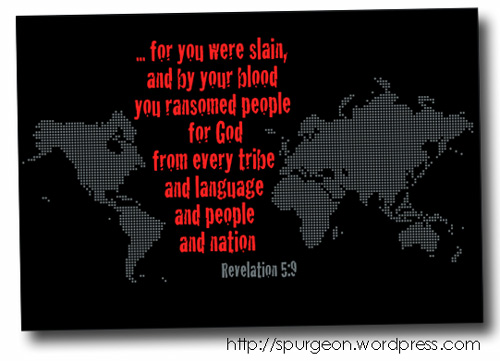
tshirt.jpgHello everyone. I just received word from our friends at Monergism Books that the T-shirt I helped design is now ready for sale. The front carries the Monergism logo and the back design is based upon the beauty of Christ revealed in Revelation 5:9 – “for you were slain, and by your blood you ransomed people for God from every tribe and language and people and nation.” The trick was in communicating the diversity of these tribes. Most designs around this passage emphasize Christ’s redeemed come from the whole earth (singular) rather than from every tribe (a plurality which is more biblically accurate). This design took all the land masses and boxed them to communicate the individuality of each tribe. Blood was shed for sinners in each and every one of these tribes. What a beautiful, globally-transforming power flows from Christ’s Blood to every unique tribe of the world!

You can learn more and order shirts from Monergism here. rev59black.jpg

BoT > Session 3 > Derek Thomas

2007-banner-of-truth-confer.jpg
Session 3 – (Wed. 9:00 AM)
“Union with Christ: The Architectonic Principle of Holiness in Calvin’s Institutes”
Derek Thomas

GRANTHAM, PA – Even if a word like “architectonic” was too big for 9 AM, one of the great anticipations of the conference for me was to learn more about John Calvin and his theology (part of my preparation for this conference was the Humble Calvinism series we started in January). Derek Thomas is a man well qualified to teach on Calvin. Thomas originates from Whales Wales but now ministers in Jackson, MS as professor of systematic and practical theology at Reformed Theological Seminary and Minister of Teaching at First Presbyterian Church. Recently we looked at Thomas’ excellent book, Calvin’s Teaching on Job (Christian Focus).

Thomas is very familiar with the Banner of Truth Conference, first attending in 1974. He began his address with kind compliments and thankfulness for the past 30+ years.

Thomas was encouraged to make one theologian his lifelong hobby. In seminary he discovered Calvin when studying Calvin’s Institutes. No one should graduate from seminary without studying them, he said.

Thomas’ messages for the conference would center in book three of the Institutes and especially upon a small section published by itself as the Golden Booklet of the True Christian Life (still in print). This small book has enjoyed, Thomas said, “a life of it’s own.” [The content of this small book can be found in the third book of the Institutes (3.6-3.10 or pp. 1:684-725 in the McNeill/Battles edition).]

Thomas began by reading the sixth chapter of Romans and a short reading from the Institutes. Coming out of Book 2, where Calvin explained the person and work of Christ, he goes on in Book 3 to explain how this is applied to the Christian. Calvin begins Book 3 by writing:

“How do we receive those benefits which the Father bestowed on his only-begotten Son – not for Christ’s own private use, but that he might enrich poor and needy men? First, we must understand that as long as Christ remains outside of us, and we are separated from him, all that he has suffered and done for the salvation of the human race remains useless and of no value for us. Therefore, to share with us what he has received from the Father, he had to become ours and to dwell within us” (3.1.1, p. 1:537).

This quote provides the critical bridge between Book 2 (the work of Christ, His Cross and the Resurrection) into Book 3 (the application of grace to the sinner). Without union to Christ, the application the work of Christ does not happen.

History of the Institutes

The Institutes first appeared in 1536 as a small book but would grow through many editions until the final French edition in 1560. The plan of the original Institutes was different than the final. The first edition followed the structure of a catechism. But in 1559 the Institutes would be remodeled to follow the outline of the Apostle’s Creed – following a Trinitarian design of the Father, Son and Holy Spirit. Some other significant changes include the moving of predestination from the opening chapters of the doctrine of God, into Book 3 being placed under the application of the Holy Spirit — because as Calvin says, “Election is the secret of God’s people.” Once you are born again, then predestination makes sense (similar to how predestination fits into the flow of Romans). Another change was that Calvin’s teaching on the Christian life formerly was a conclusion to his teaching on the church, but in the final edition is a subsection of Book 3 as can be seen from the third book’s title: “The way in which we receive the grace of Christ: What benefits come to us from is, and what effects follow.”

So if you look at the headings of Book 3, Calvin begins with a section on the Holy Spirit and then addresses faith, regeneration, repentance and justification. This is no proper ordo salutis! But Calvin is not attempting here to write an ordo salutis. Calvin is in a place where salvation by faith alone is charged as antinomian by his Roman Catholic critics. Therefore, Calvin first sets up sanctification to remove the ground of his opponents before jumping into justification. In other words, justification by faith alone does not undermine sanctification.

For Calvin, regeneration is not a one-time event that happens in the past. Rather, regeneration is an ongoing process of renewal in our sanctification. [The example of the Christian’s continued repentance for sin throughout life is an act of regeneration. Calvin writes, “in a word, I interpret repentance as regeneration, whose sole end is to restore in us the image of God that had been disfigured and all but obliterated through Adam’s transgression” (3.3.9, p. 1:601)]. It is important to know how Calvin uses the term “regeneration.”

Union with Christ

Union to Christ is the key truth of the application of His work. This union is a multifaceted and multidimensional truth. There is a mystical union with Christ brought about by the Holy Spirit where we are brought into spiritual union with Christ. But this union also incorporates Christ and believers whereby we share communion also in human nature, body and soul together. Christ identifies with believers in both a spiritual and physical union. Calvin’s eschatology includes an existence after glorification where we will have physical bodies and be in an incarnate union with Christ. Christ is the firstborn, elder brother in the family we are adopted: “For those whom he foreknew he also predestined to be conformed to the image of his Son, in order that he might be the firstborn among many brothers” (Rom. 8:29). We are engrafted into Christ and we draw from the sap and vitality of Christ (Rom. 11:17). We put on Christ and grow into One Body with Him (Gal. 3:27-28).

Calvin expands on this union with Christ and its significance to sanctification.

1. Basis of holiness. Christ possessed a spiritual wealth to give to the needy and He prays to His Father that this spiritual wealth would be to the believer’s sanctification. This profound truth is reflected in the prayer of Jesus, “And for their sake I consecrate myself, that they also may be sanctified in truth” (John 17:19). On this passage, Calvin writes in his commentary on John,

“It is, because he consecrated himself to the Father, that his holiness might come to us; for as the blessing on the first-fruits is spread over the whole harvest, so the Spirit of God cleanses us by the holiness of Christ and makes us partakers of it. Nor is this done by imputation only, for in that respect he is said to have been made to us righteousness; but he is likewise said to have been made to us sanctification, (1 Cor. 1:30) because he has, so to speak, presented us to his Father in his own person, that we may be renewed to true holiness by his Spirit.”

Thus, our union with Christ achieved both justification and sanctification for believers. Our sanctification is the result of Christ’s sanctification and it is His perfect sanctification now being worked out in our own lives! This is the union. So how are we saved? Calvin says, not by Christ but rather in Christ. A most common phrase of Paul is to be “in Christ” and this “in Christ” is the key to our justification and the key to our sanctification. Our holiness is His holiness, our righteousness is His righteousness.

Our union with Christ as the basis of holiness is evident in the beginning lines of First Corinthians. “To the church of God that is in Corinth, to those sanctified in Christ Jesus, called to be saints” (1 Cor. 1:2). The Corinthians have two zip codes – one zip code that places them in this world where they are attacked and tempted, but a second zip code that sets them in heaven because they are united with Christ. In this union with Christ we have a divine nature in this world, which means we can put off all vices of the flesh (2 Pet. 1:4).

2. Means of holiness. The Holy Spirit is the applier of the works of Christ. It’s the same Spirit that indwelt Christ in His Incarnate life. See the references to the “Spirit of Christ” (Rom. 8:9, 1 Pet. 1:11). The Holy Spirit is the bond uniting us to Christ. None know Christ more intimately nor has experienced more fellowship with Christ than the Holy Spirit. This Holy Spirit is the Spirit of Christ.

So where is Christ now? Christ is now in heaven at the right hand of the Father, but we are still united with Him. In the Lord’s Supper there is a deep mystery here. Calvin speaks of the Holy Spirit drawing us into fellowship with Christ as the Spirit draws our affections towards Him. Our hearts are lifted into communion with the Body and Blood of Christ. The Spirit comes to us because of the death, burial and resurrection of Christ.

To signify the Spirit being poured over the Body from its Head (Christ), Calvin builds from the image of Psalm 133: “It is like the precious oil on the head, running down on the beard, on the beard of Aaron, running down on the collar of his robes!” (v. 2). Christ is our Head. He pours His Spirit over Himself and the oil of the Holy Spirit runs down from the Head over the rest of His Body the Church. Sanctification from the Spirit of Christ flows from our union with Christ.

3. Shape of holiness. The Christian receives all the fullness of Christ in all of His accomplishments (justification, sanctification, glorification, etc.). Grace reigns through righteousness. “How can we who died to sin still live in it?” (Rom. 6:2). As Calvin writes, “Medicine does not foster the disease it destroys” . We have died to sin and the claims of sin have been fully met (Rom. 6:10, 23). “We know that our old self was crucified with him in order that the body of sin might be brought to nothing, so that we would no longer be enslaved to sin” (Rom. 6:6). The body of sin has been destroyed. Sin was manifested in the body and now righteousness must be manifest in the body, too. The believer has been freed from sin, freed from guilt and the power of sin. The bondage has been broken.

Being freed from sin’s bondage is no mere speculation for Calvin. For Calvin, communion with the death of Christ energizes the imperatives that follow. The imperatives – like “consider yourselves dead to sin and alive to God in Christ Jesus” — come after the indicatives (Rom. 6:11). The template of holiness is union/communion with the death/resurrection with Christ. Calvin sounds so Pauline. This is why when we have a hard time understanding the Pauline texts, Calvin is most helpful. He thinks so much like Paul.

So what does it mean to commune with Christ? Communion with Christ functions in our lives and is manifested in the perpetual death/resurrection cycle of life. The cross is the way to victory and death is the way to life. Don’t be surprised that to know life and joy we must first experience death and crucifixion. Christ is the one who blazes the trail for the Christian and we follow Him (Heb. 5:9).

So reckon yourselves dead and look to heaven where Christ is. The Christian life is not about the imitation of Christ. WWJD is not a sufficient ethic for the Christian life. We act in the Spirit of Christ, not to the details of Christ’s life.

The same Spirit that indwelt Christ is the same Spirit that molds us and takes us along the path of crucifixion and resurrection on our path to glory. Don’t be surprised if that is an increasingly difficult path as we die to self, die to the world, die to the devil, and live more for Christ and His glory.

———-

Related: For more posts and pictures from the 2007 Banner of Truth Ministers’ Conference check out the complete TSS conference index.

BoT > Session 2 > Sinclair Ferguson

2007-banner-of-truth-confer.jpg
Session 2 – (Tues. 7:00 PM)
“Our Holiness: The Father’s Purpose and the Son’s Purchase”
Sinclair Ferguson

GRANTHAM, PA – It was unfortunate Walt Chantry was not able to speak at this year’s conference (his book, The Shadow of the Cross is a treasure). Sinclair Ferguson was his chosen replacement. Ferguson, who has been a friend of Chantry for 30 years, took time at the beginning of his address to honor his friend.

Ferguson is one of the great contemporary preachers in our age. He serves as Senior Minister of The First Presbyterian Church in Columbia, SC and as professor of systematic theology at Westminster Theological Seminary in Dallas. What I love about Ferguson is that he is a Cross-centered scholar. A Puritan, really. And the opening night of the conference was a special treat because his address centered on how the Son purchases our sanctification.

Ferguson began by reading Titus 1 — words directed to a Gospel minister — with an emphasis on verses 11-15 where Christ’s redemption is tied to our sanctification.

“For the grace of God has appeared, bringing salvation for all people, training us to renounce ungodliness and worldly passions, and to live self-controlled, upright, and godly lives in the present age, waiting for our blessed hope, the appearing of the glory of our great God and Savior Jesus Christ, who gave himself for us to redeem us from all lawlessness and to purify for himself a people for his own possession who are zealous for good works. Declare these things; exhort and rebuke with all authority. Let no one disregard you.” (Titus 2:11-15)

The three messages on holiness (“Our Holiness”) at the conference are titled: 1) The Father’s Purpose and the Son’s Purchase, 2) Abiding in Christ’s Love, and 3) Walking in the Spirit. This excellent, God-centered division was outlined by Chantry.

Ferguson shared many helpful personal questions and reflections throughout his message, beginning with this statement (and continuing throughout my notes below).

Fill in this statement: My people’s greatest need is (blank). Is it my improved preaching? My improved pastoral skill? Overall church attendance and growth? Or, is my people’s greatest need my personal growth in holiness? We all come in here knowing this is our great weakness, but excellence in holiness is one of the supreme qualifications for pastoral ministry. In fact, in the lists of qualifications for elders, giftedness and skillfulness are not the dominate characteristics of the qualified pastor. But holiness is! Holiness marks out pastors as authentic believers.

We are timid of this fact because this means that others should see our progress. These questions have haunted me constantly with other ministry friends: Are they seeing my progress in holiness over the years? Is my congregation seeing my progress in godliness over the years? There are few other things more important to consider than our own personal holiness.

But here is the great encouragement. The great Gospel imperatives are rooted in the indicatives of grace that sustain those imperatives! As preachers, often our indicatives are not big enough or gracious enough to sustain the weight of our imperatives. Preaching then becomes a rod to beat holiness, but all we see are our own failures. We lose sight of the Gospel.

And we need to remember how the imperatives of holiness are grounded in the NT in the Triune God. “To those who are elect exiles of the dispersion in Pontus, Galatia, Cappadocia, Asia, and Bithynia, 2 according to the foreknowledge of God the Father, in the sanctification of the Spirit, for obedience to Jesus Christ and for sprinkling with his blood” (1 Pet. 1:1-2). Woven into the warp and woof, holiness is grounded in God. This holy God has in Himself, by Himself, for Himself, and is committed by Himself to bring about sanctification of His own people. Paul writes, “because of the grace given me by God to be a minister of Christ Jesus to the Gentiles in the priestly service of the gospel of God, so that the offering of the Gentiles may be acceptable, sanctified by the Holy Spirit”(Rom. 15:15-16). “For this is the will of God, your sanctification” (1 Thess. 4:3).

Elected to Holiness

Our holiness has been planned eternally by God. “For the grace of God has appeared, bringing salvation for all people, training us to renounce ungodliness and worldly passions, and to live self-controlled, upright, and godly lives in the present age” (Titus 2:11-12). The grace of God has appeared, and this produces holiness. That the grace of God has appeared is a reference to Christ. He has appeared and this eternal planning shows that our holiness is the fruit of eternal planning.

“Put on then, as God’s chosen ones, holy and beloved, compassionate hearts, kindness, humility, meekness, and patience” (Col. 3:12). A living Calvinist is marked by compassion, humility, kindness. If you don’t look like this, you are not a Calvinist. This holiness is rooted in the eternal counsel of the eternally blessed God. “For those whom he foreknew he also predestined to be conformed to the image of his Son” (Rom. 8:29). The divine and eternal purposes of God are shown in our conformity to Christlikeness. This is holiness. It is of supreme importance that we understand that Christlikeness is holiness, not plus or minus anything else. We may have all types of abilities, theological knowledge, intellectual ability and affection towards the Gospel, but if I am not like Him I am not holy.

Election grounds our holiness. John Owen asked the question, how do we know if we are truly elect? The answer: Has God destined you to be holy? His chosen are to be like Himself (See Owen’s Works, 3:597-598). I still have powerful sin in me and without grace I would utterly fail at holiness. God’s eternal plan is the necessary inducement to holiness. God has seen His portrait fractured in the Fall and rebellion has set in. God wants His portrait back and He is getting rid of what is not Christlike in us. He wants us to be conformed to the image of His Son. In Romans Paul goes on to say that nothing will thwart this plan? Satan? Who can stand in God’s way? Charge them? Destroy them?

God is bending all circumstances and pain, He is chiseling and doing one thing – riding the universe of what does not reflect Christ. He deconstructs us to reconstruct our character, lives, to be Christlike. God is determined that you will be transformed into Christ. Holiness is not a threat but a cause of joy, wonder, worship and humility because this holiness has been purchased by the work of the Son.

Christ and Sanctification

The role of Christ in sanctification extends beyond purchase, but we should see holiness is purchased by Christ – not as an additional work. Justification and sanctification are linked together. My sanctification is as much purchased as any other aspect of salvation (Heb. 2:14-17). We can get so focused on the blood of Christ which pardons that we lose sight of Christ purchasing our sanctification and holiness. There are no gospel blessings that come apart from the crucified Christ. The conduit is His death. We receive nothing in the Christian life unless He purchased it by His obedience and Atonement.

The death of Christ is a multifaceted reality. Just look at how many Hebrew nouns are used in the Old Testament to communicate the multidimensional, sinister, twisted, fallen, nature of sin. And these are not all synonyms. The Spirit comes and loosens the flesh. Sin is not a single independent mass in our hearts, but rather sin is woven multidimensionally into our lives. The salvation in the Blood of Christ is a corresponding Atonement to this sin. We are to be totally sanctified which means there will be no remnant of sin.

Our understanding of the Cross is often superficial. Shame on me if I expound to my people multiple dimensions of sin without expounding the multiple dimensions of the Cross! How is it possible that redemption purchases salvation from sin in all dimensions?

The Cross and Sanctification

1. Christ propitiates God’s wrath (Rom. 3:21-24). Christ answers the wrath of God for the sins of Romans 1-3:20. But propitiation is more than mere justification. Under the wrath of God (or a fear of future wrath from God) I will be emptied of all hope in sanctification. It is not psychologically possible to be under the wrath of God and desire to be like Him. We have been freed from God’s wrath, are exalted in Christ, and we now stand before God with the identical confidence of Christ. His righteousness is mine! “Bold I approach th’eternal throne, And claim the crown, through Christ my own.” Propitiation is significant for sanctification.

2. Christ expiates defilement. “How much more will the blood of Christ … purify our conscience from dead works to serve the living God” (Heb. 9:14). In the Cross our sins are washed away. But our hearts and our consciences are cleansed, too! Too often we miss this.

3. Christ dies to sin. Our holiness is affected at the Cross because in the Cross Christ died to sin. “For the death he died he died to sin, once for all, but the life he lives he lives to God” (Rom. 6:10). It does not say here Christ died for sin but rather that He died to sin. This point may be controversial. The context is in explaining Christian baptism. We no longer live in sin because Christ died to sin. We have been set free from the reign and dominion of sin in order to yield ourselves to Jesus. Christians do not die for sin but rather we die to sin which is to say that we have died to sin because Christ has died to sin. Since sin reigns in death, it was in Jesus’ death that His humanity came under the reign of sin in the process of overcoming sin. Christ not only purchased justification from the wrath of God and cleaned our consciences, but He also purchased that freedom from the dominion of sin that makes it possible to live endlessly to the glory of God. John Owen said there are two primary problems for the pastor, convincing sinners they are under sin and convincing the redeemed they are no longer under sin. Nearly all pastoral situations come back to this!

4. Christ frees from Satanic bondage.
Jesus entered enemy-occupied territory and defeated Satan. “Since therefore the children share in flesh and blood, he himself likewise partook of the same things, that through death he might destroy the one who has the power of death, that is, the devil” (Heb. 2:14). Without redemption in Christ, we are lifelong slaves to the fear of death. We see this in all non-Christian funerals. There are no windows, it is bleak, there is a concerted effort to celebrate but nobody in the room has conquered the fear of death. In a truly Christian funeral there is hope and a future. Even in the loss and grief we rejoice for the one taken into the presence of Christ. The fear of death is the mother of all fears. Psychobabble abounds over the fears people have. The world is awash in insecurities. Only Christ delivers from the fear of death. The Resurrection of Christ is such a glorious thing! Arguments to prove the Resurrection is one thing, but to be overwhelmed by the powerful reality of being saved from death is another. To be “dead to sin” is to be raised into newness of life. This is the glorious power of the Resurrection. Has it made my life different? When people look at my life do they say, ‘Someone must have been raised from the dead’?

5. Christ purchases the gift of the Holy Spirit. Because of the work of Christ on the Cross the Holy Spirit comes. Jesus said to the disciples, “Nevertheless, I tell you the truth: it is to your advantage that I go away, for if I do not go away, the Helper will not come to you. But if I go, I will send him to you” (John 16:7). Later in John’s Gospel we see that John was struck that blood and water flowed from the side of Jesus (John 19:34). This is because John understood that Jesus was not only the source of Atoning blood, but also the river of living water. He is the One for Whom the river flows, He is the true Jerusalem where the thirsty go to drink (Rev. 22). When Christ ascended into the clouds He entered behind a curtain where we can no longer see Him. We don’t know exactly what happens behind the curtain but Peter says, “Being therefore exalted at the right hand of God, and having received from the Father the promise of the Holy Spirit, he has poured out this that you yourselves are seeing and hearing” (Acts 2:33). In the ascension, Jesus pours out His life transforming Holy Spirit. “And we all, with unveiled face, beholding the glory of the Lord, are being transformed into the same image from one degree of glory to another. For this comes from the Lord who is the Spirit” (2 Cor. 3:18).

The point is that Christ purchased everything we need. We are purchased by Christ, therefore we glorify Him in our lives (1 Cor. 6:20). We are owned by Him and nobody else. Once we are purchased, we begin taking baby steps in holiness that are apparent towards others. Has anyone thought of your life, ‘There is something in this man’s life that looks like Jesus’? It is not great gifts that God blesses in the ministry but a likeness to Jesus (M’Cheyne). And this likeness to Christ is eternal.

———-

Related: For more posts and pictures from the 2007 Banner of Truth Ministers’ Conference check out the complete TSS conference index.