The Red Thread of Redemption

In one point in his writings, B. B. Warfield reflects on the ‘Son of God’ theme in the Epistle to the Hebrews. This excerpt is taken from his book, The Lord of Glory: A Study of the Designations of Our Lord in the New Testament With Especial Reference to His Deity (American Tract Society, 1907), pages 282-284:

He writes this about Christ in Hebrews:

  • He is ‘the Mediator of the New Covenant’ (8:6, 9:15, 12:24):
  • He is the Ground of eternal Salvation (5:9):
  • He is ‘the Author of Salvation’ (2:10, cf. Acts 3:15, 5:31):
  • He is ‘the Author and Perfecter of our Faith’ (12:2):
  • He is our Forerunner into that which is within the veil (6:20):
  • He is ‘the Apostle and High Priest of our Confession’ (3:1):
  • He is ‘the Great Shepherd of the Sheep’ (13:20): and, above all (for this is a favorite conception of this Epistle),
  • He is our ‘Priest’ (5:6, 7:3, 11, [15], 17, 21; [8:4]; 10:21) or more specifically our ‘High Priest’ ([2:17]; 3:1, 4:14, 15, 5:10, 6:20, 7:26, 8:1, 9:11). …

He expands:

  • As ‘Mediator of the New Covenant’ He gives His life for the redemption of His people, establishing new relations between them and God by means of His blood.
  • As the ‘Originator of Salvation,’ He tasted death for every man, receiving in Himself the penalties due to them, not to Him.
  • As ‘Author and Perfecter of our faith’ He endured the cross, despising the shame that He might be not merely our example, but our Saviour.
  • As ‘the Great Shepherd’ He laid down His life for His sheep.
  • As ‘the Apostle and High Priest’ He is the One appointed by God to make sacrifice of Himself for the sins of the people–for every High Priest must needs have somewhat to offer, and this ‘our High Priest’ has through His own blood obtained eternal redemption for us.

He concludes:

We see that [in Hebrews] the red thread of redemption in blood is woven into all the allusions to the saving work of the ‘Son of God.’
The Cross, Our Life, and Christian Ministry

1 Corinthians 2:2:

For I decided to know nothing among you except Jesus Christ and him crucified.

Roy Ciampa and Brian Rosner, The First Letter to the Corinthians (Eerdmans, 2010), page 114:

In contrast to “the wise” in Corinth and in the church, who could expatiate endlessly on all sorts of subjects, all Paul wanted to talk about was “the cross of Christ” (1:17). On first blush this may seem rather narrow and limited. After all, Paul spent eighteen months in Corinth and would have engaged in pastoral work alongside evangelism. However, as 1 Corinthians 1:10–4:17 itself demonstrates, for Paul even the most practical ills, such as divisions and problems of leadership in the church, are remedied by focusing on the cross. For Paul, Christ crucified is more than just the means of forgiveness and salvation; rather, it informs his total vision of the Christian life and ministry.

The Gospel and Eschatology

Too often we don’t equate the gospel and justification with the theme of eschatology. These themes can get separated in our minds, and each individual doctrine suffers for the disconnect, and our souls suffer from malnourishment. The fact is that these themes are inseparable—the death and resurrection of Christ mark the inbreaking of the eschatological age and the inauguration of the new creation.

Yesterday I read what may be the best summary of these interwoven themes in the back of Thomas Schreiner’s new commentary on Galatians (Zondervan, 2010), pages 394–395.

Notice how he draws the themes together:

Justification is an eschatological verdict that has been declared in advance of the last day. This is not to say that the verdict announced now only refers to a future reality. Believers are already justified, and yet at the same time they await the final declaration on the day of judgment when the verdict that God has already announced becomes public (5:5).

In the same way, the cross of Jesus Christ has launched believers into the age to come, even though they live in the present evil age (1:4). In other words, the new exodus promised in the OT has become a reality through Jesus as the crucified and risen Lord (Isa 40:3­–11; 42:16; 43:2, 5–7, 16–19; 48:20-21; 49:8–11; 51:10–11).

The resurrection in Jewish thought also signals the end of the old evil age and the coming of the new age of peace and plenty (cf. Isa 26:19; Ezek 37:1–14; Dan 12:2–3).

The resurrection is not a prominent theme in Galatians, and yet it appears in the first verse of the letter (1:1), signifying that the age to come has invaded the present age. The old evil cosmos has lost its hold over believers through the cross of Jesus Christ (6:14). Therefore, believers now belong to the new creation (6:15). The new creation has not been consummated (Isa 65:17; 66:22), but it has been inaugurated through the work of Jesus Christ. The gift of the Holy Spirit represents the arrival of the new creation (Isa 32:15; 44:3; Ezek 11:18–19; 36:26–27; Joel 2:28). The Spirit is a gift of the last days, and his presence and indwelling among the Galatians shows that the final days have begun.

Eschatological contrasts dominate Galatians, so that we have a contrast between the old age of the flesh and the new age of the Spirit. The flesh in Paul represents the old age and who human beings are in Adam, whereas the Spirit signifies the inbreaking of the age to come.

We see the same eschatological contrast between the law and the gospel. The Mosaic law belongs to the former era and believers are no longer under the law (see esp. 3:15–4:7). To be under the law is to be enslaved to the power of sin (3:10, 22, 23, 25; 4:3, 21–31; 5:18). Such slavery belongs to the former age. Now that the gospel of Christ (a fulfillment of the promise of the new exodus! Isa 40:9; 52:7) is proclaimed, the age of the law is obsolete. Believers live in the era of the cross, the resurrection, and the gift of the Spirit.

Second Corinthians 5:17 rightly summarizes Galatians: “If anyone is in Christ, he is a new creation. The old has gone; the new has come!”

A summary quote like this one that weaves together so many key themes in Galatians and throughout the Old and New Testaments is worth printing out and studying carefully and meditating over devotionally.

(And his commentary is  certainly worth the coin, in case you’re wondering.)

A Spike-Torn Hand Twitched

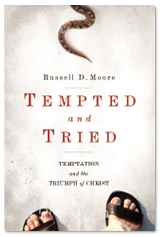
The following is my favorite excerpt from one of my favorite books of 2011: Tempted and Tried: Temptation and the Triumph of Christ by Russell Moore (Crossway, 2011). The quote is worthy of a slow and careful read (from pages 124-125):

Part of the curse Jesus would bear for us on Golgotha was the taunting and testing by God’s enemies. As he drowned in his own blood, the spectators yelled words quite similar to those of Satan in the desert: “Let the Christ, the King of Israel, come down now from the cross that we may see and believe” (Mark 15:32). But he didn’t jump down. He didn’t ascend to the skies. He just writhed there. And, after it all, the bloated corpse of Jesus hit the ground as he was pulled off the stake, spattering warm blood and water on the faces of the crowd.

That night the religious leaders probably read Deuteronomy 21 to their families, warning them about the curse of God on those who are “hanged on a tree.” Fathers probably told their sons, “Watch out that you don’t ever wind up like him.” Those Roman soldiers probably went home and washed the blood of Jesus from under their fingernails and played with their children in front of the fire before dozing off. This was just one more insurrectionist they had pulled off a cross, one in a line of them dotting the roadside. And this one (what was his name? Joshua?) was just decaying meat now, no threat to the empire at all.

That corpse of Jesus just lay there in the silences of that cave. By all appearances it had been tested and tried, and found wanting. If you’d been there to pull open his bruised eyelids, matted together with mottled blood, you would have looked into blank holes. If you’d lifted his arm, you would have felt no resistance. You would have heard only the thud as it hit the table when you let it go. You might have walked away from that morbid scene muttering to yourself, “The wages of sin is death.”

But sometime before dawn on a Sunday morning, a spike-torn hand twitched. A blood-crusted eyelid opened. The breath of God came blowing into that cave, and a new creation flashed into reality….

Astonishing.

Dr. Moore’s book will be released in April.

God’s Love and God’s Wrath

Dr. Don Carson writes the following in his outstanding article “God’s Love and God’s Wrath” published in Bibliotheca Sacra, vol. 156 (1999), pages 388–390:

The Bible speaks of the wrath of God in high-intensity language. “The Lord Almighty is mustering an army for war. … Wail, for the day of the Lord is near; it will come like destruction from the Almighty. … See, the day of the Lord is coming—a cruel day, with wrath and fierce anger—to make the land desolate and destroy the sinners within it” (Isa. 13:4, 6, 9). Even allowing for the unusual nature of language in the apocalyptic genre, Revelation 14 includes some of the most violent expressions of God’s wrath found in all literature. …

How, then, do God’s love and His wrath relate to each other?

One evangelical cliché has it that God hates the sin but loves the sinner. There is a small element of truth in these words: God has nothing but hate for the sin, but this cannot be said with respect to how God sees the sinner. Nevertheless the cliché is false on the face of it, and should be abandoned. Fourteen times in the first fifty psalms alone, the psalmists state that God hates the sinner, that His wrath is on the liar, and so forth. In the Bible the wrath of God rests on both the sin (Rom. 1:18–23) and the sinner (1:24–32; 2:5; John 3:36).

Our problem in part is that in human experience wrath and love normally abide in mutually exclusive compartments. Love drives wrath out, or wrath drives love out. We come closest to bringing them together, perhaps, in our responses to a wayward act by one of our children, but normally we do not think that a wrathful person is loving.

But this is not the way it is with God. God’s wrath is not an implacable blind rage. However emotional it may be, it is an entirely reasonable and willed response to offenses against His holiness. At the same time His love wells up amidst His perfections and is not generated by the loveliness of the loved. Thus there is nothing intrinsically impossible about wrath and love being directed toward the same individual or people at once. God in His perfections must be wrathful against His rebel image-bearers, for they have offended Him; God in His perfections must be loving toward His rebel image-bearers, for He is that kind of God. …

The reality is that the Old Testament displays the grace and love of God in experience and types, and these realities become all the clearer in the New Testament. Similarly, the Old Testament displays the righteous wrath of God in experience and types, and these realities become all the clearer in the New Testament. In other words both God’s love and God’s wrath are ratcheted up in the move from the Old Testament to the New. These themes barrel along through redemptive history, unresolved, until they come to a resounding climax in the Cross.

Do you wish to see God’s love? Look at the Cross.

Do you wish to see God’s wrath? Look at the Cross.

Read the entire article here.

Where The New Creation Has Come To Light

From Herman Ridderbos’s classic book Paul: An Outline of His Theology, page 57:

Paul’s kerygma [message] of the great time of salvation that has dawned in Christ is above all determined by Christ’s death and resurrection. It is in them that the present aeon has lost its power and hold on the children of Adam and that the new things have come. For this reason, too, the entire unfolding of the salvation that has dawned with Christ again and again harks back to his death and resurrection, because all the facets in which this salvation appears and all the names by which it is described are ultimately nothing other than the unfolding of what this all-important breakthrough of life in death, of the kingdom of God in this present world, contains within itself. Here all lines come together, and from hence the whole Pauline proclamation of redemption can be described in its unity and coherence. Paul’s preaching, so we have seen, is “eschatology,” because it is preaching the fulfilling redemptive work of God in Christ. We might be able to delimit this further, to a certain extent schematically, by speaking of Paul’s “resurrection-eschatology.” For it is in Christ’s death and subsequent resurrection that the mystery of the redemptive plan of God has manifested itself in its true character and that the new creation has come to light.