Amazingly ‘radical’ Grace in the life of John Newton

Hello everyone. I’m preparing to preach this weekend and don’t have the time for a new post so I’ve brought this recent one back. It was a little overshadowed due to my suprise on-line birthday party but it’s worthy bringing back to the front. These are some amazing thoughts of God’s ‘radical’ grace. See you on Monday! -Tony

————————–

Amazingly ‘radical’ grace in the life of John Newton

We’ve been talking recently about the Gospel and ‘radical’ depravity. Much of the biblical message is radical. It’s radical that sinners need to be rescued from ourselves. That we cannot save ourselves and that God must invade our lives to save us from our ignorance is radical. We are helpless until He initiates our salvation. That too is radical. Well the most famous song in the world was written by a man who was radically saved from himself. This is his story…

“Although we all sing the hymn ‘Amazing Grace,’ it amazes few. Why? Because grace cannot amaze until we feel the judgment we deserve… This grace amazed John Newton [1725-1807]. This is why he wrote the hymn ‘Amazing Grace.’ Newton became a Christian in his late twenties. Prior to his conversion, he had been a slave trader in West Africa and was a godless, ruthless man.

For example, he kept a black slave as a mistress. When he caught her in a sexual relationship with a black man, he beat the man to death with his shovel only to find out later that he was her husband.

On the long voyages across the Atlantic, he and his mates raped the women being transported to their North American masters. Though many arrived pregnant with his seed, he was hard and indifferent to the fate of these women and their children.

This is why, after his conversion, Newton looked at the cross with amazement. There he saw grace – Christ suffering the agony of God’s wrath in his place, so that God could reward him with eternal life. The grace of God stunned him, and he never got over it.

Our sins may be different from those of John Newton, but God’s grace works the same way for us. When a Christian choral group changed the words in Newton’s hymn from ‘saved a wretch like me’ to ‘saved a person like me’ I knew that grace had sprouted wings and flown away. Grace appears most perfectly in the knowledge of our sin revealed at the cross. Only cross-centered Christians find grace amazing.”

– Wm. P. Farley, Outrageous Mercy: Rediscover the Radical Nature of Christianity (Baker: Grand Rapids, MI) 2004. Page 52.

Humble Calvinism: Series index

02spurgeonhumcalvinism.jpg

Humble Calvinism: Full series index

——————————–

“A world-class theologian, a revered exegete, a renowned teacher, an ecclesiastical statesman, an influential Reformer — he was all of these and more. His name was John Calvin.”– Steven J. Lawson, The Expository Genius of John Calvin

——————————–

Humble Calvinism > Full Posts

1. John Calvin (1509-1564)
2. Why John Calvin?
(Why Calvinism? Why now?)
3. The Institutes > Intro
4. The Institutes > Knowing God and knowing self (1.1)
5. The Institutes > The all-sufficient God of Scripture (1.2)
6. The Institutes > The implanted knowledge of God (1.3)
7. The Institutes > Weaving a wicker basket god (1.4)
8. The Institutes > ‘Radical’ depravity (1.5)
9. The Institutes > Clinging to a thread (1.6)
10. The Institutes > The self-authenticated Word (1.7)
11. The Institutes > Proofs of Scripture’s authenticity (1.8 )
12. The Institutes > The “mutual bond” of God’s power and Word (1.9)calvininstitutes.jpg
13. The Institutes > Experiencing God (1.10)
14. The Institutes > The idol factory (1.11)
15. The Institutes > God is One (1.12)
16. The Institutes > God is Three (1.13)
17. The Institutes > Viewing God’s Theater (1.14)
18. The Institutes > The Spirit’s Application of the Gospel (3.1)
19. The Institutes > What is Faith? Pt. 1 (3.2.1-5)

——————————–

Books

1. Humble Calvinism Essentials (Institutes and McGrath bio)
2. New book > Calvin: The preacher A good corrective by Lawson
3. Review > Sermons on the Beatitudes by Calvin
4. Review > Calvin’s Teaching on Job by Derek Thomas
5. Review > Chosen for Life by Sam Storms
6. Quote > The importance of Calvinism by Steven Lawson
7. Quote > Calvinism and the redemption of counseling
by David Powlison

(Tim Challies has made the world fully aware of my biblio-photographic nerdiness. Thanks Tim for the humility. I need more of it!)

——————————–

Misc. articles and posts

1. D. Clair Davis > “What’s so good about being a Calvinist?
2. Journaling > A Day in the Life of a Humble Calvinist

3. 2007 Banner of Truth Ministers’ Conference details
4. Bonar > The Humble Calvinist in the work of God
5. Packer > Humble Calvinism and evangelism
6. Calvin > The weight, beauty and comfort of the Gospel
7. Kuyper > This all-embracing predestination

——————————–

tssimagecards.gif

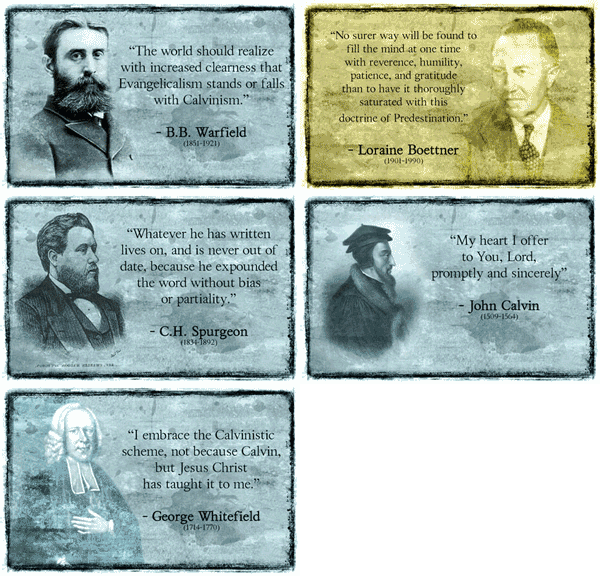
Humble Calvinism image cards: B.B. Warfield, John Calvin, Loraine Boettner, George Whitefield. Do you have a great Calvinism quote? Post it in the comments at the bottom of this post and it may become an image card.

——————————–

Reviews and notes

– The banner graphic was lifted straight from the creative minds of Sovereign Grace Ministries New Attitude group. Thanks for the graphic inspiration and the spiritual inspiration to live out humble orthodoxy! (2007.01.09)

02spurgeoncalvinsig.jpg

Free Book: Come Unto Me by Tony Reinke

Free book
Come Unto Me: God’s Invitation to the World
by Tony Reinke

This time last year I was staying up late and getting out of bed very early to put the final touches on my undergraduate thesis. I convinced my secular academic adviser that it would be good to clarify the contours of the biblical gospel. I’m sure he wasn’t too thrilled.

03spurgeoncumcover.jpgFor me, the opportunity to concentrate my attention on the character of our priceless gospel was incredible. The product was the book titled Come Unto Me: God’s Invitation to the World. My primarily goal was to take advantage of an opportunity to articulate the biblical gospel — both the work of Christ and the act of faith — with my academic adviser and fellow classmates.

Secondly, my non-Christian audience pushed me to think hard at how to best articulate the biblical worldview, something I had not consciously worked through in the past.

Finally, the book helps me retain an important balance in my personal ministry. There are several contours of the gospel and each are easy to forget or minimize.

The invitation to God, from God, is a biblical message filled with rich diversity. For those who accept it, this message requires sorrow and promises inexpressible joy. The invitation comes without price and costs everything. The invitation includes an offer of a relationship to God that is both forensic (or legal) and yet conjugal (or marital). The invitation to God is a call to leave past burdens and take up new burdens.

Frequently I need to be reminded of these important contours.

And so now I offer this book for your reading. It’s free for you to download and read. Thanks to the help of gracious friends, it now comes in three mouth-watering flavors:

1. Come Unto Me in HTML format. This is the basic text format but ideal if you are interested in browsing or reading the content online. Click here for HTML.

2. Come Unto Me in PDF format. Ideal if you are interested in downloading and printing the book. This file preserves the original pagination and formatting. Click here to download the PDF file.

3. Come Unto Me in LOGOS format. Ideal if you want to incorporate my research of the biblical gospel into your own research. Thanks to my friends at StillTruth, you can download and install my book into your Logos software. Click here to access the StillTruth Webpage and download.

Blessings!

A slave beaten … a Son killed: Illustrating the weight of Sin (John Owen)

“To see a slave beaten and corrected, it argues a fault committed; but yet perhaps the demerit of it was not very great. The correction of a son argues a great provocation; that of an only son, the greatest imaginable. Never was sin seen to be more abominably sinful and full of provocation, than when the burden of it was upon the shoulders of the Son of God. God having made his Son, the Son of his love, his only begotten, full of grace and truth, sin for us, to manifest his indignation against it, and how utterly impossible it is that he should let the least sin go unpunished, he lays hand on him, and spares him not.”

John Owen, Communion with God from The Works of John Owen (Banner of Truth), 2:96.

“Overlaying the Gospel”: Bonar on the temptation to be ashamed of the Gospel

“Overlaying the Gospel”: Bonar on the temptation to be ashamed of the Gospel

“The apostle so knew it, as to be able to say, ‘I am not ashamed of it,’ [Romans 1:16] — just as elsewhere, speaking of the cross, he says, ‘God forbid that I should glory, save in the cross of the Lord Jesus Christ’ [Galatians 6:14]. He was not ashamed of it at Jerusalem, or Athens, or Rome. Many things were there to make him ashamed of it — Jewish prejudice and Gentile pride. But these prevailed not. In spite of contempt and hatred, he held it fast.

We are apt to be ashamed of it. It looks weak, foolish, unintellectual, unphilosophical. It lags behind the age. It has become obsolete; or rather, it refuses to become obsolete. It is beginning to be supplanted by learning and eloquence. Men are apt to shun the gospel as a feeble, childish thing, that has done its work in time past, but is giving place to something higher, and more in accordance with the ‘deep instincts of humanity.’

There were some places in which the apostle might have been specially tempted to be ashamed of the gospel, or afraid of preaching it: at Jerusalem, for there the whole strength of Jewish ritualism rose against it; at Athens, for there it was confronted by the power of Grecian wisdom; at Ephesus, for there the dazzling subtleties of heathen magic rose against it; at Corinth, for there the torrent of human lust and pleasure rushed against it; at Rome, for there was the concentrated energy of earthly idolatry. Yet none of these things moved him. He was not ashamed of the gospel of Christ, though all that was intellectual, and eloquent, and sensual, and refined, and powerful in humanity protested against it, or mocked it as folly.

We are tempted in our day to be ashamed of the gospel. It is thought to be bare, unintellectual, almost childish, by many. Hence they would overlay it with argument and eloquence, to make it more respectable and more attractive. Every such attempt to add to it is being ashamed of it.”

Horatius Bonar, The Christian Treasury in The Life and Works of Horatius Bonar (CD-Rom, Lux Publications) pp. 828. (Posted with permission from publisher.)

Book review: Caleb’s Lamb by Helen Santos (1892777703)

Book review
Caleb’s Lamb by Helen Santos

The long-running children’s show Sesame Street once wrote and filmed an entire episode around Big Bird’s search for a real name. Every one else had names (Bert, Ernie, Oscar, etc.). But “Big Bird” is just a description, not a name. The episode never aired because the theme did not make sense to children. Isn’t “Big Bird” his/her/its name? Why search for another name? Doesn’t the old name work just fine?

Communicating to children is no easy task and yet is one of the most critical tasks for Christian parents. And this is because there are no more important (or often more difficult) concepts to explain to children than the substitutionary atonement of Jesus Christ.

Caleb’s Lamb by Helen Santos will help parents succeed in this task.

Set in the Old Testament era of the plagues in Egypt and the Passover, this 93-page chapter book is the story of a young boy named Caleb and his reluctant life as a shepherd. He does not like sheep and hates being a shepherd. The sheep are dumb and high-maintenance, and a burden for the young boy. One day a pregnant sheep wanders into the wilderness and Caleb is sent to find her.

After a dark night alone he finds the ewe dead. But hidden safely in a thatch of thorns he finds a newborn spotless lamb. He takes this weak and famished animal home. From here the book focuses around Caleb’s relationship with his beautiful new lamb.

In the end, word spreads to the shepherds of the coming exodus. God is coming to kill the firstborn male of every house. The race begins for the Jewish people in Egypt to sacrifice a spotless lamb as God’s judgment draws near.

Caleb’s Lamb is very well written. There are multiple themes throughout the book including life in Old Testament times, life as a shepherd, the often-repeated significance of Abraham’s near-sacrifice of Isaac, and especially the blood required to atone for sin.

The book was full of plot-line twists and vivid imagery. It will prove an excellent bedtime read for young children and a very helpful homeschool resource for older children. But most importantly, the book is filled with references to the substitutionary atonement of Jesus Christ in a storyline well-suited for children and useful for Cross-centered parenting.

Binding: Paperback
Pages: 93
Topical Index: no
Textual index: no
Bibliography: no
Photos: 0
Charts: 0
Reading level: Child. Great reading for younger children and written for an udience of readers in the 9-11 yr. category.
Publisher: Reformation Heritage
Price: $10.00/$7.50
Where this book fits into my library:
(1) Children’s books > Fiction > nature of the atonement
(2) History > Life in Old Testament times
(3) Shepherding > The nature of

Book review: Caleb’s Lamb by Helen Santos, 1892777703, 1-892777-70-3