2007 Banner of Truth Pastor’s Conference details

This year I’m planning to attend two new conferences. The first is the Sovereign Grace Ministries Leadership Conference in April and the other is the Banner of Truth pastors’botconf.jpg conference in May. I’ve heard about them but never seen them for myself. Lord willing, this spring I will attend them both.

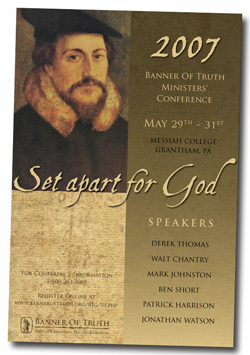
As you may have guessed, one of the major reasons I am spending so much time in John Calvin these first months of 2007 is to prepare for the upcoming Banner of Truth Ministers’ Conference entitled “Set Apart for God.” The conference runs between May 29th and 31st on the campus of Messiah College in Grantham, PA. Speakers will include two of my favorites, Derek Thomas and Walt Chantry (Chantry wrote the excellent book, The Shadow of the Cross). I look forward to Dr. Thomas’ trio of presentations on holiness, especially as they relate to Calvin’s Institutes. It is encouraging to see emphasis on Calvin’s understanding of the Christian life (as I think he has much to offer here). Dr. Thomas wrote an excellent book on Calvin’s understanding of the book of Job which has recently become one of my favorites. We’ll look more at this book on Friday.

bot.jpgUPDATE 3/14: Walt Chantry will not be available to speak this year. Instead, Sinclair Ferguson will be taking his place.

But for more information on the pastors’ conference you can download the newly-released conference PDF here and you can register here. Should be a fun time. And from what I’m told, Friends of the Shepherd’s Scrapbook will get an exclusive tour of the Banner of Truth warehouse in Carlise, PA as an added bonus!

Humble Calvinism: (10) The Institutes > The self-authenticated Word (1.7)

02spurgeonhumcalvinism.jpg

Part 10: The self-authenticated Word (1.7)

Sinners are in bad shape. We neglect as much of God’s glory as we can and the unmistakable evidence we do see is quickly suppressed and ignored. We want to live autonomously. We want to be independent from God, making our own decisions and choosing what we think is good for us. We are not merely ignorant of God, we are01spurgeoncalvin1.jpg enemies of God (Rom. 5:10). We let our worldly, temporal appetites guide our lives and become enemies of the Cross in the process (Phil. 3:18-19). We are not ignorant biology students needing more information, we are sinners actively resisting truth and rebelling against God.

So when the Roman Catholic catechism of 1997 (π 154) teaches, “Trusting in God and cleaving to the truths he has revealed is contrary neither to human freedom nor to human reason” I can only shake my head. It contradicts both depraved bondage and a mind that suppresses truth like a boot suppresses an empty pop can.

The big question of the day is this: For the sinner to give the Word of God the full weight of her reverence and obedience, God must first burn these convictions supernaturally into her heart. For the Word of God to truly impact our lives, God must abduct us! He must convince us of the authenticity of His Word. He must convince us that His words are “sweeter than honey to my mouth” (Ps. 119:103). We must be given “the mind of Christ” (1 Cor. 2:16).

Once again, it goes back to the sovereign intervention of God. He alone can cause His elect to submit to the full authority of the Word by convincing them of the authenticity of the Word. This is exactly what God does.

The church and religious authority are insufficient (1.7.1-3)

The church does not have the authority to authenticate the Word. In Calvin’s day (and to our day), Roman Catholicism believed the authority of Scripture was authenticated via the authority of the papacy. This is impossible. According to Ephesians 2:20 the Word of God’s authority and authenticity preceded the church! No church ruler, pope, cardinal or pastors can authenticate the Word because the Word preceded the church.

In fact, no human authority can authenticate the Word. Calvin writes, “what will happen to the miserable conscience seeking firm assurance of the eternal life if all promises of it consist in and depend solely upon the judgment of men?” (75). It is absurd to think that the authenticity of Scripture rests upon council or decree.

Here’s the punch line: “Scripture exhibits fully as clear evidence of its own truth as white and black things do of their color, or sweet and bitter things do of their taste” (76). Scripture is self-authenticated!

Where “divine majesty lives and breathes” (1.7.4-5)

No sinner gives their life to the biblical God and the doctrines and truths contained in the Word until they are “persuaded beyond doubt that God is its Author” (78). And later, “For even if it wins reverence for itself by its own majesty, it seriously affects us only when it is sealed upon our hearts through the Spirit” (80). In other words, you can take the “Bible as Literature” course in college and be amazed at the literary styles and structure of the Bible and yet never be changed by the eternal truths contained within. God must sovereignly burn the authenticity of the Word into our hearts. He must authenticate in our own rebellious hearts that God is the Author. He must give us spiritual eyes and tongues to see and taste that God’s Word is what it claims.

Calvin references Isaiah 43:10: “’You are my witnesses,’ declares the LORD, ‘and my servant whom I have chosen, that you may know and believe me and understand that I am He.’”

We must rest upon a divine power stronger than rational evidence and scientific proofs because even if the Word is authenticated by rationalism and proofs we will “ever waver among many doubts.” Rather, “those whom the Holy Spirit has inwardly taught truly rest upon Scripture, and that Scripture indeed is self-authenticated; hence, it is not right to subject it to proof and reasoning” (80). The authenticating power of the Spirit is “more excellent than all reason” (79).

By not resting in proofs and human reasoning, the authority and authenticity of Scripture rest upon something higher and stronger. “We seek no proofs, no marks of genuineness upon which our judgment may lean; but we subject our judgment and wit to it as to a thing far beyond any guesswork” (80). When the Holy Spirit confirms Scripture in our hearts “we feel that the undoubted power of his divine majesty lives and breathes there. By this power we are drawn and inflamed, knowingly and willingly, to obey him, yet also most vitally and more effectively than by mere human willing or knowing!” (80).

In summary, Calvin teaches us that Scripture is self-authenticated (Gk. autopiston). Its authenticity rests in the truth that Scripture is where God’s “divine majesty lives and breathes” (80). And every sinner God chooses to invade, abduct, and transform will experience the burning authenticity of the Spirit.

This does not mean there are no proofs and reasons for the authenticity of Scripture. There are, and Calvin will give us many to ponder in the next chapter. But proofs are not enough to convince spiritually dead enemies of God. Humble Calvinism teaches it that if I am going to understand God and obey His Word, He must invade my heart and burn a conviction of its truth into my heart.

Calvinistic meditations …

1. Watch your evangelism. How do we prove the authority and authenticity of God’s Word to sinners? We don’t. This truth will radically impact our evangelism. As you probably know, there is a tremendous pressure in our church culture to use rational proofs and arguments to “convince” sinners of the truth of Scripture. If this is your evangelistic strategy, you and your audience will always be haunted by the next ‘proofs’ and ‘arguments’ of the opposing views. Christianity is a call for sinners to believe in eternal things. There is no proof. How do you prove the perfect righteousness and resurrection to one who wants scientific data? As A.W. Tozer once said, “To seek proof is to admit doubt, and to obtain proof is to render faith superfluous” (Knowledge of the Holy, p. 19). Press sinners to embrace mystery, preach the gospel and let God take the responsibility of burning this truth upon sinner’s hearts. Your main concern is with presenting biblical truth accurately. The gospel – not proofs or rationalism – is the power of God to save depraved sinners (Rom 1:16).

2. Remember the depravity of our hearts. Churches that attempt to convince sinners of the truth with rationalism have fundamentally misunderstood our depravity so clearly stated in Romans and Ephesians. We need to ever remind ourselves of the state of the sinful human heart. Evidence can demand a verdict from sinners suppressing the truth in unrighteousness, but such verdict will never come (Rom. 1:18).

3. Expect rejection. Some preachers hide behind rationalism and human wisdom to avoid being rejected by sinners. Rejection and acceptance is not your responsibility – preaching the whole counsel of God is! If your audience is split over the gospel – some see it as the power of God and some see the gospel as foolishness – you are probably doing something right (1 Cor. 1:18-2:16). Keep boasting in the Cross! Some sinners will rest their hopes in signs and wonders alone, and they will never have signs or wonders enough. Some will want wisdom and proof and they will always waiver and struggle. But we are called to “preach Christ crucified, a stumbling block to Jews and folly to Gentiles, but to those who are called, both Jews and Greeks, Christ the power of God and the wisdom of God” (1 Cor. 1:23-25). If we are running from rejection we will mold church methods with fatal flaws and replace the gospel with something less foolish.

“For who knows a person’s thoughts except the spirit of that person, which is in him? So also no one comprehends the thoughts of God except the Spirit of God. Now we have received not the spirit of the world, but the Spirit who is from God, that we might understand the things freely given us by God. And we impart this in words not taught by human wisdom but taught by the Spirit, interpreting spiritual truths to those who are spiritual. The natural person does not accept the things of the Spirit of God, for they are folly to him, and he is not able to understand them because they are spiritually discerned” (1 Cor. 2:11-14).

So when you speak to other sinners, speak the truth in love. Pray that God would give them spiritual eyes to see that the “undoubted power of His divine majesty lives and breathes” in the Word. Oh, how it burns!

————————–

Click here to access previous posts in the Humble Calvinism index.

————————–

Humble Calvinism: (9) The Institutes > Clinging to a thread (1.6)

02spurgeonhumcalvinism.jpg

Part 9: Clinging to a thread (1.6)

With the help of microchips and electrical pulses, scientists are confident that the blind will one day see again. In our study of God, we now come to the reality that God confronts our spiritual blindness with His own advancements.

As we’ve seen in our series on Humble Calvin01spurgeoncalvin3.jpgism, God’s glory is displayed in the universe for all to see with the hopes that we will honor and thank Him (Rom. 1:21). We don’t. We’re blind and we suppress Him to preserve our sinfulness (Rom. 1:18). The revelation God shines in the natural world is loud and bold but because of our sinful ignorance and suppression of this truth, it calls out “in vain” (73). Our hardened hearts miss the point. We need more than brighter colors, louder sounds or more complex genetic structures in creation. We need God to reveal Himself in a new way. We need new revelation.

God must speak more directly of Himself. For Calvin, Scripture is a “better help,” a “special gift,” the “pure knowledge of Himself,” and a “more direct and more certain mark whereby he is to be recognized” (69-70). Scripture is a bold solution directed at the blindness due to our depravity.

Calvin will not address our need for Scripture to understand the way of salvation until later. Here he says, merely to see God as the Creator of the universe, we need Scripture! Even though creation screams the glory of God every day through landscapes, microscopes and telescopes we need Scripture to tell us that God is the One who “founded and governs the universe” (70).

It would be accurate to subtitle Scripture “The Working of God in the Created Order for Dummies.” Merely the need for Scripture reminds us that we sinners just don’t get the point. The need for the bible reveals our ‘radical’ depravity. We walk blind in broad daylight.

Question. Has anyone ever tapped your head with their knuckles when you didn’t get something? Now pick up your bible and smack yourself on the forehead. In love, that’s what it was made for. We should have first seen God through His creation and pursued Him. We don’t.

So by giving us His special, more specific Word (the bible) and opening its meaning to our hearts, God gives sinners the precious gift of sight! This revelation through His Word now renders faith “unambiguous forever” and “superior to all opinion” (71). His Word opens the eyes of the blind to Himself. Through Scripture we can see again. Through Scripture we are given the content of faith that no human opinion can shake!

Even here, piety is central to Calvin. We understand God rightly in the Word only when we “reverently embrace” what God reveals of Himself because “all right knowledge of God is born of obedience” (72). Again and again, Calvin protects us from the idea that knowledge of God is gained just like knowledge of biology. Genuine piety (otherwise known as ‘reverence’) is central to understanding God. We must come to Scripture to learn about God in fearfulness, not flippancy. God says we must come to Him as one who is “humble and contrite in spirit and trembles at My word” (Isa. 66:2). How does a rebel sinner come to this place? God must subdue him. We’ll talk more about this amazing work of God in the coming weeks.

There are other reasons we must have special revelation from God in His Word. Our hard hearts (even regenerated hearts!) are naturally inclined to forget God, slide towards errors and create our own empty religions. Calvin writes, “how slippery is the fall of the human mind into forgetfulness of God, how great the tendency to every kind of error, how great the lust to fashion constantly new and artificial religions” (72). Scripture protects us from these errors because it elevates truth beyond our “depraved judgment” and into the “rule of eternal truth” (73).

When you add our depravity and blindness together with the gift of the truth we make one conclusion: We must always be pressing closer to Scripture as our guide. We must walk by faith and not by sight (2 Cor. 5:7). Scripture must be the computer chip and electrical pulses to override our spiritual blindness. Calvin illustrates the concept like this,

“If we turn aside from the Word … though we may strive with strenuous haste, yet, since we have got off the track, we shall never reach the goal. For we should so reason that the splendor of the divine countenance [or God’s presence], which even the apostle calls ‘unapproachable,’ is for us like an inexplicable labyrinth unless we are conducted into it by the thread of the Word; so that it is better to limp along this path than to dash with all speed outside it” (73).

The path to the presence of God is an “inexplicable labyrinth.” There are so many winding staircases and hallways, and millions of choices that will lead away fromcalvininstitutes.jpg God’s presence. There is a way that seems right to a man but it’s the way of death (Pro. 14:12). So we must walk by faith and not by sight, opinion or feeling. In effect our sinful ignorance hides Him. Yet along the path God has stretched a thread. Some will chase their own opinions or hastily run into all error, but the Christian slowly limps along the path, following the thread of the Word through this stairway, over this bridge, now down these stairs and around through a narrow doorway off to the side and through another tunnel.

As soon as we take our hand off this “thread” we are lost. Calvin closes this chapter with John 4:1-45 where Jesus meets the Samaritan woman at a rest stop. Samaria itself was a bad place because of its theological heresies. The Samaritans built their religion off only the first five books of the Old Testament. This reductionism was dangerous. So dangerous, Jesus did not hesitate in telling the Samaritan woman she worshipped in “ignorance” (v. 22). Her church was worthless.

Calvin writes that when sinners begin “seeking God without the Word” they naturally “stagger about in vanity and error” (74). The Samaritans had taken their hands off the Word, were blind and now lost in the labyrinth.

So everyone who has a bible can see the spiritual realities clearly? Well, no. Before sinners put their entire trust in the message of the bible, they must first be convinced Scripture is the ‘real deal.’ So how do we convince other blind, truth-suppressing sinners to leave their own religious opinions and cling to the bible as God’s one revelation of Himself? Rational proofs? Arguments? Debates? What we will see next time is perhaps the most stunning truth I’ve ever learned from Calvin…

Calvinistic meditations …

1. Nothing cautions us of our own spiritual blindness more than Humble Calvinism. We miss God in creation every day! So how can we become prideful in our knowledge of Scripture? Why would I ever think that running a church or preaching a sermon without clinging to Scripture will lead through the labyrinth? How can we let go of the thread and think human opinion will guide the way? Scripture reminds us to be cautious of our own hearts because they are naturally inclined towards errors and false religions. The thread of God’s Word leads the way, but it also prevents empty speculation and the impulse to find a better route. (Occasionally you may find it helpful to smack yourself in the forehead with a bible to be reminded of this.)

2. Jesus’ conversation with the Samaritan woman reminds us to beware of theological reductionism. Theological reductionism is one of the most rampant problems in contemporary Christianity. It’s not merely that gross errors abound. Many churches believe in the Trinity and seven-day Creationism and the importance of Jesus. Theological reductionism concerned with what is missing, of churches building their theology and methods off only part of Scripture. So churches now will call people to come to Jesus but not talk about sin and hell and guilt to drive them His way. People get saved from something other than God’s wrath. Other churches will talk about Jesus but not the substitutionary atonement whereby He bears my wrath and I get the grace. Both are common examples of contemporary theological reductionism. Jesus reminds the Samaritan woman that even to build a church upon part of the truth is to take both hands off the thread. So it’s no surprise that churches who struggle with theological reductionism will not place a high priority on lengthy expositions through Scripture nor doctrinal precision.

It’s important to note that John Calvin wrote the Institutes to complement his extensive expositional studies through the bible. Look to the commentaries if you want the specific details on Calvin’s systematic conclusions. Letting the full range of Scripture determine your beliefs is an excellent model for all Christians and pastors. Summarize your faith but be ready to defend its Scriptural basis as well.
Bottom line: We must never rest ourselves in vague talk about church, Jesus and Heaven lest we likewise worship in “ignorance.” Don’t be convinced a church is truly Christian just because they use the same words and terms as the bible. Search out their gospel, their savior and their hell. And if you are a pastor, make it your top aim to always be pushing yourself and your church as deep into Scripture as God allows.

3. Prepare for a long road of biblical growth. God’s special revelation is lengthy and filled with many details. God clearly did not intend it to be read in a weekend. It will take your entire lifetime and hundreds of sermons to work through. Humble Calvinism is a call to life-long, patient growth. Put both hands on the thread of Scripture. You won’t run fast, but you’ll walk securely. Resist the temptation to live faster than you can hold on to Scripture. If books encourage you to grow your church without slowly disclosing the whole counsel of God, you can be certain its author, having lost the thread, now runs ignorantly through the dark caves.

Never! Never! Never, let go of the thread! It’s your only hope into the presence of God!

————————–

Click here to access previous posts in the Humble Calvinism index.

————————–
Journaling … A Day in the Life of a Humble Calvinist

Journaling > A Day in the Life of a Humble Calvinist

Calvinism is big. It’s a worldview that embraces God’s sovereignty over every event in world history. God is over the shifting of political powers, the immigration of people, the establishment of cultures, natural calamities, and even down to the fact that you are reading this right now. By nature, Calvinism is concerned with everything because God is concerned with everything. So how can we allow the biblical theology of Calvinism and the Cross to penetrate our daily living so that dry, stoic, intellectual Calvinism becomes living and breathing Humble Calvinism?

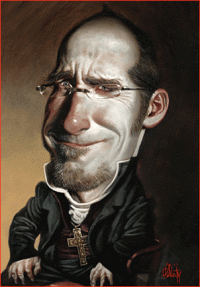
Well, one of my dear friends has helped me see what this looks like. Tom Fluharty is an tomflu.gifincredible artist. His talents are phenomenal. But even more phenomenal is God’s grace that allows him to focus his mind, will and affections on Gospel in his daily devotional times. I get to read some of these journal articles that he sends my way on occasion. I wanted to share a recent journal entry.

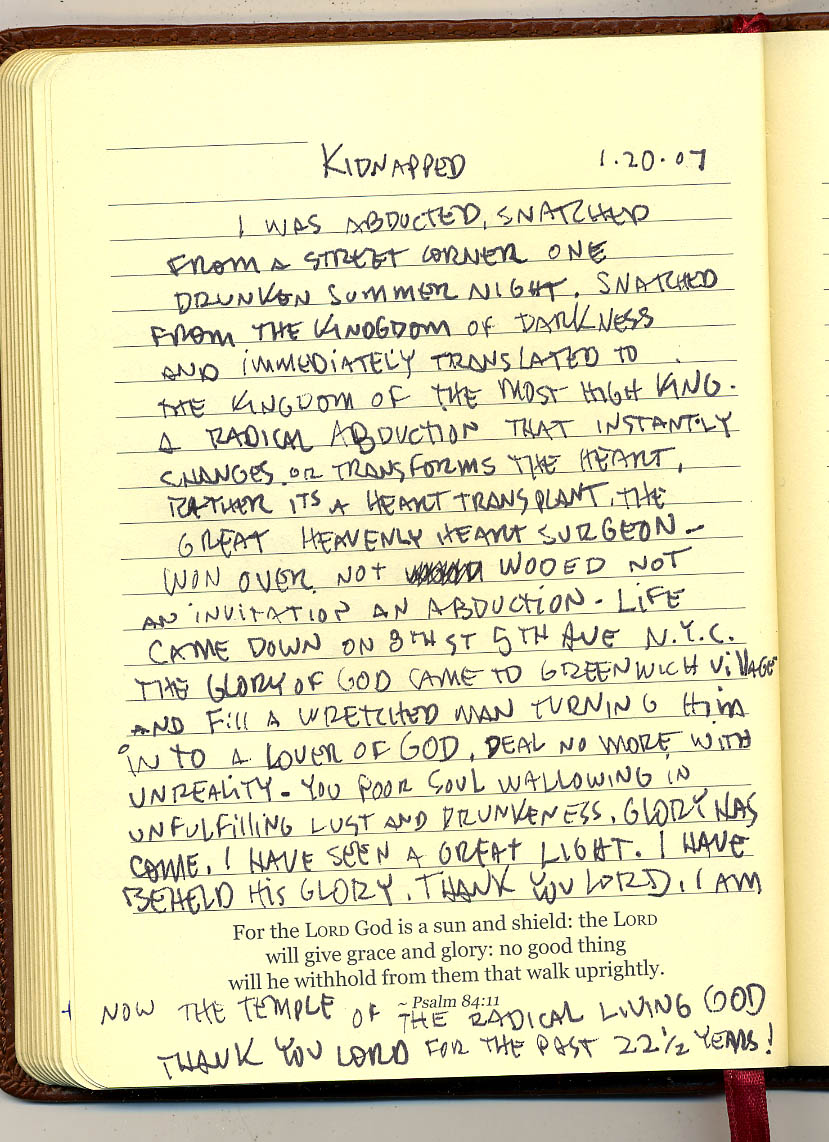
We’ve been talking recently about God’s abduction. Sinners like us don’t want God. We all naturally turn away from Him, fail to do anything to glorify Him, and thus we all become worthless to Him (Rom. 3:12). God must abduct us! He must chose for us something better than we’ve chosen for ourselves. This thought caught the attention and affections of Tom in his recent journal entry. This is what he wrote,

Kidnapped 1.20.07

I was abducted, snatched from a street corner one drunken Summer night. Snatched from the kingdom of darkness and immediately translated to the kingdom of the Most High King. A radical abduction that instantly changes or transforms the heart. Rather it’s a heartabducted.jpg transplant by the great heavenly heart surgeon. Won over not wooed. Not an invitation, an abduction. Life came down on 8th st 5th Ave N.Y.C. The glory of God came to Greenwich Village to fill a wretched man, turning him into a lover of God. Deal no more with unreality. You poor soul wallowing in unfulfilling lust and drunkenness. Glory has comes. I have seen a great light. I have beheld His glory. Thank you Lord. I am now the temple of the radical living God. Thank you Lord for the past 22 1/2 years!

“Won over not wooed. Not an invitation, an abduction.” That thought flows from a radical, Humble Calvinism. Tom encourages me through his example. Our communion with God should be saturated with the Cross, saturated with an awareness of our depravity, the personal election of God, God’s strength to uphold us and the glory of God’s sovereign majesty! This is a reminder that Humble Calvinism should transform every area of my life, and even show itself in my journal entries. We build off theology. But let’s not stop by saying “Isn’t it amazing that God elects sinners?” Let’s move beyond this and say, “Isn’t it amazing that God elected such a sinner as I when I was … ?” Humble Calvinism must penetrate our hearts and reveal itself in how we worship the Sovereign Lord and this will show itself in our daily journals.

———————–
UPDATE: I wrote this post Sunday morning only to find out that Tom and his precious family were invited over for the surprise birthday bash my wife pulled off that afternoon. Well, he shows up with a present. It was obvious that it was a painting he was giving me (that alone was and amazing). I open it to find one of my favorite paintings published on the cover of the Weekly Standard called Master & Commander.

I’m not really a political guy myself, more drawn to the phenomenal character and detail of the painting (like Condi’s pearl necklace). Because of these factors, this magazine cover sat above my desk for several months in Omaha — long before I ever met Tom. To know Tom and now to have the actual painting are both amazing gifts. You can see the painting here and you can read more about how he drew it here. But if you’re a friend, you can see it in person, featured at the Tony Reinke Museum of Art in Bloomington, MN. An amazing birthday gift from a very gracious man. Thank you Tom!

[You can watch Tom integrate art, Humble Calvinism and an amazing Cross-centered life here at his blog Amazed by Grace!]

Humble Calvinism: Series index

02spurgeonhumcalvinism.jpg

Humble Calvinism: Full series index

——————————–

“A world-class theologian, a revered exegete, a renowned teacher, an ecclesiastical statesman, an influential Reformer — he was all of these and more. His name was John Calvin.”– Steven J. Lawson, The Expository Genius of John Calvin

——————————–

Humble Calvinism > Full Posts

1. John Calvin (1509-1564)
2. Why John Calvin?
(Why Calvinism? Why now?)
3. The Institutes > Intro
4. The Institutes > Knowing God and knowing self (1.1)
5. The Institutes > The all-sufficient God of Scripture (1.2)
6. The Institutes > The implanted knowledge of God (1.3)
7. The Institutes > Weaving a wicker basket god (1.4)
8. The Institutes > ‘Radical’ depravity (1.5)
9. The Institutes > Clinging to a thread (1.6)
10. The Institutes > The self-authenticated Word (1.7)
11. The Institutes > Proofs of Scripture’s authenticity (1.8 )
12. The Institutes > The “mutual bond” of God’s power and Word (1.9)calvininstitutes.jpg
13. The Institutes > Experiencing God (1.10)
14. The Institutes > The idol factory (1.11)
15. The Institutes > God is One (1.12)
16. The Institutes > God is Three (1.13)
17. The Institutes > Viewing God’s Theater (1.14)
18. The Institutes > The Spirit’s Application of the Gospel (3.1)
19. The Institutes > What is Faith? Pt. 1 (3.2.1-5)

——————————–

Books

1. Humble Calvinism Essentials (Institutes and McGrath bio)
2. New book > Calvin: The preacher A good corrective by Lawson
3. Review > Sermons on the Beatitudes by Calvin
4. Review > Calvin’s Teaching on Job by Derek Thomas
5. Review > Chosen for Life by Sam Storms
6. Quote > The importance of Calvinism by Steven Lawson
7. Quote > Calvinism and the redemption of counseling
by David Powlison

(Tim Challies has made the world fully aware of my biblio-photographic nerdiness. Thanks Tim for the humility. I need more of it!)

——————————–

Misc. articles and posts

1. D. Clair Davis > “What’s so good about being a Calvinist?
2. Journaling > A Day in the Life of a Humble Calvinist

3. 2007 Banner of Truth Ministers’ Conference details
4. Bonar > The Humble Calvinist in the work of God
5. Packer > Humble Calvinism and evangelism
6. Calvin > The weight, beauty and comfort of the Gospel
7. Kuyper > This all-embracing predestination

——————————–

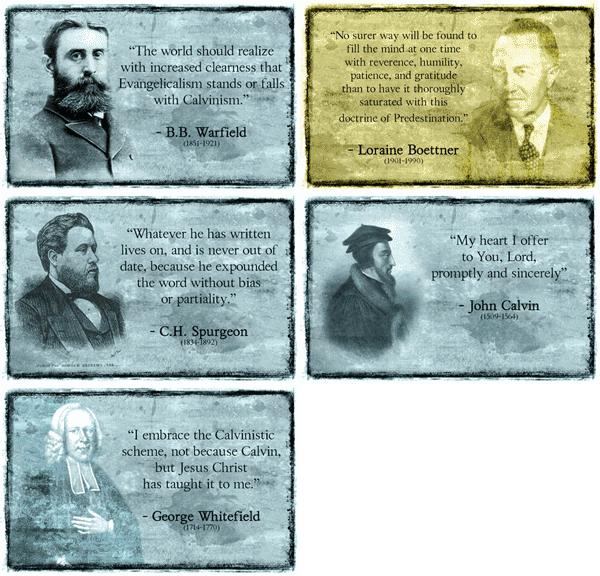
tssimagecards.gif

Humble Calvinism image cards: B.B. Warfield, John Calvin, Loraine Boettner, George Whitefield. Do you have a great Calvinism quote? Post it in the comments at the bottom of this post and it may become an image card.

——————————–

Reviews and notes

– The banner graphic was lifted straight from the creative minds of Sovereign Grace Ministries New Attitude group. Thanks for the graphic inspiration and the spiritual inspiration to live out humble orthodoxy! (2007.01.09)

02spurgeoncalvinsig.jpg