Resurrection and New Creation

Blog readers here know I particularly like to focus my attention on the many consequences of Christ’s glorious resurrection, the promise of the New Creation being one of these consequences. Recently I came across the following quote in a really excellent book by Michael Williams, Far As The Curse Is Found: The Covenant Story of Redemption (P&R, 2005). This comes under the heading “The Resurrection Previews the Final Chapter: The Restoration of Creation.”

Williams writes:

The flesh Jesus takes on in the incarnation is a flesh he never lays down. It is there in his ministry: Immanuel, God with us, come in the flesh to cure his broken world. And that same flesh, repaired, renewed, and glorified in resurrection, is there in the risen and ascended Christ. In Jesus’ bodily resurrection we view with Thomas the very meaning of the resurrection: the restoration of creation.

G. C. Berkouwer once observed that if we conceive of the Christian faith—and what it proclaims about human destiny and the goal of all things—apart from reference to the resurrection of Christ, without appreciating its nature as the restoration of all things, then we have not truly grasped the nature of redemption. Since we have been born again to “a living hope through the resurrection of Jesus Christ from the dead” (1 Peter 1:3), the hope of the believer “rests on a promise inseparable from the salvation already granted” in Christ’s resurrection from the dead.

In God’s mighty act of raising Jesus bodily from the grave we are right to glimpse the final chapter of the drama of redemption. Indeed, an understanding of redemption that fails to take its moorings from Christ’s victory over sin and death via bodily resurrection, and the promise of ultimate restoration of all things declared by the empty tomb, is not a biblical understanding of redemption at all. …

The resurrection is something of a foretaste, a movie trailer or commercial for God’s ultimate future, for in Christ’s resurrection we have a picture of the future given before its arrival. The end is seen ahead of time. As the beginning and foretaste of the future, the resurrection is the firstfruits or the first stage of the coming redemption. The bodily resurrection of Christ not only signifies God’s victory over sin and death but also declares the nature of that victory. It is total, comprehensive; so comprehensive that it claims that history is moving toward nothing less than a fully restored and glorified universe. Those who are in Christ, along with the entirety of creation, will receive his resurrection life upon his appearing (Rom. 8:21-25).
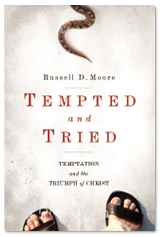
A Spike-Torn Hand Twitched

The following is my favorite excerpt from one of my favorite books of 2011: Tempted and Tried: Temptation and the Triumph of Christ by Russell Moore (Crossway, 2011). The quote is worthy of a slow and careful read (from pages 124-125):

Part of the curse Jesus would bear for us on Golgotha was the taunting and testing by God’s enemies. As he drowned in his own blood, the spectators yelled words quite similar to those of Satan in the desert: “Let the Christ, the King of Israel, come down now from the cross that we may see and believe” (Mark 15:32). But he didn’t jump down. He didn’t ascend to the skies. He just writhed there. And, after it all, the bloated corpse of Jesus hit the ground as he was pulled off the stake, spattering warm blood and water on the faces of the crowd.

That night the religious leaders probably read Deuteronomy 21 to their families, warning them about the curse of God on those who are “hanged on a tree.” Fathers probably told their sons, “Watch out that you don’t ever wind up like him.” Those Roman soldiers probably went home and washed the blood of Jesus from under their fingernails and played with their children in front of the fire before dozing off. This was just one more insurrectionist they had pulled off a cross, one in a line of them dotting the roadside. And this one (what was his name? Joshua?) was just decaying meat now, no threat to the empire at all.

That corpse of Jesus just lay there in the silences of that cave. By all appearances it had been tested and tried, and found wanting. If you’d been there to pull open his bruised eyelids, matted together with mottled blood, you would have looked into blank holes. If you’d lifted his arm, you would have felt no resistance. You would have heard only the thud as it hit the table when you let it go. You might have walked away from that morbid scene muttering to yourself, “The wages of sin is death.”

But sometime before dawn on a Sunday morning, a spike-torn hand twitched. A blood-crusted eyelid opened. The breath of God came blowing into that cave, and a new creation flashed into reality….

Astonishing.

Dr. Moore’s book will be released in April.

Easter and Ecclesiastes

The Old Testament book of Ecclesiastes tackles the tricky subject of the vanity or meaninglessness (Hebrew: heḇel) of life in our fallen world. In this fallen world there are many disappointments and injustices and so much brutality and pain. So much of life in this fallen world just doesn’t make sense to us. In fact even the ‘progress’ of life can so often feel like a mere chasing after the wind. Unhappiness abounds, even in the lives of who have all the worldly comforts imaginable and have every situational excuse to be happy. Even worse, we know that everyone in this world will die, enter into the ‘darkness,’ and be buried in a grave, an inevitable progression that is starkly contrast to God’s original design for the man and woman he created in His own image. Death is heḇel’s ultimate triumph (Ecc 3:18–21, 11:8, 12:1–8). In the New Testament the Apostle Paul picks up and builds from this heḇel theme when he writes about the “frustration” of the creation in Romans 8:19–24. There we find that this vanity is clearly cosmic in scope, reaching deeper into the soil than tree roots and stretching higher into the sky than mountain peaks. The vanity reaches all points of creation. Here Paul not only deepens our awareness the vanity of the fallen world, more importantly he sets the creation’s frustration within a redemptive framework (Webb, 108). Within this framework we see that in Christ’s death and resurrection the vanity of Ecclesiastes is being undone. In the redemption of our bodies, when our resurrection and the new creation will be fully revealed, the vanity we read about in Ecclesiastes will be completely undone. Easter marks the beginning of the end for heḇel. Meanwhile we live in hope. We have the Holy Spirit to intercede for us and we have God’s promise that although there is much about life that makes no apparent sense, everything in life is now working together for our ultimate good and according to God’s unassailable design for our lives (Rom 8:26–30). For now Christians await the final end of the heḇel by living by faith in God’s revelation: we fear God; we obey his commands; we partner together to build His church [an activity that is never done in vain (1 Cor 15:58)]; and we await our bodily resurrection by enjoying the abundant gifts that God offers us today (Ecc 2:24–25, 5:18–20, 9:7–9, 12:13).

The Resurrection

From J.I. Packer, lecture notes:

The resurrection of Jesus:

  • demonstrated his victory over death (Acts 2:24; cf. 1 Cor. 15:54–57);
  • vindicated him as righteous (Jn. 16:10);
  • vindicated his divine identity (Rom. 1:4);
  • led on to his enthronements, through his ascension (Acts 2:36; Phil. 2:9f);
  • guaranteed our hope of resurrection after death (1 Cor. 15:18);
  • guaranteed the eventual renewal of the universe (1 Cor. 15:24; Eph. 1:10; Phil. 3:21);
  • is the basis of our resurrection life now (Rom. 6; Eph. 1:18-2:10; Col. 2:9-15, 3:1-4).

Resurrection and Eschatology

Gordon Fee, God’s Empowering Presence (Hendrickson, 1994), pages 803 and 805:

Probably the one feature that distances the New Testament church the most from its contemporary counterpart is its thoroughly eschatological perspective of all of life. In contrast to most of us, eschatology—a unique understanding of the time of the End—conditioned the early believers’ existence in every way.

The first clue to this outlook came from Jesus’ own proclamation of the kingdom—as a present reality in his ministry, although still a future event. But it was the resurrection of Christ and the gift of the promised (eschatological) Spirit that completely altered the primitive church’s perspective, both about Jesus and about themselves. In place of the totally future eschatology of their Jewish roots, with its hope of a coming Messiah and the resurrection of the dead, the early church recognized that the future had already been set in motion.

The resurrection of Christ marked the beginning of the End, the turning of the ages. However, the End had only begun; they still awaited the final event, the (now second) coming of their Messiah Jesus, at which time they too would experience the resurrection/transformation of the body. They lived “between the times”; already the future had begun, not yet had it been consummated. From the New Testament perspective the whole Christian existence—and theology—has this eschatological “tension” as its basic framework.

A little later Fee focuses his attention on the eschatological significance of the resurrection.

The resurrection of the dead is for Paul the final event on God’s eschatological calendar, the unmistakable evidence that the End has fully arrived. For Paul the resurrection has already taken place when Christ was raised from the dead, this setting in motion the final doom of death and thereby guaranteeing our resurrection. Christ’s resurrection makes ours both inevitable and necessary—inevitable, because his is the first fruits which sets the whole process in motion; necessary, because death is God’s enemy as well as ours, and our resurrection spells the end to the final enemy of the living God who gives life to all who live (1 Cor 15:20–28). Believers therefore live “between the times” with regard to the two resurrections. We have already been “raised with Christ,” which guarantees our future bodily resurrection (Rom 6:4–5; 8:10–11).

Look Much And Consider Much

In 1670 Puritan William Greenhill (1591–1671) published his long sermon: “Being against the Love of the World.” Our friends at Reformation Heritage Books will reprint the sermon next year under the title Stop Loving the World. This excerpt is pulled from the forthcoming title, pages 71–72 (posted with permission):

If you would have your heart removed from the things of the word, behold the crucified and glorified Lord Jesus Christ.

Set Christ crucified often before your eyes, and look on Him with the eye of faith. “God forbid that I should glory, save in the cross of our Lord Jesus Christ, by whom the world is crucified unto me, and I unto the world” (Gal. 6:14). That is, “I look on Christ crucified, and by the eye of faith I can see Him hanging there, and all the glory of the world stained there. Is all the world comparable to Christ? There is the King, the High Priest, the Mediator, the great Prophet. There is the Heir of the world crucified. There is His blood running down. He has laid down His life for sinners, and to take my heart off from the world.” If you look on a dead man, it deadens your spirit. What will looking on Christ do then? It will deaden your heart toward the world if you look on Jesus Christ crucified. “I am crucified to the world,” said Paul.

Then look on Christ glorified, and your heart will be raised above the world. “If ye then be risen with Christ, seek those things which are above, where Christ sitteth on the right hand of God. Set your affection on things above, not on things on the earth” (Col. 3:1–2). Christ has died, risen, and gone to glory. If now you are risen out of the state of sin, transferred from the power of darkness into the kingdom of God’s dear Son, you will have your heart where Christ is. Consider Christ in this way: “There is my Head, my King, my Husband. There is my Redeemer, the one who is a thousand times better than the world. Therefore, I will not set my heart on things of the earth, but on things above. How glorious it is to see the King in His glory!”

Look much, and consider much of Christ crucified and glorified.