 In the past decade electronic Bible software has advanced radically. From the day in 2002 when I first installed BibleWorks 5.0 on my PC, I’ve watched Bible software develop at an impressive rate.
For nearly a year I’ve been running Logos/Libronix software and about two weeks ago I made the upgrade to Logos 4 Platinum on my MacBook Pro (currently in Alpha stage development). As a researcher I need a software program that is quick, intuitive, flexible, and well stocked with top-quality resources. And the new Logos 4 delivers on all these fronts.
I have logged over 30 hours so far on Logos 4, and I see four benefits that make it stand out: (1) the stock of high quality resources, (2) the flexible guides and searches, (3) resource ranking and clustering, and (4) improved access to my print library. Let me unpack each of these four benefits.
Benefit 1: Stock of high quality resources
Logos is unique when it comes to the breadth of resources available. You can see the full list of resources that come with the Platinum software package here. For me, these are just a few of the most helpful resources:
English Bibles
• English Standard Version
• Holman Christian Standard Bible
• New International Version
Interlinear Bibles
• ESV English–Greek Reverse Interlinear of the New Testament
• ESV English–Hebrew Reverse Interlinear of the Old Testament
Bible Commentaries
• Pillar New Testament Commentary (10 Vols.)
• The New International Greek Testament Commentary (13 Vols.)
• Baker Exegetical Commentary on the New Testament (8 Vols.)
• Baker New Testament Commentary (12 Vols.)
• New American Commentary (37 Vols.)
• Bible Exposition Commentary (23 Vols.)
• Bible Knowledge Commentary
• Charles Simeon’s Horae Homileticae Commentary (21 Vols.)
• Classic Commentaries on the Greek New Testament (14 Vols.)
• Keil and Delitzsch Commentary on the Old Testament (10 Vols.)
• The United Bible Societies’ New Testament Handbook Series (20 Vols.)
• The United Bible Societies’ Old Testament Handbook Series (21 Vols.)
Bible Reference
• Baker Encyclopedia of the Bible (4 Vols.)
• Eerdmans Bible Dictionary
• Eerdmans Dictionary of the Bible
• Encyclopedia of Christianity (Vols. 1–4)
• The Oxford Dictionary of the Christian Church, rev. ed.
• Treasury of Scripture Knowledge
Theology
• Studies in Dogmatics by Berkouwer (14 Vols.)
• God, Revelation and Authority by Carl F. H. Henry (6 Vols.)
• Great Doctrines of the Bible by Martyn Lloyd-Jones (3 Vols.)
• Oxford Movement Historical Theology Collection (10 Vols.)
• Systematic Theology by Charles Hodge
• Systematic Theology by Augustus Strong (3 Vols.)
Church History
• Early Church Fathers (37 Vols.)
Original Language Lexicons
• Brown Driver Briggs Hebrew Lexicon
• Exegetical Dictionary of the New Testament (3 Vols.)
• A Greek–English Lexicon of the New Testament and Other Early Christian Literature, 3rd ed.
• Theological Dictionary of the New Testament (10 Vols.)
And 25 ancient texts and morphology resources are built-in (including NA27, LSGNT, and BHS). The amount of works, and the quality of those works, in the Platinum edition of Logos 4 is very impressive. In regards to NT commentaries, Logos 4 Platinum is unrivaled.
The list of available resources grows daily, allowing users to tailor Logos 4 to their specific needs and interests. Logos offers books they’re considering digitizing on their pre-publication program to gauge user interest. It’s one of the many ways in which user preferences are pulled into development.
Benefit 2: Flexible guides and searches
The search power of Logos 4 is impressive due to the creative use of eight distinct guides and search formats. The user can choose a specific mechanism based upon what will work best in a particular search.
The guides arrange the library’s data into four categories:
1. Passage Guide (great for accessing commentaries)
2. Exegetical Guide (great for digging deeper into a single passage and original language work)
3. Bible Word Study Guide (great for digging into lexicons on a particular word)
4. Custom Guides (great for mixing features from 1–3)
The searches are similar to the guides, the difference being that they don’t organize data in groups. The search options include:
1. Basic Search (library-wide searching or searching of particular portions of your library)
2. Bible Search (searching one, or more, or all, of your Bibles)
3. Morph Search (searching for particular Hebrew, Aramaic, or Greek words or morphological categories)
4. Syntax Search (searching for particular syntactical patterns in Hebrew, Aramaic, and Greek Bibles)
The different guide and search mechanisms allow the Logos software to reconfigure based upon wide variety of user intent.
To illustrate I’ll show you how I access my collection of commentaries through the “passage guide” (click the following image for a larger view). I’ve typed “John 3:16” in the search bar and all the available commentaries are listed in the top left box (A). My favored commentaries will rank highest, a feature I’ll explain later. I’ve selected three commentaries which all open to the exact spot I need. They include the Baker Exegetical Commentary by Andreas Köstenberger (B), the New American Commentary by Gerald Borchert (C), and of course Don Carson’s commentary in the Pillar series (D). Notice on Carson’s commentary I have opened up the drop-down outline of the book, making it easy to see where I’m at in the overall book. For this photo-op I’ve opened two other handy utility windows, an ESV Bible (F) and a handy little information window that automatically looks up whatever my cursor hovers over (D). In this case my cursor was hovering over a reference to Ex 34:6–7. Click on the picture for a larger view:
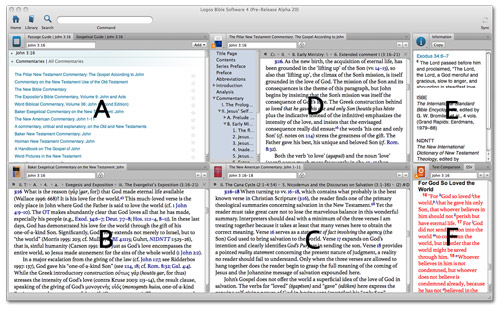
And by using this 6-window format, and due to the well-designed tab system, I can comfortably keep 20–40 books open on my desktop at the same time.
So that was in the “passage guide” function. Studying and comparing commentaries could not be easier. In the “basic search” I was surprised at how easy it was to re-find particular paragraphs within my library. Imagine walking into a library, removing a book off the shelf and reading a paragraph, placing the book back on the shelf, leaving and returning to the library in a week and attempting to find that same paragraph again. How easy would it be to find that page? Nearly impossible. Yet I’ve been constantly surprised how easily I can search the entire library to re-find paragraphs (even footnotes!) that I only remotely remember seeing previously. The access to information and the speed at which that information is available is very impressive.
This leads me to the third benefit.
Benefit 3: Resource ranking and clustering
Hosting over 2,000 books on my MacBook Pro is really handy (1,200+ in Logos). But it can also become a befuddled mess. The sheer quantity of information returned in search results can be overwhelmingly unhelpful. Let’s face it, not all books are equally useful on every topic.
To counter this problem, Logos 4 allows users to rank Bibles, commentaries, reference materials—really all the books—based upon user preference. Users can assign a star rating from between 0–5 on each resource. And search queries can be restricted to certain star levels. And this factor is why certain commentaries ranked higher than others in the screenshot I showed you earlier.
Also, users can also create customized collections of texts through tags. For example, all of my resources authored by D.A. Carson are tagged “DAC.” In the search query I can very quickly select this tag and limit my results only to the books in this collection.
These two options—ranking and clustering—bring a great deal of speed and focus to custom, library-wide, searches.
Benefit 4: Improved access to my print library
Still about half of my total library is comprised of printed books lined on shelves and I don’t intend to get rid of these books any time soon. One of the surprising benefits of Logos 4 was the amount of footnotes and references I noticed in my electronic research that pointed me back into my print library. Because of this, and because of the amount of relatively new reference works in Logos 4, I benefit more from my print library than ever before. Like I said, this was a surprising fruit of Logos 4.
Conclusion
This review on Logos 4 Platinum could continue on for a few more pages but I’ll stop now. There are dozens of other little features and functions that make Logos 4 a breeze to use. DV, I will take a closer look at these features and functions when work on the Mac version of Logos 4 is completed in the fall.
The bottom line: Logos 4 has taken a big stride forward in making premium Bible scholarship accessible to students of the Bible. And in the hands of discerning readers and wise pastors it will bless the Church in a big way.


 Tony Reinke