BoT > Session 2 > Sinclair Ferguson

2007-banner-of-truth-confer.jpg
Session 2 – (Tues. 7:00 PM)
“Our Holiness: The Father’s Purpose and the Son’s Purchase”
Sinclair Ferguson

GRANTHAM, PA – It was unfortunate Walt Chantry was not able to speak at this year’s conference (his book, The Shadow of the Cross is a treasure). Sinclair Ferguson was his chosen replacement. Ferguson, who has been a friend of Chantry for 30 years, took time at the beginning of his address to honor his friend.

Ferguson is one of the great contemporary preachers in our age. He serves as Senior Minister of The First Presbyterian Church in Columbia, SC and as professor of systematic theology at Westminster Theological Seminary in Dallas. What I love about Ferguson is that he is a Cross-centered scholar. A Puritan, really. And the opening night of the conference was a special treat because his address centered on how the Son purchases our sanctification.

Ferguson began by reading Titus 1 — words directed to a Gospel minister — with an emphasis on verses 11-15 where Christ’s redemption is tied to our sanctification.

“For the grace of God has appeared, bringing salvation for all people, training us to renounce ungodliness and worldly passions, and to live self-controlled, upright, and godly lives in the present age, waiting for our blessed hope, the appearing of the glory of our great God and Savior Jesus Christ, who gave himself for us to redeem us from all lawlessness and to purify for himself a people for his own possession who are zealous for good works. Declare these things; exhort and rebuke with all authority. Let no one disregard you.” (Titus 2:11-15)

The three messages on holiness (“Our Holiness”) at the conference are titled: 1) The Father’s Purpose and the Son’s Purchase, 2) Abiding in Christ’s Love, and 3) Walking in the Spirit. This excellent, God-centered division was outlined by Chantry.

Ferguson shared many helpful personal questions and reflections throughout his message, beginning with this statement (and continuing throughout my notes below).

Fill in this statement: My people’s greatest need is (blank). Is it my improved preaching? My improved pastoral skill? Overall church attendance and growth? Or, is my people’s greatest need my personal growth in holiness? We all come in here knowing this is our great weakness, but excellence in holiness is one of the supreme qualifications for pastoral ministry. In fact, in the lists of qualifications for elders, giftedness and skillfulness are not the dominate characteristics of the qualified pastor. But holiness is! Holiness marks out pastors as authentic believers.

We are timid of this fact because this means that others should see our progress. These questions have haunted me constantly with other ministry friends: Are they seeing my progress in holiness over the years? Is my congregation seeing my progress in godliness over the years? There are few other things more important to consider than our own personal holiness.

But here is the great encouragement. The great Gospel imperatives are rooted in the indicatives of grace that sustain those imperatives! As preachers, often our indicatives are not big enough or gracious enough to sustain the weight of our imperatives. Preaching then becomes a rod to beat holiness, but all we see are our own failures. We lose sight of the Gospel.

And we need to remember how the imperatives of holiness are grounded in the NT in the Triune God. “To those who are elect exiles of the dispersion in Pontus, Galatia, Cappadocia, Asia, and Bithynia, 2 according to the foreknowledge of God the Father, in the sanctification of the Spirit, for obedience to Jesus Christ and for sprinkling with his blood” (1 Pet. 1:1-2). Woven into the warp and woof, holiness is grounded in God. This holy God has in Himself, by Himself, for Himself, and is committed by Himself to bring about sanctification of His own people. Paul writes, “because of the grace given me by God to be a minister of Christ Jesus to the Gentiles in the priestly service of the gospel of God, so that the offering of the Gentiles may be acceptable, sanctified by the Holy Spirit”(Rom. 15:15-16). “For this is the will of God, your sanctification” (1 Thess. 4:3).

Elected to Holiness

Our holiness has been planned eternally by God. “For the grace of God has appeared, bringing salvation for all people, training us to renounce ungodliness and worldly passions, and to live self-controlled, upright, and godly lives in the present age” (Titus 2:11-12). The grace of God has appeared, and this produces holiness. That the grace of God has appeared is a reference to Christ. He has appeared and this eternal planning shows that our holiness is the fruit of eternal planning.

“Put on then, as God’s chosen ones, holy and beloved, compassionate hearts, kindness, humility, meekness, and patience” (Col. 3:12). A living Calvinist is marked by compassion, humility, kindness. If you don’t look like this, you are not a Calvinist. This holiness is rooted in the eternal counsel of the eternally blessed God. “For those whom he foreknew he also predestined to be conformed to the image of his Son” (Rom. 8:29). The divine and eternal purposes of God are shown in our conformity to Christlikeness. This is holiness. It is of supreme importance that we understand that Christlikeness is holiness, not plus or minus anything else. We may have all types of abilities, theological knowledge, intellectual ability and affection towards the Gospel, but if I am not like Him I am not holy.

Election grounds our holiness. John Owen asked the question, how do we know if we are truly elect? The answer: Has God destined you to be holy? His chosen are to be like Himself (See Owen’s Works, 3:597-598). I still have powerful sin in me and without grace I would utterly fail at holiness. God’s eternal plan is the necessary inducement to holiness. God has seen His portrait fractured in the Fall and rebellion has set in. God wants His portrait back and He is getting rid of what is not Christlike in us. He wants us to be conformed to the image of His Son. In Romans Paul goes on to say that nothing will thwart this plan? Satan? Who can stand in God’s way? Charge them? Destroy them?

God is bending all circumstances and pain, He is chiseling and doing one thing – riding the universe of what does not reflect Christ. He deconstructs us to reconstruct our character, lives, to be Christlike. God is determined that you will be transformed into Christ. Holiness is not a threat but a cause of joy, wonder, worship and humility because this holiness has been purchased by the work of the Son.

Christ and Sanctification

The role of Christ in sanctification extends beyond purchase, but we should see holiness is purchased by Christ – not as an additional work. Justification and sanctification are linked together. My sanctification is as much purchased as any other aspect of salvation (Heb. 2:14-17). We can get so focused on the blood of Christ which pardons that we lose sight of Christ purchasing our sanctification and holiness. There are no gospel blessings that come apart from the crucified Christ. The conduit is His death. We receive nothing in the Christian life unless He purchased it by His obedience and Atonement.

The death of Christ is a multifaceted reality. Just look at how many Hebrew nouns are used in the Old Testament to communicate the multidimensional, sinister, twisted, fallen, nature of sin. And these are not all synonyms. The Spirit comes and loosens the flesh. Sin is not a single independent mass in our hearts, but rather sin is woven multidimensionally into our lives. The salvation in the Blood of Christ is a corresponding Atonement to this sin. We are to be totally sanctified which means there will be no remnant of sin.

Our understanding of the Cross is often superficial. Shame on me if I expound to my people multiple dimensions of sin without expounding the multiple dimensions of the Cross! How is it possible that redemption purchases salvation from sin in all dimensions?

The Cross and Sanctification

1. Christ propitiates God’s wrath (Rom. 3:21-24). Christ answers the wrath of God for the sins of Romans 1-3:20. But propitiation is more than mere justification. Under the wrath of God (or a fear of future wrath from God) I will be emptied of all hope in sanctification. It is not psychologically possible to be under the wrath of God and desire to be like Him. We have been freed from God’s wrath, are exalted in Christ, and we now stand before God with the identical confidence of Christ. His righteousness is mine! “Bold I approach th’eternal throne, And claim the crown, through Christ my own.” Propitiation is significant for sanctification.

2. Christ expiates defilement. “How much more will the blood of Christ … purify our conscience from dead works to serve the living God” (Heb. 9:14). In the Cross our sins are washed away. But our hearts and our consciences are cleansed, too! Too often we miss this.

3. Christ dies to sin. Our holiness is affected at the Cross because in the Cross Christ died to sin. “For the death he died he died to sin, once for all, but the life he lives he lives to God” (Rom. 6:10). It does not say here Christ died for sin but rather that He died to sin. This point may be controversial. The context is in explaining Christian baptism. We no longer live in sin because Christ died to sin. We have been set free from the reign and dominion of sin in order to yield ourselves to Jesus. Christians do not die for sin but rather we die to sin which is to say that we have died to sin because Christ has died to sin. Since sin reigns in death, it was in Jesus’ death that His humanity came under the reign of sin in the process of overcoming sin. Christ not only purchased justification from the wrath of God and cleaned our consciences, but He also purchased that freedom from the dominion of sin that makes it possible to live endlessly to the glory of God. John Owen said there are two primary problems for the pastor, convincing sinners they are under sin and convincing the redeemed they are no longer under sin. Nearly all pastoral situations come back to this!

4. Christ frees from Satanic bondage.
Jesus entered enemy-occupied territory and defeated Satan. “Since therefore the children share in flesh and blood, he himself likewise partook of the same things, that through death he might destroy the one who has the power of death, that is, the devil” (Heb. 2:14). Without redemption in Christ, we are lifelong slaves to the fear of death. We see this in all non-Christian funerals. There are no windows, it is bleak, there is a concerted effort to celebrate but nobody in the room has conquered the fear of death. In a truly Christian funeral there is hope and a future. Even in the loss and grief we rejoice for the one taken into the presence of Christ. The fear of death is the mother of all fears. Psychobabble abounds over the fears people have. The world is awash in insecurities. Only Christ delivers from the fear of death. The Resurrection of Christ is such a glorious thing! Arguments to prove the Resurrection is one thing, but to be overwhelmed by the powerful reality of being saved from death is another. To be “dead to sin” is to be raised into newness of life. This is the glorious power of the Resurrection. Has it made my life different? When people look at my life do they say, ‘Someone must have been raised from the dead’?

5. Christ purchases the gift of the Holy Spirit. Because of the work of Christ on the Cross the Holy Spirit comes. Jesus said to the disciples, “Nevertheless, I tell you the truth: it is to your advantage that I go away, for if I do not go away, the Helper will not come to you. But if I go, I will send him to you” (John 16:7). Later in John’s Gospel we see that John was struck that blood and water flowed from the side of Jesus (John 19:34). This is because John understood that Jesus was not only the source of Atoning blood, but also the river of living water. He is the One for Whom the river flows, He is the true Jerusalem where the thirsty go to drink (Rev. 22). When Christ ascended into the clouds He entered behind a curtain where we can no longer see Him. We don’t know exactly what happens behind the curtain but Peter says, “Being therefore exalted at the right hand of God, and having received from the Father the promise of the Holy Spirit, he has poured out this that you yourselves are seeing and hearing” (Acts 2:33). In the ascension, Jesus pours out His life transforming Holy Spirit. “And we all, with unveiled face, beholding the glory of the Lord, are being transformed into the same image from one degree of glory to another. For this comes from the Lord who is the Spirit” (2 Cor. 3:18).

The point is that Christ purchased everything we need. We are purchased by Christ, therefore we glorify Him in our lives (1 Cor. 6:20). We are owned by Him and nobody else. Once we are purchased, we begin taking baby steps in holiness that are apparent towards others. Has anyone thought of your life, ‘There is something in this man’s life that looks like Jesus’? It is not great gifts that God blesses in the ministry but a likeness to Jesus (M’Cheyne). And this likeness to Christ is eternal.

———-

Related: For more posts and pictures from the 2007 Banner of Truth Ministers’ Conference check out the complete TSS conference index.

Banner of Truth Tour (Carlisle, PA, Wed. PM)

2007-banner-of-truth-confer.jpg

Banner of Truth Tour
Carlisle, PA, Wed. PM

One personal highlight from the trip East was a tour of the Banner of Truth warehouse in Carlisle, PA (about 30 minutes from the conference). The tour was pushed back until late Wednesday night. But it was worth the wait.

Steve, who manages the US branch of the Banner of Truth, was gracious enough (at 11:00 PM last night!) to drive me down so I could see the warehouse. It was a great treat.

The Banner of Truth offices and warehouse in Carlisle are sandwiched by condos in what seemed to be a residential area. The Banner building itself is a very long and narrow with two levels of offices in the front and warehouse in the back. The first books you see in the entry are the damaged volumes (most only slightly damaged). These volumes sell at 50-percent off. Also in the entry are a few desks (one of another Banner friend, Beth). Another set of offices is directly upstairs. From the entry you walk back to the packing room. This room holds a handful of copies of each Banner book and a table outfitted for packaging. From this packing room and through an industrial door, you enter in to the large warehouse. The warehouse is mainly a large metal structure where the pallets and bulk stacks of individual volumes are stored. The paperbacks are stored on the second level and the hardcover books on the main level. The warehouse was very tidy. To the far back of the warehouse and along one of the walls were the new arrivals from Edinburgh. Many of these volumes were on crates and simple boxes.

I was greatly surprised at the volume of works warehoused and (by consequence) gratefully surprised at the amount of books the Banner must sell on a regular basis. So having personally seen the impact of authors like John Bunyan in my own life, it was an especially moving experience to see a stack of hundreds of copies of his works. Or to see thousands of copies of Expository Thoughts on John by J.C. Ryle or stacks of boxes of the Works of John Owen or a pile of Spurgeon’s autobiography or to see 10,000 copies of Jonathan Edwards’ Religious Affections. Walking through the Banner warehouse was a powerful experience — not merely as a bibliophile – but as a Christian who has experienced the powerful content of these works in drawing me closer to Christ and His Cross.

What will become of this stack of John Bunyan or Jonathan Edwards? This will be left in the hands of our Sovereign God. But we can be sure there will be new readers who, through the work of the Banner staff, will be introduced to a new world of reading, to new authors and new books. And through this introduction these readers will be eternally changed for the glory of God. My personal experience of these volumes and my expectations for a new generation of readers is what made a tour of the Banner warehouse so special. It was a great experience, even if it was midnight before we returned to Grantham.

————

A few choice pictures. Here are some books in the packing room.

Stacks of boxes filled with Spurgeon’s autobiography.

The Works of John Bunyan. Isn’t this beautiful?

Two crates filled with Edwards’ Religious Affections (perhaps 10,000 copies).

The Forgotten Spurgeon by Iain Murray.

Ryle on John (vol. 3).

The warehouse.


———-

Related: For more posts and pictures from the 2007 Banner of Truth Ministers’ Conference check out the complete TSS conference index.

BoT pictures

2007-banner-of-truth-confer.jpg

GRANTHAM, PA — Hello again everyone. We have been treated to wonderful messages on holiness by Derek Thomas and Sinclair Ferguson. The overwhelming content in each presentation has made it difficult to get summaries up quickly so they will be coming over time. The photographs from the conference are more speedily available. Here are a few from today.

Sinclair Ferguson

———-

Related: For more posts and pictures from the 2007 Banner of Truth Ministers’ Conference check out the complete TSS conference index.

Sinclair Ferguson walk through the bookstore

2007-banner-of-truth-confer.jpg

Sinclair Ferguson walk through the bookstore (Tues. PM)

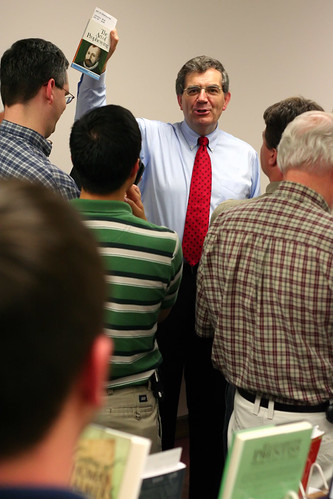
GRANTHAM, PA — One of the great joys of the conference Tuesday night was experiencing Sinclair Ferguson’s now-famous book recommendations and discounts. After the sessions were over for the day, the men packed into the bookstore and Ferguson walked around highlighting volumes particularly important in his own growth. Each book he held up was then marked down between 60 and 75-percent for the conference. To hear Ferguson rattle of a list of books and why they are important was a great treat. For various reasons, books included the sermons of M’Cheyne, the memoirs of Thomas Boston, Biblical Theology by Vos, The Upper Room by J.C. Ryle (for chapter 3 on preaching), Faith and Life by B.B. Warfield, the first volume of the biography of Martyn Lloyd-Jones. There were many others. (If you were there and transcribed a list of books recommended please leave them in the comments.) It would have been great to get this recorded in audio. Maybe next time.

Here are the photographs from the Sinclair Ferguson field trip through the BoT conference bookstore last night.

———-

Related: For more posts and pictures from the 2007 Banner of Truth Ministers’ Conference check out the complete TSS conference index.

Book: Sweet Communion by Arie de Reuver

Book Announcement
Sweet Communion by Arie de Reuver

So I was all ready to wind down a bit this weekend, and not push to get another post up. That was all disrupted Saturday when a bubble mailer arrived in my mailbox from Baker Academic. I simply could not wait until next week to announce their new release. The book is Sweet Communion: Trajectories of Spirituality from the Middle Ages through the Further Reformation by Arie de Reuver. The book was published in Dutch in 2002 and translated into English by James A. De Jong.

To explain the importance of this book, I need to give some background.

We are familiar with the English Puritans (men like John Owen, Richard Sibbes, John Bunyan, Thomas Brooks, etc.) primarily because their original works were written in English, and easily reprinted over the centuries with little editing necessary. However, in the Netherlands another “Puritan” movement was taking place. Like their English counterparts, men like Willem Teellinck, Herman Witsius and Thodorus and Wilhelmus à Brakel were producing valuable theological and spiritual works in Dutch. But until only recently has the work of Dr. Joel R. Beeke and the Dutch Reformed Translation Committee made these works more accessible. In fact, one of the great highlights of Beeke’s Meet the Puritans is a section entirely devoted to the Dutchmen of the “Further Reformation” (see pages 739-824). Books of the Dutch “Further Reformation” authors (like the recently translated The Path of True Godliness by Willem Teellinck) bear all the marks of brilliance we see in the English Puritans.

One of the most noticeable strengths of these “Dutch Puritans” (as I call them) is their emphasis on Reformed spirituality and their enjoyment of sweet communion with Christ. Theirs was a deep and sincere devotion to Christ where their union with Christ was the means of experiencing vibrant communion with Christ. They defended the doctrines of grace and simultaneously enjoyed a joyful and warm spirituality.

This beautiful Reformed spirituality can be seen in the works of Wilhelmus à Brakel (1635-1711).

Wilhelmus à Brakel is most noted for his four-volume work, The Christian’s Reasonable Service (Reformation Heritage Books; 1993; 4 vols.). While it looks like another Reformed systematic theology it is actually more practical in nature and intended to provide content for small group discussions as Christians gather to encourage one another in the Christian life. It is one of the beautiful works of the “Dutch Puritans.”

I have noticed in the past the “sweet communion” of the believer with Christ is a theme that sparkles from this work. After emphasizing the marriage union between the Groom (Christ) and His Bride (the Church), à Brakel explains the believer’s communion with Christ within this marital union. Once this union between the sinner and his Savior has taken place in conversion “Jesus Himself delights in having communion with you” (2:93). Read that incredible sentence again! This communion produces a “sweetness and overflowing delight … Here they (Christians) find balm for their sick souls, light to clear up their darkness, life for their deadness, food and drink for their hunger and thirst, peace for their troubled heart, blood to atone for their sins, the Spirit for their sanctification, counsel when they are at their wit’s end, strength for their weakness, and a fullness of all for their manifold deficiencies” (2:93,94).

Of this marital union and the communion that follows, à Brakel writes,

“A temporal believer concerns himself only with the benefits and has no interest in Christ Himself. Believers, however, have communion with the Person of Jesus Christ, but many neither meditate upon nor closely heed their exercises concerning Christ Himself. They err in this, which is detrimental to the strength of their faith and impedes its growth. Therefore we wish to exhort them to be more exercised concerning the truth of belonging to each other, and the union and communion with Jesus Himself. They will then better perceive the unsearchable grace and goodness of God that such wretched and sinful men may be so intimately united with the Son of God. Such reflection will most wondrously set the heart aflame with love. It will strengthen their resolve to put their trust in Jesus without fear. It will give them strength and liberty to obtain everything from Him to fulfill the desires of their soul, causing them to grow in Him, which in turn will generate more light and joy. Therefore, faith, hope, and love are mentioned in reference to the Person of Christ. Scripture speaks of receiving Him, believing in Him, trusting in Him, living in Him, loving Him, and hoping in Him” (2:91).

This beautiful passage points the believer back to the Person of Christ to find her joy and strength in the beauty of Jesus Christ. This light and joy is the byproduct of communion with Him and this communion goes back to the believer’s union with Christ in justification.

Later, à Brakel explains that since our union with Christ is absolute, our communion with Christ does not shift with circumstances or emotions. “By faith, hold fast to the fact that you are reconciled to and are a partaker of Him and His benefits, even if you do not perceive and feel this. This belonging to Him is not based on feeling. If the souls may truly believe this and be exercised therewith, this will lead the soul toward communion with Him” (2:96). Communion can never be separated from our union and our union is described by our justification by faith alone and in our election in the Son. So à Brakel and the “Dutch Puritans” remind us that our sweet communion with Christ is inseparably bound to our understanding of our union with Christ in the gospel!

In his conclusion on the teachings of Wilhelmus à Brakel, de Reuver writes that his “spirituality is one that is rooted in Christ through the word believed, even in its most intimate and mystical moments. This foundation protects his mysticism from spiritualism” (258).

Many today are drawn towards Roman Catholic mysticism or a non-theological spirituality by thinking a deep spiritual experience of Christ can be separated from a genuine understanding of the gospel. This, as à Brakel displays, is not the case. Neither does Reformed theology favor a cold orthodoxy. Following the best intentions of the Medieval theologians, the Reformed “Dutch Puritans” always believed that rich biblical doctrine is the vein for the warm blood of spiritual experience of the Son in communion.

So here is the importance of Sweet Communion by de Reuver: The rich spirituality we have received from the “Dutch Puritans” is a spiritual legacy following the spiritual traditions of Bernard of Clairvaux (1090-1153) and Thomas à Kempis (1379-1471) but is firmly rooted in the precious theology of the Reformation. The final conclusion of de Reuver is that the all-controlling center of the Dutch Further Reformation spirituality rested in the Reformed theology. This is a beautiful and timely book to further dismantle the idea that Reformed theology is cold and stiff intellectualism. Our rich theology actually leads us deeper into true “mysticism” of direct communion with Christ.

Title: Sweet Communion: Trajectories of Spirituality from the Middle Ages through the Further Reformation.
Series: Texts and Studies in Reformation and Post-Reformation Thought
Author: Arie de Reuver (Dutch)
Translator: James A. De Jong (English)
Reading level: 4.5/5.0 > academic and some untranslated Dutch quotations
Boards: paper
Pages: 303
Volumes: 1
Dust jacket: no
Binding: glue
Paper: normal
Topical index: no
Scriptural index: no
Text: perfect type
Publisher: Baker Academic
Year: 2007
Price USD: $29.99/23.99 from Baker
ISBNs: 0801031222, 9780801031229

————-

Related: Communion with God by Kelly Kapic. Another gem from Baker this year on communion with God. Kapic studies English Puritan John Owen’s understanding that communion with God takes place within a balanced Triunity of the Father, Son and Spirit. Highly recommended.

————-