Perseus Classics Collection (Logos 4)

On Friday I downloaded a pre-release of the Perseus Classics Collection into my Logos 4 library. The new collection is the largest single batch of books I’ve downloaded since I began using Logos nearly two years ago. The collection is a library in itself of over 1,100 ancient Greek and Latin titles and includes many corresponding English translations and helpful commentaries. Authors include Aristotle, Cicero, Homer, Plato, Plutarch, Sophocles, Demosthenes, and many others.

The release of this massive collection is significant step for New Testament studies since many of the Greek titles are referenced in technical Greek reference works and lexicons like TDNT, BDAG, and EDNT. The folks at Logos have announced on their website that over time they plan to add lemma tags to all the Greek books and add hyperlinks to the lexical reference to correspond to the original books in the Perseus Classics Collection. So when you see a reference in TDNT to, say, Aristotle’s Metaphysics, the reference will be hyperlinked and a click will land you in Aristotle’s work to read the context for yourself.

Skilled Greek exegetes will benefit from the collection because of the tags and hyperlinks, but what about those who want to engage the classic Greek works on a less technical level? Most of the books are available as English translations. With these English translations the collection is quite accessible to all readers and offers many key books that can help sharpen your communication skills.

Last month I read Clear and Simple as the Truth: Writing Classic Prose by Francis-Noel Thomas and Mark Turner (Princeton, 2011). This book was an inspiring and helpful guide to understanding the persuasive power of writing in the classic style, a style that seeks to persuade by presenting truth as clearly as possible by a writer whose style builds symmetry with his reader. Write Thomas and Turner:

[The] sense of shared competence is characteristic of the relationship between writer and reader in classic style. There is always a tacit appeal to a standard of perception and judgment that is assumed to be general, rather than special. There is no need for the writer to make appeals to his sincerity, for example, or to some special insight or competence, to arcane or technical knowledge, or to a lifetime of experience obviously not available to anyone else. …

The classic symmetry between writer and reader is broken whenever the writer presents distinctions as if they are the product of her exceptional insight or temper, distinctions the reader could not have been trusted to see on his own in the right circumstances. (50–51)

If you have read the nonfiction works of C.S. Lewis you have been exposed to the classic style. Of all styles, the classic style is powerful one, but it’s also a subtle one that requires interested writers to do a lot of reading in the classics. Thomas and Turner motivated me to read more classic Greek literature and introduced me to many of the best-written ancient models of classic style. The classics that come highly recommended by Thomas and Turner are here available in readable English translations in the Logos collection. These include titles like:

  • Thucydides, History of the Peloponnesian War
  • Euclid, The Elements of Geometry
  • Aristotle, Poetics
  • Aristotle, Rhetoric
  • Plato, Apology
  • Quintilian, Institutio Oratoria, books 1-3
  • Quintilian, Institutio Oratoria, books 4-6
  • Quintilian, Institutio Oratoria, books 7-9
  • Quintilian, Institutio Oratoria, books 10-12

A wide range of readers will equally benefit from this collection, from skilled technicians of ancient Greek and to readers who engage the classics only in English translations.

So what is the cost of this library of classics?

Nothing.

The Perseus Classics Collection is free for Logos 4 users who simply need to place a pre-order. When it’s ready to download, the entire collection (over 600 MB of text!) will be added to your Logos library.

Pre-order the Perseus Classics Collection and find a full list of titles here.

Many thanks to our friends at Logos!
Sentences

Alan Jacobs, Wayfaring: Essays Pleasant and Unpleasant (Eerdmans, 2010), page 3:

I may not be much of a writer, but I do like sentences; indeed I love them, and think about them a lot–shockingly often, really. I am one of the few remaining Americans blessed with the opportunity to walk to and from work each day, and as I walk I am likely to be rolling sentences around in my head. I have even stopped listening to This American Life on my iPod, the better to facilitate concentration. Sometimes, when I want extra time to consider my options–the walk is only about fifteen minutes–I take a detour to Starbucks. I enjoy the coffee, but I’m really just prolonging my commute for the sake of the sentences.

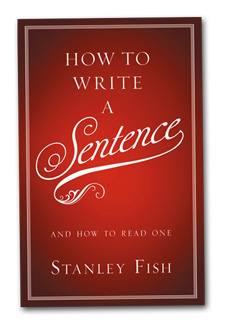
How To Write A Sentence

Forget grammar. Writing is about logic.

Stanley Fish makes this argument in his new book How To Write A Sentence: And How To Read One (Harper: 2011), and it defines for me something that has been morphing in my writing philosophy over the last couple of years. At some point I began shifting time away from grammatical studies and investing more time in the study of logic. I was pleased to read an author who articulated this intuitive shift. Fish writes,

Many people are put off writing because they fear committing one or more of the innumerable errors that seem to lie in wait for them at every step of composition. But if one understands that a sentence is a structure of logical relationships and that the number of relationships involved is finite, one understands too that there is only one error to worry about, the error of being illogical, and only one rule to follow: make sure that every component of your sentences is related to the other components in a way that is clear and unambiguous (unless ambiguity is what you are aiming at). (p. 20)

Brilliant.

In other words, don’t let the fear of breaking grammatical rules stop you from writing. Seek first to make logical connections in your writing, make those connections clear, and gauge your success on how well you make them. This point is liberating to me as a writer, but more than liberating, it inspires my writing in a way that grammar cannot, since, as Fish writes, writing with an eye on logic will force your mind to think of correlations and contradictions in ways that can add new dimensions to your thinking and writing (see pp. 30-33).

Another point that Fish makes well is the importance of determining a sentence’s purpose. He asks: What is the intended effect of the sentences that we write? The question is important because there is a wide range of sentence effects that are reflected in various forms, and each form communicates something different to the reader. Too often writing instruction discusses the how of writing, but not the why.

People write or speak sentences in order to produce an effect, and the success of a sentence is measured by the degree to which the desired effect has been achieved. That is why the prescriptive advice you often get in books like Strunk and White’s The Elements of Style—write short sentences, be direct, don’t get lost in a maze of piled-up clauses, avoid the passive voice, place yourself in the background, employ figures of speech sparingly—is useful only in relation to some purposes, and unfortunate in relation to others. The first thing to ask when writing a sentence is “What am I trying to do?” … In short, pick your effect, figure out what you want to do, and then figure out how to do it. (pp. 37, 44)

Fish’s point is brilliantly illustrated a few pages later when he explains how using a short and long sentence create different effects for the reader.

Shorter sentences feel planned because they have the proverbial air of being pre-packaged. The writer is saying, “I didn’t make this up on the fly; I’m just giving form to what everyone knows.” Longer sentences can achieve a similar effect by calling attention to their own construction. The writer is saying, “I’m not just putting down whatever comes into my head; I’m giving you the ordered fruits of my considered deliberations.” (p. 48)

Can you see the difference? Short sentences proverbially restate an idea that should be familiar to the reader. On the other hand, longer sentences are better suited for communicating the inner life and the extended deliberations in the author’s mind—thoughts that are anything but proverbial and assumed, but are unique, revealing the secret thought life of the author. Paragraph-length descriptions of the effects of certain sentence styles, like the one I quote above and the others spread throughout the book, illustrate how different sentence forms accomplish different tasks, and reinforce his motto: “You shall tie yourself to forms and the forms shall set you free” (p. 33). The form is part of the message.

The bulk of the book is comprised of five chapters on subordinate sentences, additive sentences, satirical sentences, first sentences, and last sentences.

  • The subordinating style: “which ranks, orders, and sequences things, events, and persons in a way that strongly suggests a world where control is the imperative and everything is in its proper place.”
  • The additive style: “which gives the impression of speech and writing just haphazardly tumbling out of the mouth or the thoughts of a writer who is not worrying about getting every particular just right.”
  • The satirical style: “employed as a weapon by writers who want to harpoon persons, parties, or society as a whole.”
  • First sentences: are “promissory notes. Whether they foreshadow plot, sketch in character, establish mood, or jump-start arguments, the road ahead of them stretches invitingly and all things are, at least for the moment, possible.”
  • Last sentences: “are more constrained in their possibilities. They can sum up, refuse to sum up, change the subject, leave you satisfied, leave you wanting more, put everything into perspective, or explode perspectives. They do have one advantage: they become the heirs of the interest that is generated by everything that precedes them; they don’t have to start the engine; all they have to do is shut it down.”

Conclusion

How To Write A Sentence is simple enough that you can learn the very basics of how to construct a sentence to achieve an intended effect. But Fish is also deeply perceptive of what makes a great sentence, and readers will delight in his careful exegesis of many great sentences in literary history. In this short book (162 pages) Fish serves two audiences quite well. It will inspire young writers to write clear, purposeful, sentences; and it will delight advanced writers as it breaks down great sentences. How To Write A Sentence will be added to the shelf with my favorite books on writing and frequently revisited for fresh inspiration.

He, She, It, They—Dealing With Generic Singular Personal Pronouns

The following excerpt is from a footnote on page 36 of the most nutty (and most helpful), logic textbook I own—Peter Kreeft, Socratic Logic: A Logic Text Using Socratic Methods, Platonic Questions, and Aristotelian Principles (South Bend, IN: St. Augustine’s, 2008). He writes:

The use of the traditional inclusive generic pronoun “he” is a decision of language, not of gender justice. There are only six alternatives.

(1) We could use the grammatically misleading and numerically incorrect “they.” But when we say “one baby was healthier than the others because they didn’t drink that milk,” we do not know whether the antecedent of “they” is “one” or “others,” so we don’t know whether to give or take away the milk. Such language codes could be dangerous to baby’s health.

(2) Another alternative is the politically-intrusive “in-your-face” generic “she,” which I would probably use if I were an angry, politically-intrusive, in-your-face woman, but I am not any of those things.

(3) Changing “he” to “he or she” refutes itself in such comically clumsy and ugly revisions as the following: “What does it profit a man or woman if he or she gains the whole world but loses his or her own soul? Or what shall a man or woman give in exchange for his or her soul?” The answer is: he or she will give up his or her linguistic sanity.

(4) We could also be both intrusive and clumsy by saying “she or he.”

(5) Or we could use the neuter “it,” which is both dehumanizing and inaccurate.

(6) Or we could combine all the linguistic garbage together and use “she or he or it,” which, abbreviated, would sound like “[word removed].”

I believe in the equal intelligence and value of women, but not in the intelligence or value of “political correctness,” linguistic ugliness, grammatical inaccuracy, conceptual confusion, or dehumanizing pronouns.

There you have it.

I know what you’re asking: Where does Grammar Girl stand in the debate? She starts out a bit shilly-shally (or is it dilly-dally?) but eventually seems to favor a bold and reckless solution—using “they.”

What do you think?

Build Great Sentences

Until November 30, you can get a great deal on Brooks Landon’s lectures on writing, “Building Great Sentences: Exploring the Writer’s Craft.” The course is comprised of 12 hours of lectures. I purchased and watched the DVDs about a year ago (I plan to watch them all again later this winter). While the lectures can be dry at times, after watching them my writing certainly improved both in clarity and creativity. The lectures are available as audio recordings, but the visuals are helpful and recommended. The DVDs normally sell for $255 but for the next 10 days you can buy them for $70. And if you enter priority code 49458 you can get the DVDs for just $35! This is a great deal, and certainly worth a look from any serious writer, especially if you want to learn how to pen gracefully flowing cumulative sentences that roll on and on to the right, capturing the readers attention, then gently pulling them into the story, leading them deeper and deeper into the thick forest of your imaginative world that has been awakened by your newfound discovery of right-branching sentences and their power to compel and to inspire.

A Word to Profs, Preachers, and Writers

From the Letters of John Newton (Banner of Truth, 1869/2007), page 364:

I believe the liveliest grace and the most solid comfort are known among the Lord’s poor and undistinguished people. Every outward advantage has a tendency to nourish the pride of the human heart, and requires a proportional knowledge of the deceitful self and the evil of sin to counterbalance them. It is no less difficult to have great abilities than great riches without trusting in them. …

If I were qualified to search out the best Christian in the kingdom, I should not expect to find him either in a professor’s chair or in a pulpit. I should give the palm [prize] to that person who had the lowest thoughts of himself, and the most admiring and cordial thoughts of the Savior. And perhaps this person may be some bedridden old man or woman, or a pauper in a parish workhouse. But our regard to the Lord is not to be measured by our sensible feelings, by what we can say or write, but rather by the simplicity of our dependence, and the uniform tenor of our obedience to his will.