
Literature is Life

One of the best little summaries of the value of literature in the Christian life comes from Leland Ryken’s book Windows To the World: Literature in Christian Perspective (Wipf and Stock, 2000). Here’s what Ryken writes on page 34:

“Literature is life. If you want to know what, deep down, people feel and experience, you can do no better than read the stories and poems of the human race. Writers of literature have the gift of observing and then expressing in words the essential experiences of people.

The rewards of reading literature are significant. Literature helps to humanize us. It expands our range of experiences. It fosters awareness of ourselves and the world. It enlarges our compassion for people. It awakens our imaginations. It expresses our feelings and insights about God, nature, and life. It enlivens our sense of beauty. And it is a constructive form of entertainment.

Christians should neither undervalue nor overvalue literature. It is not the ultimate source of truth. But it clarifies the human situation to which the Christian faith speaks. It does not replace the need for the facts that science and economics and history give us. But it gives us an experiential knowledge of life that we need just as much as those facts.

Literature does not always lead us to the City of God. But it makes our sojourn on earth much more a thing of beauty and joy and insight and humanity.”

Literary Frivolity

Here is a very helpful and balanced perspective on literature and aesthetics from a paper by C. S. Lewis published the book Christian Reflections (Eerdmans, 1967) page 10:

“The Christian will take literature a little less seriously than the cultured Pagan: he will feel less uneasy with a purely hedonistic standard for at least many kinds of work. The unbeliever is always apt to make a kind of religion of his aesthetic experiences; he feels ethically irresponsible, perhaps, but he braces his strength to receive responsibilities of another kind which seem to the Christian quite illusory. He has to be ‘creative’; he has to obey a mystical amoral law called his artistic conscience; and he commonly wishes to maintain his superiority to the great mass of mankind who turn to books for mere recreation. But the Christian knows from the outset that the salvation of a single soul is more important than the production or preservation of all the epics and tragedies in the world …

It thus may come about that Christian views on literature will strike the world as shallow and flippant; but the world must not misunderstand. When Christian work is done on a serious subject there is no gravity and no sublimity it cannot attain. But they will belong to the theme. That is why they will be real and lasting—mighty nouns with which literature, an adjectival thing, is here united, far over-topping the fussy and ridiculous claims of literature that tries to be important simply as literature.

And a posteriori it is not hard to argue that all the greatest poems have been made by men who valued something else much more than poetry… The real frivolity, the solemn vacuity, is all with those who make literature a self-existent thing to be valued for its own sake.”

Satan’s Tactic

From Puritan Thomas Brooks’ book Precious Remedies Against Satan’s Devices:

“The first device that Satan has to keep souls in a sad, doubting, and questioning condition, and so making their life a hell, is by causing them to be still poring and musing upon sin, to mind their sins more than their Savior; yes, so to mind their sins as to forget, yes, to neglect their Savior, that, as the Psalmist speaks, ‘The Lord is not in all their thoughts’ (Psalm 10:4). Their eyes are so fixed upon their disease, that they cannot see the remedy, though it be near; and they do so muse upon their debts, that they have neither mind nor heart to think of their Surety. A Christian should wear Christ in his bosom as a flower of delight, for he is a whole paradise of delight. He who minds not Christ more than his sin, can never be thankful and fruitful as he should.”

Librophiliac

is a word that denotes someone who suffers from an inordinate love of libraries. Two librophiliacs (always more dangerous in pairs), after being “shocked into a library induced euphoria” (yikes), assembled a compendium of photographs of some of the world’s most beautiful libraries. See the collection here. Beautiful.

Orthodoxy

Whether you love him or hate him you cannot help but love him. G. K. Chesterton that is.
In the past I’ve featured a series of favorite Chesterton quotes on the blog (which explains the graphic to the right). Many of those quotes I pulled directly from my favorite Chesterton title, Orthodoxy, a book that celebrated its 100th anniversary a few years back. And I must be behind on my blog reading because I just came across a tribute by Ralph Wood. Wood writes:

G.K. Chesterton’s most renowned book is a hundred years old. Orthodoxy was first published in London by John Lane Press in 1908, and it has never gone out of print—with more than two dozen publishers now offering editions of the book. Graham Greene once described it as ‘among the great books of the age.’ Etienne Gilson declared that Chesterton had a philosophical mind of the first rank. Hugh Kenner said that the only twentieth-century author with whom Chesterton could be compared is James Joyce. And Dorothy Day was inspired to return to Christianity mainly by reading Orthodoxy. Indeed, we might say that the last century belongs to Chesterton—for in that now one-hundred-year-old book, Orthodoxy, he remarkably prophesied the ailments of both modernism and postmodernism, while adeptly commending Christianity as their double cure.

Wood’s article is a good read. Chesterton’s book is a fun read (if you can stomach the wrongheaded assumptions about Calvin and Calvin’s theology). And it is a book that has been said to cure insanity. It’s a classic and there are many different versions available online.

Holy Subversion

The Christian life is a journey to the patria, our eternal homeland. It is a journey to a place that will astound us like nothing we have ever seen and it will welcome us like an old familiar home at the end of a long journey.

But we are not home. We are pilgrims hitchhiking across this life, walking by faith and not by sight. And we are seeking to live holy lives, lives that contradict the world’s unholy desires that we have ingested from birth.

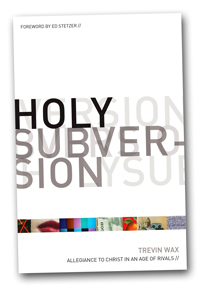
This pilgrimage of subversion is the theme of Trevin Wax’s new book Holy Subversion: Allegiance to Christ in an Age of Rivals (Crossway, 2010). It is a book about subverting the worldly temptations in relation to power, sex, leisure, money, success, and even the self. It is a book that challenges assumptions. It is a bold book. It is a prophetic book. It is a call for God’s people to be alert to the spiritual dangers lurking in the commonly approved social priorities of this world and to rejoice in the holy provisions of God. You should check it out.

But you don’t have to take my word for it (LeVar Burton). Here are three endorsements:

Albert Mohler: “Trevin Wax faithfully sounds the call for world-changing, Christ-exalting Christian practice. By unmasking contemporary ‘Caesars,’ he reveals real dangers and points to pitfalls of which many believers are completely unaware. This book serves as a helpful reminder and competent guide to draw out the implications of true allegiance to Jesus Christ.”

J. I. Packer: “How should God’s American people put the lordship of Jesus Christ on display in their lives? Wax’s searching answer is biblical, basic, businesslike, and blunt.”

Russell Moore: “Christianity is all about paradox. We lose our lives to gain them. We find life in crucifixion. We serve in order to reign. In his book, Holy Subversion, Trevin Wax takes up the question of how to be both a rebel—against the false authorities of this time—while simultaneously being submissive—to the divine authority of the God and Father of our Lord Jesus Christ. This book is a helpful warning against both nihilism and cynicism.”