Theologian Karl Barth [1886-1968] was a bright Swiss chap with much to say. The oldest son of a Reformed pastor, Barth was soaked in the Reformed faith throughout his life and with the writings of Calvin and Luther. 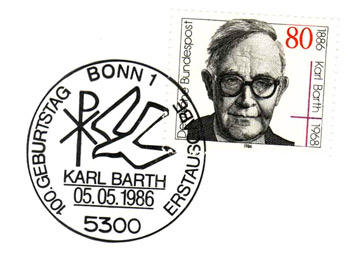 It was Barth’s approach to theology—his firm belief that God’s Word alone, and not human reason, as the basis for theology—that propelled him into conflict with theological liberals.
In 1919, a time when theological liberalism was thriving, Barth published a commentary on Romans emphasizing the transcendence of God, the radical differences between God and man. The book landed on the contemporary theological liberalists like a bombshell (to use an appropriate, but overworked, war image). Barth found himself to be a spokesman for conservative theology which I assume helped launch what became a prolific writing career that includes one series of books [Church Dogmatics] that sprawls to a length of 6 million words!
But Barth was also neo-orthodox in his theology, which means a lot of what flew off the tip of his pen includes wild and un-Reformed views on a host of subjects too lengthy for this blog post. And because you’ve already paused from reading to investigate which Barth books are carried by Amazon, let me sound a caution. Anyone interested in reading Barth should (1) understand Barth’s theological mistakes before attempting to sift for his theological and exegetical gold (which there are). And (2) ask your local church pastor to see if he is familiar with Barth and what he would specifically recommend for reading (if anything). If you try and read Barth without (1) background discernment and (2) wise direction, you will become easily confused and wander down some theologically treacherous paths.
Let me be clear: I don’t recommend reading Barth. The proverbial baby has dissolved into the bathwater. And there are less expensive and more useful men like Edwards and and Bavinck to invest your time and attention into. But what I am seeking to convey today is a specific glimpse into Barth’s Christological interpretation of theology, which is taken a bit far at times but interwoven into occasionally insightful, fresh, and helpful points (much like his writing in general).
The Morally Perfect Man vs. the Morally Average Man
One section in Church Dogmatics I have found beneficial is titled “The Sloth and Misery of Man” (vol. IV.2, pp. 378-498). In this section on defining the sinfulness of man, Barth reminds us that Christ is the incarnate Word, which makes Him the incarnate Law. The point being that Christ’s coming to earth was significant not merely for him to live and die for the salvation of man (which is primary) but also significant as the enfleshed God as the perfect contrast to sinful man.
Let me say it another way. We may, like the Pharisee, compare our moral goodness to other humans and decide we are above the average man (Luke 18:9-14). But this would be a false gauge because the One perfect Man has come. Because of Christ’s glorious perfections, his incarnate arrival on earth brings perfect man alongside non-perfect man as a living comparison. This fact reinterprets our concept of “the morally average man” to really be (in God’s divine perspective) a wicked sinner opposed to Christ.
Among a world of creatures bent on comparing ourselves and the worst sinners, Christ’s incarnation makes the “average man” a depraved sinner and really creates a world (in comparison to Himself) where “there are no outstanding villains, no titans of iniquity,” but all are somewhere about average (p. 390). Unlike the Pharisee, we can no longer compare our morality to other sinners to seek comfort in above-average morality. Like the tax collector, we can only compare ourselves to God and we are broken. Christ is the new moral standard. The perfect One has come and lived among us and we have seen his glory. Therefore all of us—slightly above or slightly below average morality—are all horridly wicked.
This uncovers, or so it seems to me, the heart of Barth’s argument in “The Sloth and Misery of Man”.
Which brings me to a small excerpt I wanted to share with you today. Read this quote in light of the theological liberalism he faced and that lives on today where the stress rests heavily upon moral conformity to the life of Christ as the center of Christianity. I suppose one illustration could be the widespread fascination of the WWJD theme that appears to have been pursued (at least by some) as license to shift the center of Christianity as following the moral example of Christ as opposed to focusing on the finished work of Christ.
Should we live hard for Christ-like holiness? Yes! But may we first realize what Christ’s actions say to our own moral failure.
Now, over to Barth:
“Between us men it is not the case that the one encounters God in the other. It may well be that we mutually attest God, and therefore the fact that we are compared with Him and shamed by Him. It may well be that we can and must lead one another to shame before Him. But none of us is confronted with God Himself, or shamed by Him, in the existence of another man. This takes place only, but genuinely, in the existence of the true man in Jesus, the Son of God. It is in relation to Him—and we all stand in relation to Him—that there is the comparison with a man which is also our comparison with the holy God. And in this comparison with His of our actions and achievements, our possibilities and actualizations, the true expression of that which is within us, and the inwardness of that which we express, our whole whence and whither, the root and crown of our existence, we are genuinely shamed.
We are shamed because our own human essence meets us in Him in a form in which it completely surpasses and transcends the form which we give it. In Him we are not encountered by an angel, or a being which is superior and alien to our own nature, so that it is easy to excuse ourselves if we fail to measure up to it. We are confronted by a man like ourselves, with whom we are quite comparable. But we are confronted by a man in the clear exaltation of our nature to its truth, in the fulfillment of its determination, in the correspondence to the election and creation of man. We are confronted by the man who is with and for God as God is with Him, at peace with God and therefore with His fellows and Himself. But this means that we are all asked by Him who and what we ought to be as His brothers.
What about human life as we live it? What about our thinking and willing and speaking and acting? What about our heart and actions? What about the use we make of our existence, of the time which is given us, of our own distinctive opportunity both as a whole and in detail? What about our coming and going? What about our motives and restraints, our plans and attainments? What about the ordering of our relationship to God and our neighbors and ourselves? And finally and comprehensively, what about our life-act as God’s good creatures within the cosmos of God’s good creation? If we had the freedom to orientate and measure ourselves by other men, or by an abstraction that we regard as God, or by a law invented and established by ourselves, it might well be possible to acquit ourselves creditably, or not too discreditably, in face of these questions.
But we do not have this freedom. We can only imagine that we have it.
The measure by which we are measured is the true man in whom the true God meets us concretely in a living encounter. Compared with Him we stand there in all our corruption. The failure of all that we have and do is revealed. The lost state of our humanity is exposed. Our holiness, however great or small, drops away. Our brilliance is extinguished, our boasting reduced to futility, our pride deprived of its object. The untruth in which we are men is disclosed. The need in which God has accepted us in His Son, and which consists in the untruth of our humanity, is incontestable. This is our actual shaming, whether we see it or not, whether we are ashamed of ourselves or not. We stand there as those who are shamed in this way, in this shame, because and as the man Jesus is among us.”
-Karl Barth, Church Dogmatics: The Doctrine of Reconciliation (T&T Clark, 1958 ) vol. IV.2, p. 386-387.
This sobering insight has helped refocus my interpretation of the life of Christ. When I see His compassion for the lost, I am reminded of the hardness of my own heart at all of the lost souls I ignore. When I see the healing love of Christ given to the sick, I see my own neglect of the sick. In His genuine love for others I see my selfish pride. In His reverence, I see my flippancy. In His contentment with a stone pillow, I see my irritability when stabbed in cheek by the feather in mine.
If we see this side of Christ’s perfections in the Gospel stories we will be protected from the error of making an emulation of Christ’s moral example the center of Christianity.
“The Word became flesh and dwelt among us” (John 1:14). As we read and study the person and activity of Christ presented in the Gospel accounts, we should be reminded that Christ’s perfect life, perfect love, perfect obedience is not merely a model for us, but the Law in living flesh. Christ is the gold standard placed beside our dunghill.
Seeing the works and life of Christ from this angle …
(1) … gives us a fresh appreciation for our personal sinfulness. Before we jump to the conclusion that a story in the Gospels is intended for moral emulation, let’s first stop and interrogate off the contrast: “What does this reveal about me and my sinful heart?”
(2) … fills our hearts with thankfulness for what Christ has accomplished as our atoning sacrifice on the cross of Christ! What better way to go from the healing love of Christ extended to bleeding woman to my need for the Savior’s blood?
(3) … grants us eyes to discern theological liberalism (an enduring struggle for the church). Christ’s moral example first condemns us before it beckons emulation.
(4) … reminds us that our kind, morally average neighbors desperately need the gospel. I’ve always found it difficult to share the gospel with nice people who seem morally average, and easier to share the gospel with those I know have dark sin issues.
I could add some more lines—and Barth could add some more books—on the topic. But it’s good place to stop, reflect on the amazing morality on display in the life of Christ, and be reminded of amazing grace—how sweet the sound!—that saved a morally-average sloth like me!
 Newly released edition of
 I recently stepped out of the daily routine for a few days of reading. I brought with me a tall stack of books (some old, some new) on the topics of practical theology, biblical theology, and systematic theology. My stack on biblical theology included a little book of sermons delivered by biblical theologian Geerhardus Vos,
  Tony Reinke