A Treatise on Earthly-Mindedness by Jeremiah Burroughs

Book review
A Treatise on Earthly-Mindedness
by Jeremiah Burroughs

IMG_1455.ed.jpg

Jeremiah Burroughs (1599-1646) is one of my favorite Puritan authors and (I dare say) one of the most overlooked.

In his extensive writings, Burroughs authored a very helpful book on discerning worldliness in a book now titled A Treatise on Earthly -Mindedness. It was retypeset and edited by Don Kistler and published in 1991 by Soli Deo Gloria.

Burroughs builds his argument from Paul’s sobering ‘enemies of the Cross’ statement — “their end is destruction, their god is their belly, and they glory in their shame, with minds set on earthly things. But our citizenship is in heaven, and from it we await a Savior, the Lord Jesus Christ” (Phil. 3:19-20).

Contents

Burroughs first discerns the seriousness and dangers of worldly thinking (pp. 3-92). His goal in this first section is to call this earthly-mindedness what it really is – adultery, idolatry and enmity. This earthly-mindedness suffocates the work of grace, opens the soul to further temptations (1 Tim. 6:9), stifles the hearing of preaching, breeds foolish lusts in the soul, spreads roots for future apostasy, deadens the heart for prayer, dishonors God, hinders our preparations for death, and ultimately drowns the soul into perdition.

The second section covers the implications of our citizenship in heaven (Phil. 3:20), and is filled with helpful practical advice on to living as foreigners in our sojourning through life on earth (pp. 93-178). This theme continues in the final section which helps discern what walking with God looks like in everyday life (pp. 179-259). The final chapter contains very useful wisdom on walking with God when His presence seems distant (pp. 254-259).

Grace

Throughout his works, Burroughs avoided a common Puritan pitfall. The Puritans frequently narrowed in so tightly on a particular topic that surrounding contexts and connections were forgotten. It’s not uncommon to read a Puritan on the topic of sin continue on and on without any mention of the Cross, God’s grace, and living in freedom and victory over sin. Even some of the great Puritan classics (such as the works of Richard Baxter and The Life of God in the Soul of Man by Henry Scougal) woefully assume the Cross.

Burroughs is quite the opposite. He’s hardly begun a lengthy diagnosis of worldliness in the heart before breaking into a short digression on the glorious work of grace in conversion (pp. 29-30)! This work of God transforms enemies of the Cross into those who now have quickened souls. Those once veiled by sin and blinded by the world now see the light of God’s glory! We are new creatures, creatures no longer content with worldliness but now transcending the circumstances of the world and clinging to eternal hope. This new life enlarges our heart and our spiritual appetite becomes so large that no earthly means could fill it. This grace severs our grip on the world, and we begin to experience God’s sanctifying grace in our souls. For Burroughs, even when discovering the depth and darkness of sinfulness in the heart, God’s grace is ever in view.

With careful pastoral balance, Burroughs encourages us to pursue excellence in our earthly calling, while exhorting us to carefully avoid the snares of worldly-mindedness.

“Considering what has been delivered, I beseech you, lay it seriously upon your heart, especially you who are young beginners in the way of religion, lest it proves to be with you as it has with many who are digging veins of gold and silver underground. While they are digging in those mines for riches, the earth, many times, falls upon them and buries them, so that they never come up out of the mine again. … Keep wide open some place to heaven, or otherwise, if you dig too deep, noxious gas vapors will come up from the earth, if it doesn’t fall on you first. There will be noxious gas vapors to choke you if there is not a wide hole to let in the air that comes from heaven to you. Those who are digging in mines are very careful to leave a place open for fresh air to come in. And so, though you may follow your calling and do the work God sets you here for as others do, be as diligent in your calling as any. But still keep a passage open to heaven so that there may be fresh gales of grace come into your soul” (p. 85).

Conclusion

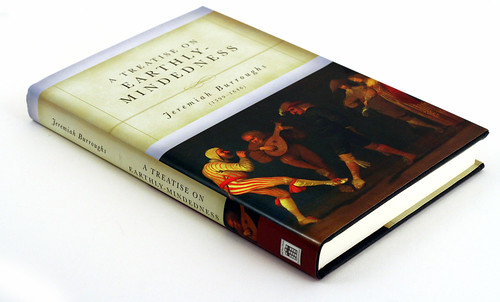
Fitting of Burrough’s classic, Soli Deo Gloria published A Treatise on Earthly -Mindedness with an attractive dust-jacketed, durable cloth cover and Smyth-sewn binding. It’s an excellent work for those of us who sometimes find ourselves surrounded by the cares of this world, asphyxiating on temporal toxins rather than breathing fresh grace.
IMG_1458.ed.jpg

Title: A Treatise on Earthly-Mindedness
Author: Jeremiah Burroughs (1599-1646)
Editor: Don Kistler
Reading level: 2.0/5.0 > easy thanks to excellent editing (includes nice section and subpoint headings)
Boards: hardcover, embossed
Pages: 259
Volumes: 1
Dust jacket: yes
Binding: Smyth sewn
Paper: white and clean
Topical index: no (would have been very useful)
Scriptural index: no (would have been very useful)
Text: perfect type
Publisher: Ligonier; Soli Deo Gloria
Year: original ed., 1649; edited ed., 1991
Price USD: $18.00 from Ligonier
ISBN: 1877611387

Piper’s Prayer in Discouragement

From the Desiring God National conference this Fall in Minneapolis I am reminded of a short excerpt from the first panel discussion with Justin Taylor, John MacArthur and John Piper. The question was over responding to discouragement. Piper gave this glimpse into his (very humbling) prayer life.

“Probably, I pray the prayer ‘keep me’ and ‘preserve me’ as often as I pray any prayer. Keep me saved – because I think God uses means to cause us to persevere. Keep me in the ministry – I don’t want to be a short-lived person [minister]. Keep me married – I don’t want to wreck it that way. Keep me! I pray that: ‘now unto him that is able to keep you from falling’ (Jude 24, KJV). I pray that blessing down on me a lot.”

Whether we are discouraged or not, that’s a great outline for our personal prayers.

Personal Evangelism and Divine Sovereignty

tsslogo.jpgAnother excellent book on evangelism appearing this year is Richard D. Phillips’ Jesus the Evangelist: Learning to Share the Gospel from the Book of John (Reformation Trust: 2007). His book concludes with a helpful appendix on the relationship of divine election and personal evangelism built from J.I Packer’s classic (pp. 168-185).

Here is Phillips’ outline:

A. Does God’s sovereignty argue against evangelism?

  1. Sovereignty does not rule out human will and responsibility.
  2. Sovereignty ordains not merely the ends but the means.
  3. Evangelism is one of the best ways to glorify God.
  4. Evangelism is one of the best ways to fulfill God’s command that we love our neighbors.
  5. Sovereignty does not invalidate anything the Bible shows us about our calling to evangelize.

B. Does God’s sovereignty actually encourage evangelism?

  1. It makes us dependent upon Him.
  2. It makes us bold in evangelism.
  3. It makes us patient in evangelism.

C. How should our belief in God’s sovereignty reform our approach to evangelism?

  1. Our evangelism should be biblical, both in its message and method.
  2. Our evangelism should be prayerful.
  3. Our evangelism should be personal, courteous, and loving.
  4. Our evangelism should be zealous and creative.
  5. We should never lose heart in our evangelism efforts.

Apologetics is not Evangelism

tss-baseball.jpgFrom my (very limited) vantage point, American churches seem to be cultivating a growing interest in apologetics (that is, defending the faith and answering objections). In a pluralistic culture that grows ever diverse, it’s important for the church to formulate answers to the challenges. This is commendable and biblical (1 Peter 3:15).

But along with this new emphasis on apologetics runs a concurrent temptation for churches to confuse evangelism and apologetics, to confuse defending and proclaiming.

Examples of this are not hard to find. In an interview with Christianity Today, Brian McLaren blurs traditional evangelism and apologetics to the point where they are really indistinguishable. I think this reflects a broader confusion.

This blurring of lines and even an apologetics-for-evangelism replacement is especially dangerous because it relocates the ultimate goal of the Gospel. In apologetics we seek the intellectual assent of others by overcoming their questions and engaging their obstacles. But the goal of evangelism is to proclaim the message of the Cross and see God (by His sovereign grace) produce personal brokenness, humility, and repentance.

By replacing evangelism with apologetics, we may unwittingly replace weeping hearts for nodding heads. Carried out ecclesiastically, everyday evangelism gets replaced by group meetings led by experts.

So I was especially encouraged by these comments in Mark Dever’s new book, The Gospel and Personal Evangelism (Crossway: 2007):

“… practicing apologetics is a good thing, but it’s not evangelism. Answering questions and defending parts of the good news may often be a part of conversations Christians have with non-Christians, and while that may have been part of our own reading or thinking or talking as we came to Christ, such activity is not evangelism … By far the greatest danger in apologetics is being distracted from the main message. Evangelism is not defending the virgin birth or defending the historicity of the resurrection” (pp. 77-78).

And with this shift from evangelism to apologetics comes a subversive shift in agenda. Dever writes,

“Apologetics is defending the faith, answering the questions others have about Christianity. It is responding to the agenda that others set. Evangelism, however, is following Christ’s agenda, the news about him. Evangelism is the positive act of telling the good news about Jesus Christ and the way of salvation through him” (p. 78).

This is a great point to stop for personal reflection. Does what I call evangelism look more like apologetics? Is the ultimate goal of my evangelism aimed towards mere agreement? Or am I lovingly and gently calling sinners to see sin as personal sin, and see wrath as wrath directed towards them? Am I calling for repentance, encouraging “godly grief,” seeking repentance from “dead works,” and a clinging to the Cross (Acts 26:20; 2 Cor. 7:10; Heb. 6:1)? In short, is my evangelism marked as defending or proclaiming?

These are good things to consider.

IMG_8052.ed.jpg

Hidden sin and Luther’s discovery of the Cross

tsslogo.jpg“In his struggles with penance and confession, he [Martin Luther the monk-scholar] wrestled with Psalm 19:12, ‘Clear thou me from hidden faults’ (ASV). Luther’s problem was never whether his sins were large ones or small ones, but whether in fact he had confessed every single one. What about the sins he could not remember? What about the sins committed in his sleep? Luther anticipated Freud by recognizing a depth-dimension to the human person and by refusing to limit the effects of sin to the conscious mind alone. Such a radical reading of the human situation could only be answered with an even more radical reading of divine grace. …

Luther’s new insight was that the imputation of Christ’s alien righteousness was based, not on the gradual curing of sin, but rather on the complete victory of Christ on a cross. The once-for-allness of justification was emphasized: ‘If you believe, then you have it!’ Nor is there any direct correlation between the state of justification and one’s outward works, as Luther made clear in his sermon on the pharisee and the publican (1521): ‘And the Publican fulfills all the commandments of God on the spot. He was then and there made holy by grace alone. Who could have foreseen that, under this dirty fellow?’

Luther’s doctrine of justification by faith fell like a bombshell on the theological landscape of medieval Catholicism. It shattered the entire theology of merit and indeed the sacramental-penitential basis of the church itself.”

Timothy George essay on Luther in Reading Romans Through the Centuries: From the Early Church to Karl Barth (Brazos Press: 2005) pp. 115-116.

Reformation Heritage Books

Our friend Steve Renkema, manager of Reformation Heritage Books, was interviewed by Ingrid Schlueter on CrossTalk yesterday about books. The interview provides a nice look behind the scenes of a rising Reformed publisher.

Related: RHB produced the 2006 TSS Book-of-the-Year — Meet the Puritans.
Related: RHB is currently working on the Works of William Perkins.
Related: Find TSS reviews of RHB titles here.