Bonar: The Humble Calvinist in the work of God

Bonar: The Humble Calvinist in the work of God

“If Jewish or Gentile unbelief, and alienation from God were things which could be reached by moral persuasion, and human warmth; if men’s souls were within our reach as completely as their bodies, then God’s definite purpose as to salvation would be of little moment [importance]. But if the estrangement of humanity from God be a thing quite beyond man, and man’s argument or eloquence; if the resistance of a human will be a thing of almost unconceivable potency, and if the subjugation of that will require the direct forth-putting of Omnipotence, such as that which created heaven and earth, then God’s purpose is the first and last thing to be considered in going forth to deal either with Jew or Gentile. Other considerations may light up a false fire and produce a fair seeming zeal; but only the knowledge of a divine purpose can bring a man into a right missionary position, fill him with missionary devotedness, and nerve him [give confidence] in the hour of disappointment or discomfort. ‘Even so Father for so it seemed good in thy sight,’ was the truth on which the Son of God rested in the day of Israel’s first rejection of His Word; and it is just on such a truth as this, — a truth that lifts the divine purpose into its true place, that each of us, whether minister or missionary, must lean, in the day of apparent failure. The Pauline, or, if you like, the Calvinistic scheme, which connects all work for God with a definite purpose, and not with an indefinite wish, is that which alone can make us either comfortable or successful. Armed with this divine purpose, we feel ourselves invincible; nay, we are assured of being victorious. Having ascertained God’s purpose, and adopted it as the basis of our operations, we feel that we are in sympathy with God while working for Him. And it is this sympathy, this oneness of mind with God, that cheers us and sustains. He ever wins who sides with God. We shall thus be better fitted for enduring hardness, for ‘spending and being spent;’ that is, for expending ourselves, till all that is in us is expended.”

– Horatius Bonar, The Christian Treasury (1871) in The Life and Works of Horatius Bonar (CD-Rom, Lux Publications) pp. 1334-1335.

Book review: Calvin’s Teaching on Job by Derek Thomas

tsslogo.jpgBook review:
Calvin’s Teaching on Job by Derek Thomas

After recently completing N.T. Wright’s new book, Evil and the Justice of God, I came away with the sense that evil is at God’s ankles like a small poodle biting and pestering. While I learned some things, the conclusion that we should simply learn to forgive more (while being true) was also a bit unsatisfying. For one who believes in the total sovereignty of God, this picture of evil was incomplete.

But the question, ‘Why do the most godly suffer?,’ is a question every Christian comes face-to-face with and to which every pastor must give an answer. I’m finding that the answer to this question is found within another big problem – how do we interpret the book of Job?

So when Derek Thomas’ book, Calvin’s Teaching on Job: Proclaiming the Incomprehensible God, arrived in the mail, I was eager to dive deep. And Thomas did not disappoint. With incredible depth, Thomas leads the reader systematically through Calvin’s thoughts as he wrestled with the book of Job. Here you will find both encouragement to tackle the book of Job expositionally and also real-life answers to the most perplexing questions in the Christian life. It’s a book that I will come back to time and time again when my own soul and the souls of friends ask the question ‘Why?’

Maybe the most helpful point I learned was exegetical. Calvin teaches us to use Elihu to interpret the Jobian dialogues (see Job 32:1-37:24). “While Calvin is consistently critical of the advice of Bildad, Eliphaz, and Zophar, he is generally supportive of the contribution of Elihu” (226). Elihu best understood the sovereignty of God, the nature of justice, the separation between God and man and that God’s justice and power go alongside His goodness.

By favoring the advice and input of Elihu, Calvin takes from the dialogues several helpful principles: Trials are appointed by God’s providence to educate us, they are used by God to humble us, they bring our hidden sins to the surface, and they bring us to repentance. “Afflictions also drive us to desire more of God’s help, provoking us to return to him, by drawing us to him, taming us, and teaching us to pray.” Certainly, “the distribution of trials is not whimsical or arbitrary” (228).

The bottom line is that God is incomprehensible. His providence is beyond our understanding. We cannot see the big picture, but we can rest in a sovereign God who does!

“When bad things happen to the righteous, the Lord is involved in the deepest possible way. Far from removing God from such crises in the interest of rescuing him from the charge of sin’s authorship, Calvin regularly takes God further and further into the difficulty. He meets the ensuing theological and pastoral difficulties by resorting to God’s incomprehensibility” (375).

Although it was a doctoral dissertation, the book reads very well. The old English spelling of Calvin’s sermons on Job may be annoying but you will pick up on it as you read (to “… shewe vs hee is the iudge of the world we must learne to stande in awe of him”). Thomas is critical of Calvin when necessary. The book itself is over 60-percent footnotes (surely setting some record). The masses of footnotes are mostly direct references from Calvin, providing him an extensive first-hand voice while keeping the book clean and concise.

For 14 months between 1554 and 1555 John Calvin preached through the book of Job, leaving a wealth of expositional insights and pastoral applications for future expositors. Dr. Thomas has assembled these insights in a systematic format that will benefit the student seeking a guide to Calvin’s thought, the pastor seeking a guide to counseling, and for the preacher seeking an exegetical guide to interpret the book of Job. An excellent addition to the library of a Humble Calvinist.

Title: Calvin’s Teaching on Job: Proclaiming the Incomprehensible God
Author: Derek Thomas
Boards: hardcover
Pages: 416
Volumes: 1
Dust jacket: no
Binding: glue
Paper: normal
Topical index: yes
Scriptural index: no
Text: perfect type
Publisher: Christian Focus Publications, Mentor
Year: 2004
Price USD: $25.99/$18.99 from CBD
ISBNs: 1857929225, 9781857929225

————————–

Click here to access previous posts in the Humble Calvinism index.

————————–

100,000 hits!

100,000 hits!

Party time! Today or tonight will mark the 100,000th hit at The Shepherd’s Scrapbook blog. To celebrate were giving away free books (sorry no blank bibles this time). I’ve got three wonderful book prizes in front of me …

1. The Valley of Vision paperback
2. John Piper’s newest book Amazing Grace in the Life of William Wilberforce
3. A.W. Pink’s classic The Doctrine of Sanctification

Here’s how you win. You’ll need to know how to take computer screenshots. As soon as the 100,000th hit takes place, take a screen shot of the TSS hit counter (see “Blog Stats” on the right sidebar). Send us the picture. The nearest to 100,000 wins and the next closest (ex. 100,003) gets second place and so on. Three prizes … three winners. First place chooses between the 3 books, second place chooses between two books and the third winner gets what’s left.

Please don’t just re-load the page and please don’t PhotoShop manipulate images either. :-)

Blessings to you all and thank you for reading and supporting The Shepherd’s Scrapbook! I do appreciate the many friendships this blog has initiated over the past several months. Thank you!

Tony

tony AT tonyreinke DOT com

——————————————–

And the winners are …

1. James T. (London)

2. Gareth R. (Nottingham, England)

3. Jeff C.

Humble Calvinism: (12) The Institutes > The “mutual bond” of God’s power and Word (1.9)

02spurgeonhumcalvinism.jpg

Part 12: The “mutual bond” of God’s power and Word (1.9)

For John Calvin, the connection between the power of God’s Spirit and God’s Word are inseparable. It is the Spirit’s confirming power in our unbelieving hearts that authenticates the divine origin of the Word of God. No proofs or philosophical reasoning could ever seal this01spurgeoncalvin5.jpg truth in a dead and blind soul.

But this chapter brings us to one of the first places Calvin points out those who are in error (something Calvin does not shy away from). These “Libertines” were introducing “a heinous sacrilege” and a “devilish madness” (93). Apparently these “rascals” had begun believing that the Spirit works independently of the Word of God and that those who continued to follow the old Scriptures were “simple” and too limiting of the Spirit.

Now before we get into the debate a little more (and why its important for us today) we should take a moment to notice how Calvin teaches theology. Calvin frequently uses antithesis. He first teaches what Scripture teaches and then he reveals the doctrinal antithesis and those who contradict. Calvin teaches us about truly divine knowledge, true revelation, the true worship of God, the Trinity and biblical anthropology in these first chapters of the Institutes. But along the way he will point out the false ways to know God, the nature idolatry, false views of the Trinity and anthropology. (For an excellent chart on the antithetical arguments see Analysis of the Institutes by Battles, pp. 19-23). Calvin keeps the antithesis in view at all times.

According to the arguments of Calvin, we learn that these Libertines believed the Word of God was “fleeting or temporal” and that over time the Holy Spirit would succeed Scripture in relevance. The Spirit would be newer and more original, Scripture would become less important and less relevant. Calvin will rebuke the Libertines with Scripture.

According to what we have seen recently in the Institutes, there can be no separation between God’s power and God’s Word. Calvin calls this a “mutual bond” (95). We’ve seen in the past two chapters that it’s the Holy Spirit Himself that confirms the authenticity of the written Word. At least for apologetics and evangelism, the two go hand-in-hand. But in this chapter Calvin will broaden his language beyond evangelism and apologetics.

The major argument of Calvin grows from John 16:13 where Jesus says “When the Spirit of truth comes, he will guide you into all the truth, for he will not speak on his own authority, but whatever he hears he will speak, and he will declare to you the things that are to come.” Therefore Calvin writes, the Spirit “has not the task of inventing new and unheard-of revelations, or of forging a new kind of doctrine, to lead us away from the received doctrine of the gospel, but of sealing our minds with that very doctrine which is commended by the gospel” (94). The Spirit’s work is intimately concerned with Scripture.

Specifically, we see the power of the Spirit is unleashed when He seals our minds with the doctrine of the gospel (94). The mighty power of the Spirit is unleashed when sinners are brought under conviction of their sin and see the freedom and beauty of Christ dying as their perfect substitute! God’s power and God’s Word work hand-in-hand. Thus drawing people away from the gospel towards new revelation undermines the very work of the Spirit Himself.

God’s Word and God’s Spirit cannot be separated in apologetics and evangelism (as we see in chapters 7 and 8). But in this chapter Calvin broadens the language to say, “we ought zealously to apply ourselves both to read and to hearken to Scripture if indeed we want to receive any gain and benefit from the Spirit of God” (94). So here in this chapter the language is broadened to say that “any gain and benefit” we receive from the Spirit comes through the Word of God.

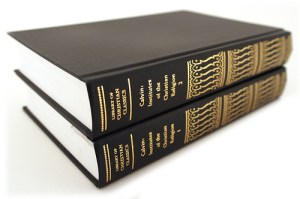
It appears the Word creates a sort of boundary to the Spirit’s work. And it should be this way, Calvin argues, because how would we ever authenticate the work of the Spirit if not by the guide of Scripture? Wouldn’t we be assaulted by Satanic counterfeits of the Spirit’s work if Scripture does not provide ‘parameters’ for the work of the Spirit? How will we know the Spirit is at work, not Satan, if not through “a most certain mark” (94)?calvininstitutes.jpg

Thus Scripture gives us a guide to the work of the Holy Spirit so we may “embrace the Spirit with no fear of being deceived when we recognize him in his own image, namely, in the Word” (95). If the Spirit works beyond Scripture, we have no way of discerning the authenticity of that work.

Back to the Libertines. Calvin argues that spiritual experiences do not negate the authority and sufficiency of the Word. Was not Paul taken to the third heavens and yet he could say “All Scripture is breathed out by God and profitable for teaching, for reproof, for correction, and for training in righteousness, that the man of God may be competent, equipped for every good work” (2 Tim. 3:16-17). Paul’s experience of the Spirit of God did not shake his confidence in the sufficiency of Scripture. Did not Peter hear God’s direct voice from heaven? Yet he confirms the sufficiency of God’s Word (2 Pet. 1:18-19). The power of the Spirit confirms the Word; it never makes Scripture obsolete.

Therefore only when “proper reverence and dignity are given to the Word does the Holy Spirit show forth his power” (95). When we revere God’s Word it becomes the “word of life” whereby the Holy Spirit revives life to dead souls (Phil. 2:16, Ps. 19:7, Luke 24:27,45).

In evangelism, apologetics, or any other time when the Spirit is at work, there is no separation between the power of the Spirit and the words of Scripture! They abide together in a “mutual bond.”

Calvinistic meditations …

1. Emphasize the Spirit and the Word together. Rarely will you find churches and preachers de-emphasize the power of God’s Spirit. But daily I hear of churches that de-emphasize the importance of Scripture. We need to be reminded that by de-emphasizing Scripture we are de-emphasizing the Spirit’s power at the same time. The two walk hand-in-hand in a “mutual bond.” Expect the full power of the Spirit to come alongside the full preaching of the Word. If we preach a tiny bit of Scripture we should expect a tiny bit of the Spirit. Ironically, it’s weakening churches that typically abandon most of Scripture, the one God-given balm to their downward slide. The Spirit and Word go together (see John 3:34, 6:63, Acts 4:31, 10:44, 1 Cor. 2:4,13, Eph. 6:17, 1 Thes. 1:5-6, Heb. 4:12).

2. Beware of discontent with Scripture. Church history teaches us that great errors are introduced into the church when its leaders grow discontent with Scripture. The intrusion of psychological language and methods that replaced the concepts of sin and sanctification is one great example. To this day, the church is still weeding out this intrusion of decades past. Our job is not to add power or relevance to Scripture. We are called to rest by faith that God’s power will come through God’s Word. It’s through the Word that the Spirit will “show forth His power” (95). God responds in power to those who tremble at His Word (Isa. 66:2).

3. Cling to the sufficiency of Scripture. By tying the power of God to the Word of God, Calvin has made a strong case for the sufficiency of Scripture. The discontent and impatience with Scripture will only happen if we have abandoned a commitment to the sufficiency of Scripture. If God’s Word is sufficient to transform dead souls, does it lack anything (see Ps. 19:7, Jam. 1:18, 1 Pet. 1:23)? The overall sufficiency of Scripture is a major theme (read Ps. 19, 119 and 2 Tim. 3:15-17). A practical denial of the sufficiency of Scripture leads to discontent with Scripture, which leads to a failure to understand Scripture, which opens the door for Satanic deception. Like a handful of rock on the side of a cliff, we must cling to Scripture’s sufficiency or there will be no end to the fall.

(Warning! Bandwagon approaching…)

4. Let Scripture define the work of the Spirit. Read 1 Corinthians 14 and see how the strength of the New Testament church rests upon the continuing prophetic gifts. Don’t limit the Spirit’s work in the church to something less than biblical. Re-think Cessationism. [Much love to my disagreeing brothers!] :-)

Bottom line: The power of God and the Word of God walk together in a “mutual bond.” Don’t expect the Spirit to be unleashed where the Word is not preached. And pray in expectation that as you preach His truth, His power will change lives forever! This reverence towards the Word and expectation of the Spirit’s power are at the heart of Humble Calvinism.

————————–

Click here to access previous posts in the Humble Calvinism index.

————————–

2007 Banner of Truth Pastor’s Conference details

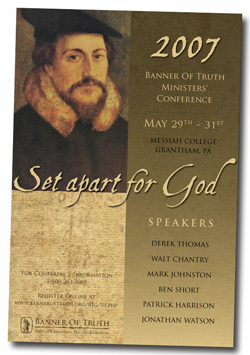
This year I’m planning to attend two new conferences. The first is the Sovereign Grace Ministries Leadership Conference in April and the other is the Banner of Truth pastors’botconf.jpg conference in May. I’ve heard about them but never seen them for myself. Lord willing, this spring I will attend them both.

As you may have guessed, one of the major reasons I am spending so much time in John Calvin these first months of 2007 is to prepare for the upcoming Banner of Truth Ministers’ Conference entitled “Set Apart for God.” The conference runs between May 29th and 31st on the campus of Messiah College in Grantham, PA. Speakers will include two of my favorites, Derek Thomas and Walt Chantry (Chantry wrote the excellent book, The Shadow of the Cross). I look forward to Dr. Thomas’ trio of presentations on holiness, especially as they relate to Calvin’s Institutes. It is encouraging to see emphasis on Calvin’s understanding of the Christian life (as I think he has much to offer here). Dr. Thomas wrote an excellent book on Calvin’s understanding of the book of Job which has recently become one of my favorites. We’ll look more at this book on Friday.

bot.jpgUPDATE 3/14: Walt Chantry will not be available to speak this year. Instead, Sinclair Ferguson will be taking his place.

But for more information on the pastors’ conference you can download the newly-released conference PDF here and you can register here. Should be a fun time. And from what I’m told, Friends of the Shepherd’s Scrapbook will get an exclusive tour of the Banner of Truth warehouse in Carlise, PA as an added bonus!

Humble Calvinism: (11) The Institutes > Proofs of Scripture’s authenticity (1.8)

02spurgeonhumcalvinism.jpg

Part 11: Proofs of Scripture’s authenticity (1.8)

As we travel through the Institutes of the Christian Religion by John Calvin (1559 edition) I am amazed by its contemporary significance. We have much to learn and apply to our own churches and evangelism today.
01spurgeoncalvin2.jpg
Through our study, Calvin has recently reminded us that until and unless the Holy Spirit confirms Scripture’s authenticity in our hearts, we will not give our lives and our hopes over to its message. God does this by breaking through and confirming Scripture in our hearts directly, not by indirect proofs (we saw this last time).

Today we see that there are sufficient proofs of Scripture’s authenticity, but we must first have faith to comprehend them. So God must first give us the conviction that Scripture is truly from God before these proofs make sense. This is why Calvin can close the chapter with an evangelistic plea by writing, “those who wish to prove to unbelievers that Scripture is the Word of God are acting foolishly, for only by faith can this be known” (92). We can share the gospel message with any unbeliever, but until Scripture is seen as the place where “divine majesty lives and breathes,” any proofs of Scripture’s authenticity are unfruitful (80). We rest upon the Spirit to work this confirmation into other hearts.

So here is the clarification from the last chapter: There are inherent proofs within Scripture to prove its uniqueness. Most of this chapter is given to this theme. “What wonderful confirmation ensues when, with keener study, we ponder the economy of the divine wisdom, so well ordered and disposed; the completely heavenly character of its doctrine, savoring of nothing earthly; the beautiful agreement of all the parts with one another” (82).

For Calvin, the evidences of divine origin center around the conciseness of its content, its heavenly nature, that it was written by the least expected authors, it carries a consistent theme, and because its message predates all other existing theological systems.

But the proof is also seen in the unflattering accounts Moses writes of his own family. You have the embarrassment of Levi (Gen. 49:5-6) and his brother Aaron and sister Miriam (Num. 12:1). Was Moses speaking “from the feeling of his flesh, or that he is obedient to the command of the Holy Spirit?” (85). Such embarrassment is not published from a desire to elevate Moses’ fame.

Also, the content of Scripture is heavenly. There is a vision of the unseen realities. The prophets are “crammed with thoughts that could not be humanly conceived” (83). And these prophecies are filled with events that would not be fulfilled until after the death of the prophet himself (1.8.7).

But there is an “almost rude simplicity” of Scripture (82). It was written by men like Matthew, Mark, Luke, Peter and John – “all of them rude, uneducated men” (91). It was not ordained with the jewels of ornate eloquence, but its divine truths are communicated in simplicity. For Calvin, a man familiar with literature and philosophy, can say that in comparison the words of God “surpass all gifts and graces of human endeavor, breathe something divine” (82).

And there is Saul, a man filled with rage against the church who was converted asevidence.gif Paul and the writer of much of the New Testament. His change shows that “he was compelled by heavenly authority to affirm a doctrine that he had assailed” (91).

Calvin argues that Scripture’s age, the miracles of Scripture, the preservation of Scripture through eras in which books were commonly burned, and the blood of the martyrs all show Scripture to be more than another book. These arguments comprise the bulk of the chapter.

All of these “secondary aids” confirm scripture’s authenticity only after “the chief and highest testimony” of the Spirit (92). God must supernaturally convince us of Scripture’s authenticity before the secondary “aids” and “props” are convincing (92). So Calvin ends the chapter by warning us not to try and win converts by persuading them with philosophical evidences of Scripture’s authenticity. We must pray that the Spirit would break into the depravity and rebellion of sinners and give them a taste of Scripture’s sweetness. Then they can taste the evidences in Scripture for themselves.

There are proofs, no doubt. But Calvin reminds us to let these proofs follow the Spirit-wrought conviction!

Calvinistic meditations …

1. Faith precedes reason. Anselm (1033-1109) understood well that faith must come before true understanding. In the introduction to Proslogium, the editor summarizes Anselm’s view in this way: “The unbelievers … strive to understand because they do not believe; we, on the contrary, strive to understand because we believe. They and we have the same object in view; but inasmuch as they do not believe, they cannot arrive at their goal, which is to understand the dogma. The unbeliever will never understand. In religion, faith plays the part that experience usually plays in the understanding of the things of this world. The blind man cannot see the light, and therefore does not understand it; the deaf-mute, who has never perceived sound, cannot have a clear idea of sound. Similarly, not to believe means not to perceive, and not to perceive means not to understand.”

Faith is not unreasonable, but faith must come first before the evidence. It is surely hard to grasp in the realm of spiritual truth that confirmation comes before the proof, but that is how Calvin, Anselm and Scripture itself explains this reality. The Spirit must convince us first through His power and then the evidences begin to make sense. Until the Spirit works, there are not enough proofs to cause a faith that reveres and trusts God as the genuine author. Convincing others that Christianity is legitimate is not a process or a seminar, but a point in time when the Sovereign touches a dead heart and causes it to pulse. This is why Jesus can say, “To you it has been given to know the secrets of the kingdom of heaven, but to them it has not been given” (Matt. 13:11). The evangelist, apologist and preacher all center their messages around the gospel, waiting patiently for the life-giving blood to begin pulsing in others at the sovereign timing of God. More about this in a moment.

2. Our understanding of God and the Gospel are the fruit of His “gracious will.” Our understanding of the divine mysteries has everything to do with a Sovereign God (Matt. 11:25-26 see also Matt. 16:17; Mark 4:11; Luke 8:10; John 7:17; 1 Cor. 2:9-10, 14; 2 Cor. 4:4; Col. 1:26-27; 1 John 2:27). That we understand anything is merely from His “gracious will” to reveal them to us! What amazing grace, that sinners are given eternal wisdom! If we truly understand the message of the gospel, this fact alone should be a powerful means of humility in us. To truly grasp Calvinism is to be a very Humble Calvinist. All divine light comes from God’s gracious sovereignty.

3. The message is the method. Not only is the gospel the message of salvation, but it is also the “the power of God for salvation” (Rom. 1:16). The Old Testament prophets understood this, too. “Is not my word like fire, declares the LORD, and like a hammer that breaks the rock in pieces?” (Jer. 23:29). God’s Word is a living and active force, piercing and discerning our hearts (Heb. 4:12). But specifically, Paul understands the life-changing power in the message of the Cross. That is why Paul can say the gospel is “the power of God for salvation” (Rom. 1:16), that “faith comes from hearing, and hearing through the word of Christ” (Rom. 10:17), and that “the word of the cross is folly to those who are perishing, but to us who are being saved it is the power of God” (1 Cor. 1:18). So it’s no wonder Paul fights for the clarity of the gospel (2 Cor. 10:4-5; Gal. 1:6-2:21). The clear and accurate gospel message of the Cross is where both the message and the Spirit’s effectual power to save sinners from hell reside!

So don’t try to change lives through gimmicks. The power of God is not introduced to sinners through props and proofs and philosophy and arguments and seeker-sensitive devices. Place your trust in God. He alone displays His power to awaken sinners through the message of the gospel! Talk about depravity, talk about sin, talk about the wrath of God coming upon all unrepentant sinners, talk of Christ who satisfied the wrath of God and Whose work is our only hope to substitute for our sin and unrighteousness! Seek to center everything about your ministry here on the Cross.

This one gospel is the only self-sustained, self-powered and self-authenticated message to awaken and transform sinners. What glorious freedom is there for the preacher and evangelist who understand Calvinism. Preach with power by preaching Christ and Him crucified (1 Cor. 1:23, 2:2)!

————————–

Click here to access previous posts in the Humble Calvinism index.

————————–