Book review: John Gill’s Exposition of the Old and New Testaments (9 vols)
Everyone in history lives within a historical context. I love Meet the Puritans by Beeke and Peterson primarily because it offers biographies to introduce the context behind the best Puritan writers.
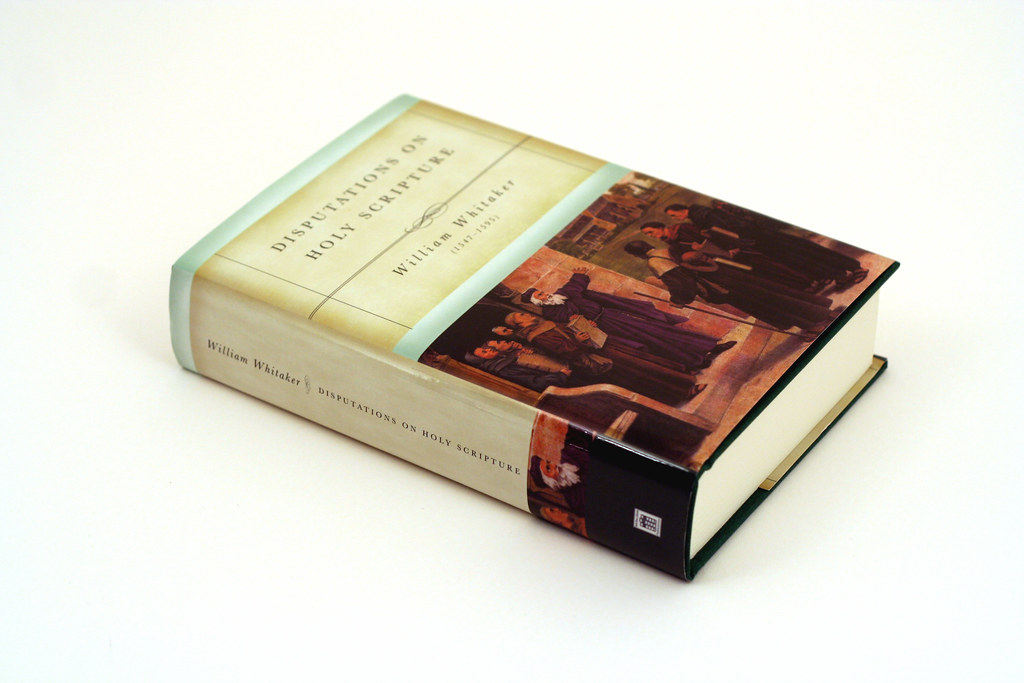
Now for some specific context. In 1517, Martin Luther nailed the 95 Theses to signal a shift away from Roman Catholic traditionalism towards a thoroughly biblical theology. This reformation burst on the scene and continued to develop with the Puritans that followed. This Reformation and Post-Reformation period stressed the fact that understanding divine realities demands faith, the illumination of the Spirit and divine revelation (God’s Word). In 1588, William Whitaker wrote,
“It is only the external light of nature that is required to learn thoroughly the arts of philosophy; but to understand theology aright, there is need of the internal light of the Holy Spirit, because the things of faith are not subject to the teaching of mere human reason” (Disputations on Holy Scripture, p. 364).
Unfortunately, this emphasis upon the preciousness of God’s Word and the primacy of its divine truth did not last unhindered.
The Enlightenment – with the rise of mathematics, science and philosophy – introduced a new “rational” interpretation upon divinity. Beginning around 1725, the rise in “rationalism” attempted to reduce faith to what can be proven with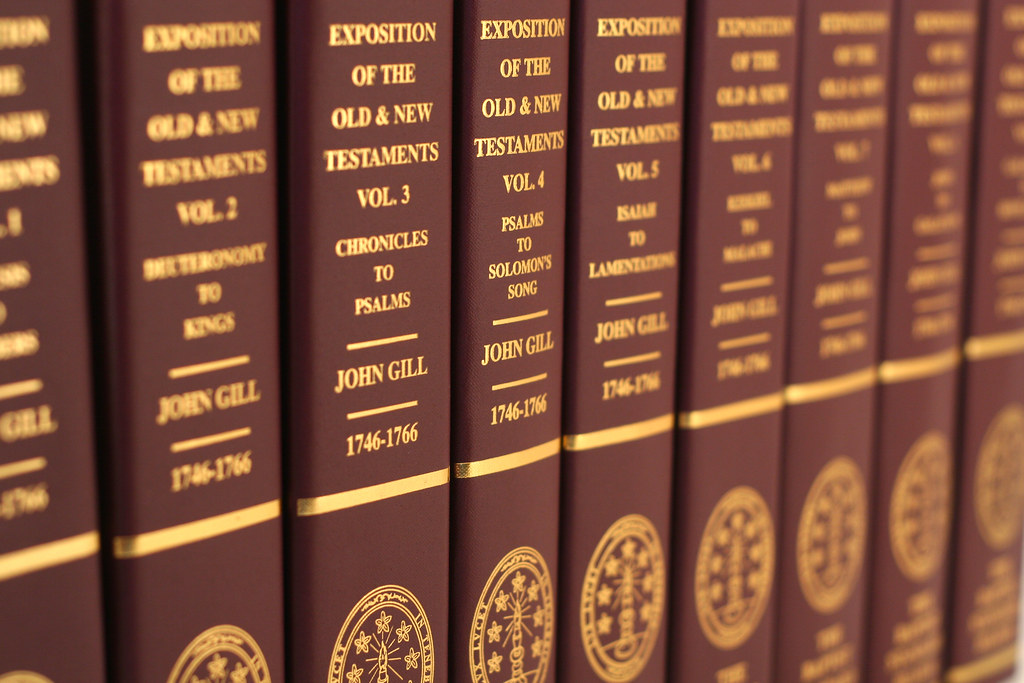 philosophy and reason. Truth no longer rested upon faith, the Spirit and revelation, but upon “demonstrable evidence and rational necessity.” Clearly, this was a serious break from the former traditions.
Needless to say, the rise in “rationalism” brought significant biblical compromise into the church by de-emphasizing the Word and faith-filled, Spirit-illuminated interpretation. In their place was erected a philosophical understanding of divinity. But philosophical interpretations of divine truth, Paul tells us, simply miss the point of the biblical gospel (1 Cor. 1:18-2:16).
John Gill
It was in the midst of this rise in rationalism that some writers stood faithful to a Spirit-led, literal interpretation of Scripture as the sole object of faith. One of the most prominent of these men was Baptist John Gill (1697-1771).
Gill was a prolific author and well-known Old Testament scholar. An excellent overview of John Gill’s life and works comes to us in a sermon Spurgeon preached on August 16th, 1859 at the laying of the first stone of the new Tabernacle building. You can read the entire sermon at CCEL. Here is an excerpt,
“A man of profound learning and deep piety, he was notable as a divine for the exactness of his systematic theology in which he maintained the doctrines of grace against the innovations of Arminian teachers. His Body of Divinity has long been held in the highest repute. As the fervent exposition of an entire and harmonious creed, it has no rival. His famous treatise entitled The Cause of God And Truth, obtained for him the championship of the Calvinistic School of Divinity.”
The eulogy delivered upon Gill’s death by Augustus Toplady reminds us that Gill was both forceful and intellectually skillful.
“That his labors were indefatigable, his life exemplary … if any one can be supposed to have trod the whole circle of human learning, it was this great and eminent person. His attainments, both in abstruse and polite literature, were equally extensive and profound, and so far as the distinguishing doctrines of grace are concerned, he never besieged an error which he did not force from its stronghold, nor ever encountered an adversary whom he did not baffle and subdue.”
The Commentary
John Gill’s commentary is nine volumes long, including six volumes on the Old Testament and three on the New Testament. At first glance this specific printing is superb! The facsimile printing comes in a larger book format and in higher quality cloth binding than expected.
Gill follows the traditional commentary style of a short summary of the book, summary of each chapter, and then commentary on each individual verse following up to the next chapter.
John Gill was a forefather of the Metropolitan Tabernacle we now most associate with Charles Spurgeon. Spurgeon, who spent much time reading and critiquing commentaries, is quick to say that he was unaware of a better commentator of the Old Testament. Gill’s greatest asset was his expertise as a Hebrew scholar.
Spurgeon had his criticisms as well. He wrote publicly that Gill used too many straw-man arguments and held loose interpretations of the Parables. Spurgeon wrote,
“Very seldom does he allow himself to be run away with by imagination, except now and then when he tries to open up a parable, and finds a meaning in every circumstance and minute detail; or when he falls upon a text which is not congenial with his creed, and hacks and hews terribly to bring the word of God into a more systematic shape. Gill is the Coryphaeus of hyper-Calvinism, but if his followers never went beyond their master, they would not go very far astray.”
But the bottom-line, Spurgeon writes, is that “the world and the church take leave to question his dogmatism, but they both bow before his erudition [learning] … For good, sound, massive, sober sense in commenting, who can excel Gill?”
At another place, Spurgeon considered this commentary “remarkable for the copiousness of its glossary, the brilliance of its argument, his apprehension of prophecy, and the richness of his Hebrew scholarship. His preparations for the pulpit having, as is well known, furnished the materials for the press, we can but reflect on the priceless value of his ministry.”
In other words, the obvious power of his public preaching endures through the press. This was not a man addicted to scholarship, but a man driven by the conviction to preach through the whole counsel of God. His commentaries exemplify what was certainly a “priceless ministry.”
Extras
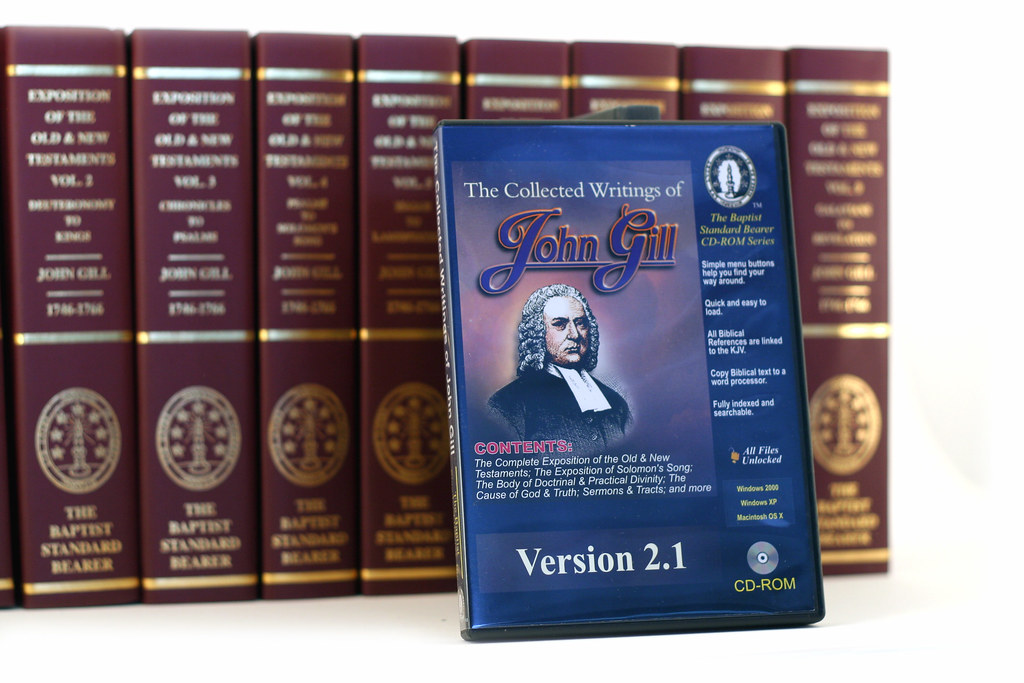
It is encouraging to see publishers incorporating electronic books with printed books. This is a trend we see have recently seen Crossway pull off with great success.
This commentary set from The Baptist Standard Bearer comes bundled with a CD-ROM of The Collected Writings of John Gill, which includes the full text of his commentary, nearly 100 of his sermons and his many books (including the massive, 2,000 page Complete Body of Doctrinal and Practical Divinity and the 1,000 page The Cause of God and Truth). It makes a very helpful and handy complement to the printed commentary because it makes searching and copy-and-pasting of Gill’s material very easy to incorporate in sermon prep.
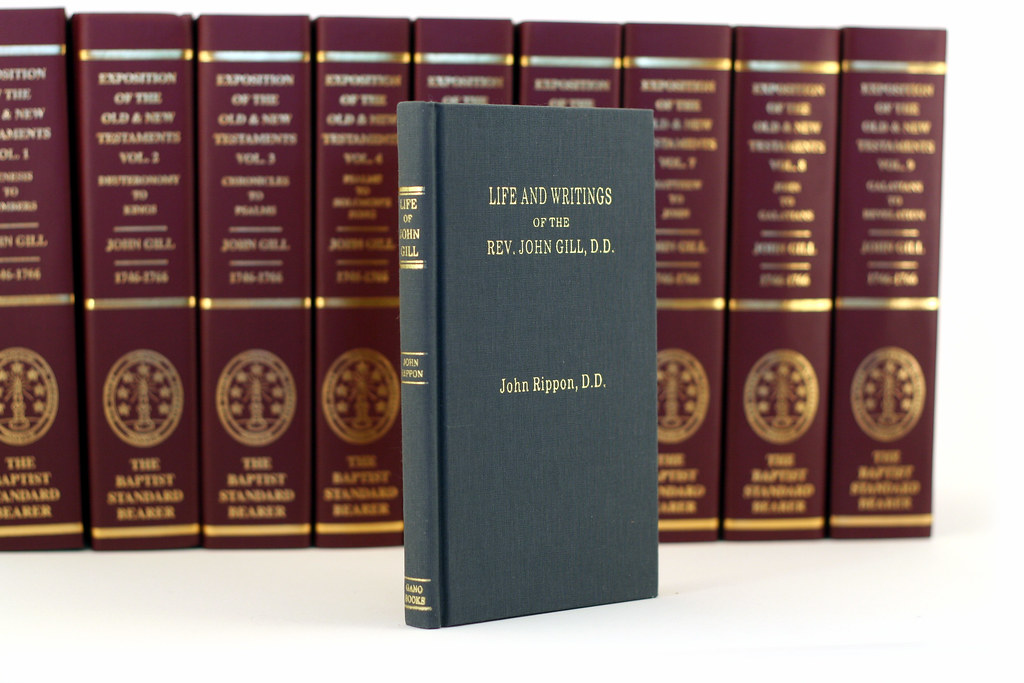
The set also includes the Life and Writings of the Rev. John Gill, D.D., a short biography written by John Rippon.
Conclusion
Richard Muller writes of Gill that he “stands as perhaps the most erudite [or learned] of the eighteenth-century Dissenting theologies in the tradition of the older orthodoxy” (Post-Reformation Reformed Dogmatics, 3:150). “Erudite” being the same word used by Spurgeon.
There seems to be a consensus that Gill’s writings are firmly founded upon solid biblical scholarship. He shows a deep level of understanding with Scripture, allowing the bible to interpret itself. His wealth of insight into the Hebrew language, tradition and culture soaks both the Old and New Testaments. John Gill’s commentary is an excellent work, worthy of the beautiful edition now available.
Now 240 years later this work stands as an ebenezer of one man’s faithfulness to preach through the entire bible in light of a culture encouraging men and women to judge divine reality through empty philosophical “rationalism.” He was and remains through his works “a star of the first magnitude amidst surrounding darkness” (Spurgeon).
———————————————-
Title: John Gill’s Exposition of the Old and New Testaments
Author: John Gill [1697-1771]
Boards: cloth (maroon, guilded)
Pages: 7,370
Volumes: 9
Dust jacket: no
Binding: Smyth sewn
Paper: normal
Topical index: no
Scriptural index: no (unnecessary in commentary)
Text: facsimile of 1809 ed. (London: Mathews and Leigh)
Extras: Comes with CD-ROM of Gill’s extensive writings in digital format and Life and Writings of the Rev. John Gill, D.D. by John Rippon, clothbound, published by Gano Books.
Publisher: Printed in 2006 by The Baptist Standard Bearer, Inc.
Price USD: $300.00/$250.00 from Vision Forum
ISBNs: none

 ———————————-
 work that gave you better understanding of the Christian life and caused permanent life change as a result. Explain the situation, the book and author, the moment of illumination and the permanent fruit of that change.”
 Tony Reinke