Get This Clear In Your Mind

Romans 5:20-21:

Now the law came in to increase the trespass, but where sin increased, grace abounded all the more, so that, as sin reigned in death, grace also might reign through righteousness leading to eternal life through Jesus Christ our Lord.

Martyn Lloyd-Jones, Romans: Assurance (Banner of Truth, 1971), 299–300:

What grace has done is not merely to counteract exactly what sin has done. If grace had done just that, and that alone, it would still be something wonderful. If the effect of grace had merely been to wipe out, and to cancel, all that had happened on the other side, we should have had a theme for praising God sufficient to last us through all eternity.

But, says the Apostle, it is not an exact counterbalance; what I have on the right side does not exactly tally with what I have on the left. In fact there is no comparison; it is a superfluity, an abounding, and engulfing, it is an overflowing on the side of grace.

We must hold on to this truth at all costs and get it clear in our minds.
Ordinary Churches

The following was written by D. A. Carson and John Woodbridge in the form of a fictional letter to a young pastor published in the book Letters Along the Way: A Novel of the Christian Life, pages 226–227:

Feed people the Word of God, pray for them, love them, convey the reality of God’s presence to them by word and deed.

What is important at the end of the day is the church–ordinary churches trying to live faithfully in a rapidly changing society. Ordinary churches pastored by ordinary people like you and me, knowing that we cannot do everything, but trying to do what we can and seeking God’s face for His presence and blessing so that His dear Son might be honored and His people strengthened.

Dazzle Them with the Gospel of Grace

From Elyse Fitzpatrick’s new parenting book, Give Them Grace: Dazzling Your Kids with the Love of Jesus (Crossway, 2011), page 166:

The one thing that our children really need is the gospel of grace. They need to be absolutely dazzled by the kind of love that would suffer the way Christ suffered, forgive the way he forgives, and bless the way he blesses. Martin Luther wrote that it is grace that brings us forgiveness of sins, which produces peace of conscience. The words are simple; but during temptation, “to be convinced in our hearts that we have forgiveness of sins and peace with God by grace alone is the hardest thing.”

Living and parenting in grace is not the easy road. In fact, it is much harder to rest in his promise of grace than it is to make a list and try to live by it. Some parents may think that giving grace to their children equates to giving themselves a pass. Just the opposite is true. Giving grace to children is an exercise of faith, and faith is always more difficult than works. It flows out of humility, a character trait that none of us comes by naturally. That’s why most people miss it and why works, not faith, is the stumbling block of the cross. You are not slacking off when you tell them of his dazzling love. You are doing the hardest thing.

So go ahead. Freely dazzle your babies with the cross of Christ. Give them grace when they succeed and grace when they fail. Show them how much he loves little children, like you.

Mini Bavinck

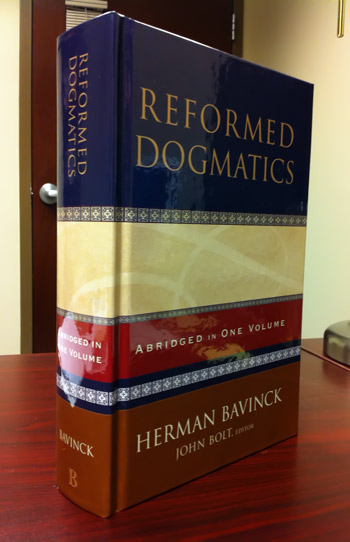
John Bolt’s new abridgement of 19th century Dutch theologian Herman Bavinck’s 4-volume magnum opus, Reformed Dogmatics, is now available for purchase. My copy arrived in the mail on Tuesday and since it arrived I have been browsing through the new abridgement and comparing a handful of sections with the original unabridged work. By all accounts it appears Bolt has done a fine job of shrinking Bavinck’s classic from 3,000 pages to 850 while preserving the essence of Bavinck’s theology. Props to the folks at Baker Academic who continue to serve the church by translating, and now abridging, one of the Church’s most precious theological works.

Severing Our Love Affairs

Thomas Schreiner, Galatians (Zondervan, 2010), 392:

The cross plays a bookends role in the letter [of Galatians], for just as Paul begins the letter by featuring the freedom won in the cross, so too he closes the letter by underlining the significance of the cross.

Paul’s only boast is in Christ’s cross, by which he is crucified to the world and the world is crucified to him (6:14). The cross and eschatology are inseparable. Just as the cross liberated believers from the present evil age (1:4), so too it crucifies attachment to this world (6:14). The opponents boasted in circumcising converts and took pleasure in external accomplishments because they lived to win the applause of others (6:12–13). They lived for comfort in order to avoid persecution.

The cross severs a love affair with the world and grants a person (by grace!) a desire to boast only in the cross. A new reality—a new age—has begun through the cross, and Paul summons the Galatians and all believers to find their joy only in the cross and to renounce any boasting in human accomplishments.

The Cross, Our Life, and Christian Ministry

1 Corinthians 2:2:

For I decided to know nothing among you except Jesus Christ and him crucified.

Roy Ciampa and Brian Rosner, The First Letter to the Corinthians (Eerdmans, 2010), page 114:

In contrast to “the wise” in Corinth and in the church, who could expatiate endlessly on all sorts of subjects, all Paul wanted to talk about was “the cross of Christ” (1:17). On first blush this may seem rather narrow and limited. After all, Paul spent eighteen months in Corinth and would have engaged in pastoral work alongside evangelism. However, as 1 Corinthians 1:10–4:17 itself demonstrates, for Paul even the most practical ills, such as divisions and problems of leadership in the church, are remedied by focusing on the cross. For Paul, Christ crucified is more than just the means of forgiveness and salvation; rather, it informs his total vision of the Christian life and ministry.