
TSS Podcast #1 (July 7, 2007)

TSS Podcast #1 (July 7, 2007)
Interview with Thomas Fluharty

tsspodcast.jpgArtist and blogger Thomas Fluharty is the busiest person I know, so when an opportunity opened to interview him this past Saturday morning I grabbed my microphone and met him at a local restaurant. Fluharty is known around the world for his illustrations and especially his editorial caricatures. His award-winning “Sir Hillary Poised for a Takeover” painting is one example. But my personal favorite will always be “Master and Commander,” a painting that caught my attention as a Weekly Standard subscriber long before I paid any attention to its artist. But more amazing than his illustrations is Tom’s personal testimony of God’s sovereign grace. Saturday was his 23rd anniversary of being saved on a street corner in New York City. Tom reminds us, in his own words, that being a Christian is not synonymous with being an American — but a radical experience where a sinful, idol-worshiping soul is unveiled to the infinite joy in Christ. The interview provided us a great excuse to launch the inaugural TSS podcast.
TSS Podcast #1 (July 7, 2007) 26.5 MB, 46:17

download or listen [you are free to download, burn and share this podcast]

.

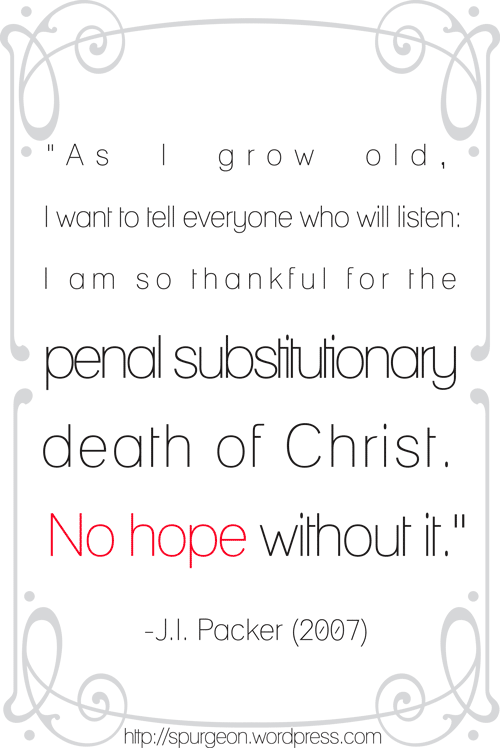
Packer on the Atonement

tsspackeratonement.gif

***********

For more of Packer’s latest comments click here.

 ***********

1. God, in Denney’s phrase, ‘condones nothing’, but judges all sin as it deserves, which Scripture affirms, and my conscience confirms, to be right.

2. My sins merit ultimate penal suffering and rejection from God’s presence (conscience also affirms this), and nothing I do can blot them out.

3. The penalty due to me for my sins, whatever it was, was paid for me by Jesus Christ, the Son of God, in his death on the cross.

4. Because this is so, I through faith in him am made ‘the righteousness of God in him’, i.e. I am justified; pardon, acceptance and sonship (to God) become mine.

5. Christ’s death for me is my sole ground of hope before God. ‘If he fulfilled not justice, I must; if he underwent not wrath, I must to eternity’ (John Owen).

6. My faith in Christ is God’s own gift to me, given in virtue of Christ’s death for me: i.e. the cross procured it.

7. Christ’s death for me guarantees my preservation to glory.

8. Christ’s death for me is the measure and pledge of the love of the Father and Son to me.

9. Christ’s death for me calls and constrains me to trust, to worship, to love and to serve.

Only where these nine truths have taken root and grow in the heart will anyone be fully alive to God.

Was, is and is to come!

[YouTube http://www.youtube.com/watch?v=FObjd5wrgZ8%5D

I am the Alpha and the Omega,’ says the Lord God, ‘who is and who was and who is to come, the Almighty.'”(Rev. 1:8).

————-

“… [lively] faith concerns the person of Christ, his grace, his whole mediatory work, with all its results, and his glory in them all. Therefore the one thing most needed in our recovery and revival is a steady view of the glory of Christ, in his person, grace and office through faith, or a constant, lively exercise of faith in him as he is revealed in Scripture. This is the only way to be revived and to receive such grace as will keep us fresh and flourishing even in old age. … A constant view of the glory of Christ will revive our souls and cause our spiritual lives to flourish and thrive. Our souls will be revived by the transforming power with which beholding Christ is always accompanied. This is what transforms us daily into the likeness of Christ. So let us live in constant contemplation of the glory of Christ, and power will then flow from him to us, healing all our declensions, renewing a right spirit in us and enabling us to abound in all duties that God requires of us. … the more we behold the glory of Christ by faith now, the more spiritual and the more heavenly will be the state of our souls. The reason why the spiritual life in our souls decays and withers is because we fill our minds full of other things, and these things weaken the power of grace. But when the mind is filled with thoughts of Christ and his glory, these things will be expelled (see Col. 3:1-5, Eph. 5:8). When we behold the glory of Christ by faith every grace in us will be stirred up. This is how our spiritual life is revived (see Rom. 5:3-5, 2 Pet. 1:5-8).”

John Owen, The Glory of Christ (Banner of Truth) pp. 166-167.

———

Video HT: (of all people) a group of Puritans that should be studying rather than Tube-ing.


Mohler: Christianity and Mormonism are ‘incompatible’

tsslogo.jpgAl Mohler wrote the following words in response to Mormon Orson Scott Card at Beliefnet. Read the entire response here. Here is an excerpt:

I appreciate Orson Scott Card’s response to my first entry, and his rather lengthy essay can serve to move the discussion along.

The first matter of concern is to clarify the question. When I asked, “Are Mormons ‘Christians’ as defined by traditional Christian orthodoxy?,” I was stating the question exactly as it was put to me. The words “as defined by traditional Christian orthodoxy” were part of my assignment, not my imposition.

At the same time, I was glad the question was asked in this manner, for it is the only way I can provide an answer that matters. The question could surely be asked in other ways and we could attempt to define Christianity in terms of sociology, phenomenology, the history of religions, or any number of other disciplines. In any of these cases, someone with specific training in these fields should provide the argument.

The question could simply refer to common opinion – do people on the street believe that Mormonism is Christianity? But then the matter would be in better hands among the pollsters.

In any event, the question was framed theologically, and it was framed by Beliefnet in terms of “traditional Christian orthodoxy.” With the question structured that way, the answer is clear and unassailable – Mormonism is not Christianity. When the question is framed this way, Mr. Card and I actually agree, as his essay makes clear.

In his words, “I am also happy to agree with him that when one compares our understanding of the nature of God and Christ, we categorically disagree with almost every statement in the “historic creeds and doctrinal affirmations” he refers to.”

Mr. Card would prefer that the question be put differently. I understand his concern, and if I were a Mormon I would share that concern and would try to define Christianity in some way other than traditional Christian orthodoxy. The reason is simple – traditional Christian orthodoxy and Mormon theology are utterly incompatible.

Sinclair Ferguson: No such ‘thing’ as grace

tsslogo.jpgNo such ‘thing’ as grace
by Sinclair Ferguson

“There is nothing between the person of the Lord Jesus and the person of the believer as that union and communion develops and grows. I think this is a very important thing for us to grasp. Let me put it the way I sometimes put it: The union with Christ we have is not that we somehow or another share His grace. Because – follow me carefully – there actually is no ‘thing’ as grace. That actually is a Medieval Roman Catholic teaching. There is a ‘thing’ called grace that can be separated from the person of Jesus Christ. It is something Jesus Christ won on the Cross and He can bestow it on you. And there are at least seven ways it can be bestowed on you and they all, as it happens, turn out to be in the hands of the church. And you can have this kind of grace, and this kind of grace, and this kind of grace … There is no such ‘thing’ as grace! Grace is not some appendage to His being. Nor is it some substance that flows from us: ‘Let me give you grace.’ All there is is the Lord Jesus Himself. And so when Jesus speaks about us abiding in Him and He abiding in us – however mysterious it may be, mystical in that sense – it is a personal union. Do not let us fail because of the abuse of expressions. Do not let us fail to understand that, at the end of the day, actually Christianity is Christ because there isn’t anything else. There is no atonement that somehow can be detached from who the Lord Jesus is. There is no grace that can be attached to you transferred from Him. All there is is Christ and your soul.”

Sinclair Ferguson on John 15 at the Banner of Truth Ministers’ Conference in Grantham, PA this Spring.

The Cross and Civil Justice

tssflag.jpgThe Cross and Civil Justice
by Francis A. Schaeffer

“… The problem always was, and is, What is an adequate base for law? What is adequate so that the human aspiration for freedom can exist without anarchy, and yet provides a form that will not become arbitrary tyranny?

In contrast to the materialistic concept, Man in reality is made in the image of God and has real humanness. The humanness has produced varying degrees of success in government, bringing forth governments that were more than only the dominance of brute force.

And those in the stream of the Judeo-Christian worldview have had something more. The influence of the Judeo-Christian worldview can be perhaps most readily observed in Henry De Bracton’s influence on British Law. An English judge living in the thirteenth century, he wrote De Legibus et Consuetudinibus (c. 1250).

Bracton, in the stream of the Judeo-Christian world view, said:

And that he [the King] ought to be under the law appears clearly in the analogy of Jesus Christ, whose vice-regent on earth he is, for though many ways we are open to Him for His ineffable redemption of the human race, the true mercy of God chose this most powerful way to destroy the devil’s work, he would not use the power of force but the reason of justice.

In other words, God in His sheer power could have crushed Satan in his revolt by the use of that sufficient power. But because of God’s character, justice came before the use of power alone. Therefore Christ died that justice, rooted in what God is, would be the solution. Bracton codified this: Christ’s example, because of who He is, our standard, our rule, our measure. Therefore power is not first, but justice is first in society and law. The prince may have the power to control and to rule, but he does not have the right to do so without justice…

What the Reformation did was to return most clearly and consistently to the origins, to the final reality, God; but equally to the reality of Man – not only Man’s personal needs (such as salvation), but also Man’s social needs.

What we have had for four hundred years, produced from this clarity, is unique in contrast to the situation that has existed in the world in forms of government. Some of you have been taught that the Greek city states had our concepts in government. It simply is not true. All one has to do is read Plato’s Republic to have this come across with tremendous force.

When the men of our State Department, especially after World War II, went all over the world trying to implant our form-freedom balance in government downward on cultures whose philosophy and religion would never have produced it, it has, in almost every case, ended in some form of totalitarianism or authoritarianism.”

– Francis Schaeffer, A Christian Manifesto (Crossway: 1982/2005) pages 27-29.

[Summary: God does not act out of power alone, but rather His power is displayed in acting righteously according to His Law. Thus, we see the significance of the Cross and the character of God in a democracy where the law curbs the power of its rulers. Countries that do not grasp the justice of God revealed in Christ’s work on the Cross (justification) are prone to being ruled unjustly by those with the most power. We can thank God today for His Law and for His Son and for His declaration that those in His Son’s blood are free from guilt! He is both just and the justifier (Rom. 3:26). … Have a great 4th of July! … “For freedom Christ has set us free” (Gal. 5:1).]