
Part 8: ‘Radical’ depravity (1.5)
Calvin has already covered two important points: First, the wisdom of God is displayed for all to see (like in lightening storm) and seco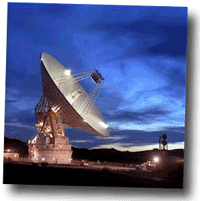 nd, sinners naturally suppress this truth for the sake of preserving their own sinful lifestyles. But he wants to cover these themes one more time before moving on to the importance of Scripture. So chapter five is a lengthy clarification.
1. All see the wisdom of God
It doesn’t matter if you are a renowned scholar in the natural sciences, astronomy, or medicine, or if you are skilled in the arts or a simple “unlearned stupid folk,” no one can “open their eyes without being compelled to see him” (52). And later, “there is no spot in the universe wherein you cannot discern at least some sparks of his glory” (52). And still later he broadens the language to say “there is no one to whom the Lord does not abundantly show his wisdom” (53).
Taking his cue from Psalm 104, the wisdom of God is “abundantly” displayed throughout the heavens for all to see. The ordering of the universe – and especially the things we take for granted – is a lesson in God’s wisdom.
But Calvin goes beyond the natural order. Using Psalm 107, Calvin understood that God reveals His sovereignty over the world in His relationship to us. He helps the troubled and humbles the proud. That God interacts with His creatures is unmistakable and obvious for all to see. He raises up the needy (Ps. 113:7) and confound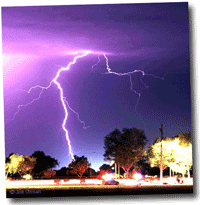 s the wisdom of the world (1 Cor. 1:20; 3:19; Job 5:13).
Whether we are looking to the lightning storm, listening to the deafening power of a waterfall, looking at a satellite image of the earth, watching our hands work meticulously; or as we see God’s providence in caring for the needy and humbling the proud, all display God’s wisdom.
2. God’s wisdom in our bodies
Specifically, Calvin is blown away by the “articulation, symmetry, beauty and use” of the human body (54). To understand the wisdom of God, we don’t need an out-of-body experience. It’s right here.
Our own mouths, eyes and even our “toenails” display the wisdom of God (“toenail” is Calvin’s own word!). And what about dreams and the subconscious mind, ever working even when our bodies are asleep? What wondrous divine wisdom that as our bodies lay silent our souls are fully engaged! Look down at the hand scrolling through this blog post. You can command this hand from your brain and instantaneously your hand will move. Now fix your eye on the period at the end of this sentence. Amazing! What complexity is there in our bodies, even in voluntarily moving or stopping our eyes and hands. We should be amazed by God’s wisdom simply in the composition of our complex bodies.
Calvin builds from Acts 17:26-28 where he understands that even a blind man can search and find evidences of God when he says, “there is no need to go outside ourselves to comprehend God” (54). We descend into our composition to see God’s wisdom. This is not saving revelation, but it’s certainly enough to cause us to humble ourselves, seek and thank Him!
That sinners look for more evidences of God’s existence is proof of our sinful stupidity. We’ve missed it! “For the Lord manifests himself by his powers, the force of which we feel within ourselves and the benefits which we enjoy … we ought more to adore than meticulously to search out” (62). God’s wisdom was right there all along, woven into you.
That God’s revelation is right under our noses makes us even more guilty of not ‘finding’ Him. In his commentary he writes, “For God hath not darkly shadowed his glory in the creation of the world, but he hath everywhere engraven such manifest marks, that even blind men may know them by groping. Whence we gather that men are not only blind but blockish, when, being helped by such excellent testimonies, they profit nothing.” We are not blind, we are sinfully hard.
3. Sinfully guilty
Although we walk around showered in the wisdom of God, we repel this wisdom by our own sinfulness. This is one of the most heartbreaking truths of Scripture. “Yet after we rashly grasp a conception of some sort of divinity, straightaway we fall back into the ravening or evil imaginings of our flesh, and corrupt by our vanity the pure truth of God. In one respect we are indeed unalike, because each one of us privately forges his own particular error; yet we are very much alike in that, one and all, we forsake the one true God for prodigious trifles. Not only the common folk and dull-witted men, but also the most excellent and those otherwise endowed with keen discernment, are infected with this disease” (64).
For Calvin, the tendency of philosophy to birth man-made mental gods is a perfect illustration of the smartest men living with the disease of atheism. The longer philosophers contemplate God, the further away from Him they end up, until they have twisted and extinguished Him into nothing but a figment and a dream. We are all ravaged by this theological ‘disease.’
So where do we end up when our sin-filled search for God is not governed by divine revelation? We universally – scientist, artist and “stupid folk” – end up with a twisted, ignorant, demonic, futile, empty shadow of worship (1 Cor. 10:20, Eph. 2:12-13, Rom. 1:21, John 4:22).
Thus the wisdom of God in nature speaks to depraved sinners in vain. Without God breaking into our ‘disease’-laden interpretation of reality, we suffocate God’s wisdom with our foolishness.
And our blindness is our guilt. We exchange the knowledge of God for our own sin and thereby become God’s enemies (Rom. 1:18-32; 5:6-11). And Calvin has shown conclusively that (apart from the Cross) none are excluded from this condemnation. That includes you and me.
But there is hope. God is sovereign and His Word and Spirit are set to work. In the next two chapters Calvin will confront us with some of the most profound theology our little minds can hold. New and unstoppable wisdom is about to break into our deafness!
Calvinistic meditations …
1. The perfect knowledge of God is our goal! Our remaining atheistic tendencies (or ‘disease’) cause believers to look forward to a time when we will see God perfectly. Alluding to John 17:3, Calvin began this chapter by writing, “The final goal of the blessed life … rests in the knowledge of God” (51). Enjoying pleasure perfectly has everything to do with knowing God perfectly! And someday, though now we see dimly as in a reflection, our eyes will soon be filled with the untainted knowledge of God. What we ran from (the knowledge of God) will be our great and eternal delight!
2. There is nothing more sobering than our ‘radical’ depravity. We live scattered lives running towards sin and away from God. To even say the words “God does not exist” requires millions of brain cells, electrical reactions and muscle movements to produce, all of which display divine wisdom! We substitute God’s holiness for the off chance that it’s all coincidence.
There is a 100-percent chance our world was created by One with a Master plan (and we know it!). But in sin we cling to the 0-percent chance that everything came from nothing, and the even more unlikely and absurd idea that all of life originated from non-life.
We may not be full-throttled atheists, but we are all guilty of atheism. We are all theologically ignorant of God, turning our backs on Him (Rom. 3:10-12). Although we all continue in religion, we have become futile in our thinking and our foolish hearts are further darkened (Rom. 1:21). Only under this steeping pile of ignorance can we foster the courage to live in autonomy. We would rather worship our bodies (by clothing, weight loss, fitness, intelligence) the natural world (through astronomy, medicine, science, outdoors) and art (paintings, movies, music) than the One who made our bodies, the whole natural world and all our artistic senses! It is further evidence that as sinners “we grow increasingly dull” and the testimonies of God “flow away without profiting us” (63).
It’s hard to even contemplate the next point, but it’s true: It is for the sinful neglect of God (not for a lack of Election or Predestination) that sinners are justly condemned to hell forever. We deserve judgment for our ignorance and blindness. We are guilty.
And so this ‘radical’ depravity is a fitting Calvinistic title for us all. We become ‘radically’ blind to God and ‘radically’ given to sinfulness and self-righteousness. It’s no surprise that sinners are saved only through ‘radical’ repentance (Luke 18:9-14). And our ‘radical’ sin and just condemnation being removed by the perfect sacrifice of Christ becomes ‘radical’ grace!
But our church culture defines sinners as broken people who need healing not depraved sinners who are hopeless. According to the bible, “to be a sinner is not merely to be morally imperfect or to be unable to achieve one’s full potential without God. It is rather a description of human beings in an utterly ruined state, a state from which we are unable to deliver ourselves and in which we might all have been left to perish, and justly so” (Boice and Ryken, Doctrines of Grace, p. 72).
You will not read of this ‘radical depravity’ in N.T. Wright, John Eldredge, Joel Osteen, Rick Warren or most pop-Christian books. No matter how cool the cover looks, depravity doesn’t sell. But Calvin reminds us that this ‘radical’ truth about sin must be central to everything else. ‘Radical’ depravity must rest heavily upon us. It must weigh heavily in our churches, our friendships, our blogs, our evangelism and our sermons. I am convinced that Calvin presses us on this topic early and repeatedly in the Institutes because unless and until we comprehend our utter helplessness under our own sin, we will never understand God and His ‘radical’ grace. We will find grace “helpful,” but not truly amazing!
3. Our only hope is a God who overcomes our wills and invades our ignorance. Sinners, bound to their sinfulness, have no free will. The deception of our hearts is a bottomless pit of wickedness (Jer. 17:9). I cannot change my skin color, a leopard cannot change the color of its spots and a sinner cannot replace this ‘radical’ depravity (Jer. 13:23).
We cannot choose God. In fact, our problem is more that we would never want to choose Him on our own! He must choose us (John 15:16). As Dr. D. Clair Davis wrote, “The Lord doesn’t talk about your sin so you’ll think you’re trash. He talks about it just because you’re not. He talks about it because he made you in His own image, with an infinitely higher and brighter plan for you than the one you chose for yourself” (The Practical Calvinist, p. 28). God must come and invade the plan we have chosen for ourselves!
I close with Spurgeon’s personal account of this ‘radical’ grace: “There is a power in God’s gospel beyond all description. Once, I, like Mazeppa, bound on the wild horse of my lust, bound hand and foot, incapable of resistance, was galloping on with hell’s wolves behind me, howling for my body and my soul, as their just and lawful prey. There came a mighty hand which stopped that wild horse, cut my bands, set me down, and brought me into liberty… There was a time when I lived in the strong old castle of my sins, and rested in my works. There came a trumpeter to the door, and bade me open it.  I with anger chided him from the porch, and said he never should enter. There came a pleasant person, with loving countenance; his hands were marked with scars, where nails were driven, and his feet had nail-prints too; he lifted up his cross, using it as a hammer. At the first blow the gate of my prejudice shook. At the second it trembled more. At the third down it fell, and in he came, and he said, ‘Arise, and stand upon thy feet, for I have loved thee with an everlasting love.’ A thing of power! Ah, the gospel is a thing of power. I have felt it here, in this heart. I have the witness of the Spirit within, and know it is a thing of might, because it has conquered me. It has bowed me down.” (C.H. Spurgeon, Christ Crucified, sermon #7-8)
We have all chosen to turn away from God (Rom. 3:12). O, how God must save us from ourselves, our own wills, our own desires, our own pursuits! In our ‘radical’ depravity, God must “conquer” us. Lord, let this ‘radical’ message weigh heavily upon us as we pursue Humble Calvinism.
————————–
Click here to access previous posts in the Humble Calvinism index.
————————–
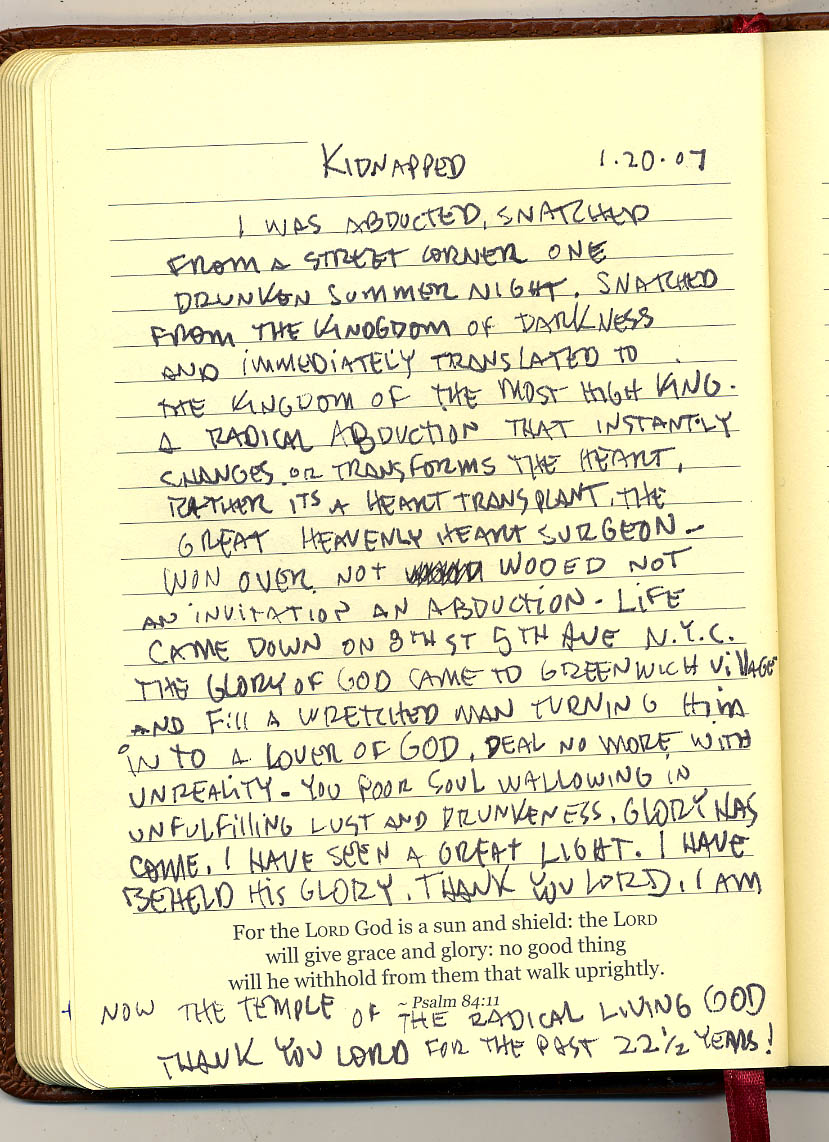
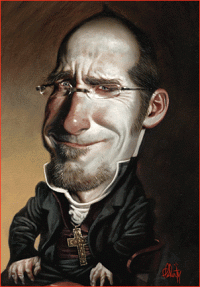 incredible artist. His talents are phenomenal. But even more phenomenal is God’s grace that allows him to focus his mind, will and affections on Gospel in his daily devotional times. I get to read some of these journal articles that he sends my way on occasion. I wanted to share a recent journal entry.
transplant by the great heavenly heart surgeon. Won over not wooed. Not an invitation, an abduction. Life came down on 8th st 5th Ave N.Y.C. The glory of God came to Greenwich Village to fill a wretched man, turning him into a lover of God. Deal no more with unreality. You poor soul wallowing in unfulfilling lust and drunkenness. Glory has comes. I have seen a great light. I have beheld His glory. Thank you Lord. I am now the temple of the radical living God. Thank you Lord for the past 22 1/2 years!
 can have a Reformation Day slide show of the


 Tony Reinke