 Kris Lundgaard is the author of two excellent books, ‘The Enemy Within‘ and ‘Through the Looking Glass‘. Both of these books are adaptations of works by English Puritan John Owen [1616-1683]. Someone has suggested these books should be subtitled: “John Owen for Dummies” (not to be confused with John Owen’s original works that simply make most of us feel like dummies). On Saturday, October 14th Mr. Lundgaard will be speaking at Omaha Bible Church in Omaha, NE. He joins us today on The Shepherd’s Scrapbook to talk about John Owen, the battle with sin, and his new endeavors in the mission field.
—————–
 TSS: It is wonderful to dialogue with you after having used your books for a number of years. The first question I must ask: How were you introduced to John Owen?
KL: In 1985 a friend in Little Rock gave me several volumes of the Banner of Truth edition of Owen’s Works. I thanked him and displayed them proudly on my shelf, not having any idea of their value. When I was in seminary a few years later, Dr. Douglas Kelly recommended Owen highly, but warned us that he was no easy read. His theory was that Owen must have thought in Latin, because his sentence construction was more Latin-like than English-like. J. I. Packer also came to RTS to teach a week-long course on the English Puritans, and he whetted my appetite further—but still I was unwilling to make the effort.
But around 1996 I got fed up with my own lack of progress against my flesh. I picked up Volume 6 of Owen out of desperation. I found out that the warnings were no idle threats—I could cover maybe eight pages in 45 minutes. I had to read with a dictionary in one hand and Owen in the other, and until I got the hang of his style I had to read many sentences several times over. But the value of Owen had been undersold: I was underlining more than half of every page. In his works on Temptation, Indwelling Sin, and Mortification, my heart was being laid bare. How did he know me so well?
But he didn’t just cut me up and leave me to pick up the pieces. He offered help, strong medicine—lots of strong medicine. And by God’s grace things began to change for me. I’ll always be grateful to Owen for that—I hope to tell him so when I see him.
TSS: Why does John Owen especially strike you as interesting?
KL: Owen’s ability to exegete my heart overwhelms me. He exposes my flesh’s defense strategies, which leaves me vulnerable—vulnerable to the gospel. He doesn’t just tear down; he builds up. And he helps me to see Christ more clearly, so that I may adore him more fully.
TSS: I find it very interesting that you were driven to John Owen out of desperation. There are probably readers out there who are not familiar with the Puritans, so they don’t know what types of desperate situations would warrant turning to the Puritans like John Owen. I know we all desperately need biblical wisdom but if you could exegete the heart, what types of heart conditions really “desperately” need to read Puritans like Owen?
KL: The desperation I have in mind is born out of the distance I feel between my desire to love God with all my heart and to love my neighbor as myself, and the feebleness of my actual love. I know there are others like me, whether or not they share the same weaknesses. Someone may be trapped and mastered by scandalous sexual sin, or the by seemingly unbreakable habit of offending people with a sharp, sarcastic wit. I don’t think there is a particular class of sinner that can only be helped by Puritans, or that the usefulness of the Puritan writings is limited to certain sinners. We all need help. Many will find the Puritans helpful.
TSS: Many readers today, I fear, will get buried when starting Owen’s full works. I get emails often from people who decided they wanted to read the full Owen books and want suggestions how to continue on past page 3. You have mentioned going slowly and using a dictionary. What type of dictionary? Do you have any suggestions to help people who are stuck or are people pretty much in over their heads?
KL: Any time we approach a writer from another era or another culture we have work to do. Shakespeare, for example, is hard going for high school sophomores—but those who are willing to stay with him, to read repeatedly, to learn his vocabulary in its Elizabethan context, to feel the rhythm of his poetry—those are the people who will discover the richness of his imagination. They will be rewarded their whole lives by rereading Hamlet and Macbeth and Julius Caesar. But I doubt anyone can hang with Shakespeare without help: movies, plays, and CDs of the plays help, as well as good footnotes and an enthusiastic (and skilled) teacher.
Of course there are no movies or plays of Owen’s works, and there are few footnotes in the reprints available; unless you go to seminary you are unlikely to find an enthusiastic (and skilled) teacher of Owen. But there are helps. There are some fine abridgments published by Banner of Truth that are a great place to start—and for many people they will be a great place to end. Sinclair Ferguson has written some introductory material to Owen (John Owen on the Christian Life), and even if you never read a Puritan you will be helped by J. I. Packer’s A Quest for Godliness: The Puritan Vision of the Christian Life.
TSS: Those are some excellent insights. Thank you… I think what makes your books so powerful is your candidness about your own personal sin. You have already shared a little but I wanted to ask you: You have been familiar with Owen’s works on sin now for a decade. How does the fight against sin change as the years go by? Easier? More joyful? More subtle? More Christ-centered?
KL: Your comment about my candidness about my own sin surprises me: although I opened The Enemy Within with a personal illustration from my own failure, I believe it’s the only such personal reference in the book. I never intended the book to be about me, though I wanted readers to know that the ideas I stole from Owen were as much for me as for anyone.
I suspect that everyone will find that his struggle with sin changes over time as he grows in wisdom. For me growth has been painfully slow, and it’s only when I stop and look carefully back over decades that I can see changes that remind me that God is at work. I wouldn’t say that anything has become easier, but I like your phrase “more joyful”—for it is increasingly so. The joy comes in times when I am less interested in figuring out how much I love God, and more delighted in the too-good-to-be-true truth that God loves me. And what has stirred me lately is that my increasing assurance of God’s love—built on more frequent reflection on the depths of the gospel of grace—steels me against temptation more than any fasting or self-discipline ever did.
TSS: I think the reason you appear so candid in my mind is how clearly you present your own sin in the opening of The Enemy Within. It was clear from those early pages that this was not a book about Owen, or about Owen’s book, not even just a book about sin, but the testimony of a man using Owen and his book to personally fight sin. There is a very personal aspect to both of your books, which comes from a sense of their sincerity, as though they are written to mentor the reader. The personal link between author and reader you build is quite rare…I like that you say you are still growing in grace. This gives me much to look forward to.
Speaking of John Owen, the Works of John Owen are accessible to pretty much anyone who wants them today. There are full versions, abridged versions and updated versions. You decided to completely re-write Owen’s works. Please explain how you ‘translated’ and why you were compelled to do so.
KL: When I discovered the value of Owen’s expositions of the scriptures and my heart, I wanted others to read him. And I didn’t want only pastors and antiquarians to read him—nor did I want only reformed Christians to read him. So I set out to find a way to strip away everything that would distract most readers today: Because it would wear most readers out, I reduced his redundancy; because it would divert attention from the main mission of battling the flesh, I eliminated his attacks against Roman Catholicism; because his vocabulary was elevated and antiquated (quick: tell me what “commination” is), I brought it down to earth and up to date; and because theological buzz-words tend to carry a lot of baggage with people, which would again distract from the mission, I avoided (where possible) highly charged words and stuck to biblical terminology (without compromising the theology).
Once I had done that, I decided I might as well just go all the way and completely repackage his ideas. In essence, I pretended his expositions were mine, and I figured out how I would try to get my (er, his) points across to my readers today. So I added my own illustrations and worked to express the kernel of his thoughts in the fewest words. Then I tried it out on real people to see what they thought, and from their comments I revised the manuscript.
TSS: So you have written books on the subjects on both the Glory of Christ (Through the Looking Glass) and the battle with sin (Enemy Within). Which work receives more attention?
KL: The Enemy Within has been more broadly received than I ever imagined, and Through the Looking Glass less.
TSS: Why do you think this is the case?
KL: I don’t have a clue. I find Owen’s meditations on the glory of Christ to be even more helpful against the flesh than his works on sin. I hope the reason is that there are other, far better works on Christ available—such as John Piper’s.
TSS: I’m uncertain of the ratio, but I would guess in the past 10 years there have been many more books printed on fighting sin (counseling, self-help, etc.) compared to those on the beauty of Christ… But you bring up an interesting point about the fight against sin. What particularly makes Owen’s work on the Glory of Christ “more helpful” in the fight against sin?
KL: His thesis is that we become what we worship (see Psalm 115:4-8 and 1 John 3:2). We all experience this—our lives are often shaped by the people and ideas that we admire and adore, whether or not we are conscious of the effects. Owen is able to linger over the beauty of Christ for hundreds of pages—and by so doing he trains me to reflect more fully on our dear Lord.
TSS: What other books and authors have most helped you meditate upon the beauty of Christ?
KL: I’m most stirred by the poetry of George Herbert [1593-1633]. I know that people don’t read much poetry these days—to their loss. For example, Herbert portrays his soul entering heaven as a conversation between a weary traveler and a gracious innkeeper whose name is Love. The pilgrim is burdened—especially with the sense that he is unworthy to approach Love and to rest. Love meets and overcomes every objection with a tenderness that is perfectly human, yet beyond anything we experience. In the final exchange the pilgrim finally agrees to come in, but only if he can serve. Love will have none of it—he insists that the traveler sit at the table and taste Love’s meat. Isn’t this what Jesus is like? The Son of Man came not to be served, but to serve….
TSS: That does sound like an incredible poem. Thank you. … Your books were especially helpful for me when I directed a college ministry in Omaha. Both of them are easy to read, fun (at times) and biblically sound. I found them to be excellent books for group studies. What advice do you have for pastors or ministry leaders who want to use your books with others? In what situations have they been most blessed?
KL: Thank you for your kind comments—it always encourages me to hear that the books have helped someone.
I think a leader who wants to use any book with a group should (as best he can) get to know his group well, and find out what’s going on in their lives. As he leads the discussion he should help people to avoid the trap of sticking to the abstract, safe zone. Groups need to get to where they can really help each other at their points of need, which demands a willingness to let others inside their hearts (at least a little) to see those unpleasant weaknesses. Of course, groups need to get to this point gradually, as they develop trust over time. Perhaps The Enemy Within isn’t a good book for a group to start with—because it naturally leads toward discussion that could be uncomfortable (or even unfair) among people who are not well acquainted.
TSS: A few questions about your ministry. Have you ever been a pastor? What has your role been in your church?
KL: I served as Associate Pastor of University Presbyterian Church in Las Cruces, New Mexico, from 1989 to 1997. Since then I’ve been a manager and program manager in the computer industry in Austin, Texas. My family and I worship and serve at Redeemer Presbyterian Church, where I teach and write.
TSS: On October 14th, you are coming to Omaha, Nebraska to lead a conference. How many conferences have you done?
KL: I have chosen not to do many—and this is the first in a long time.
TSS: We are certainly looking forward to this rare conference opportunity. Speaking of upcoming ministry… What’s next for Kris Lundgaard?
KL: My family and I were recently invited to join a mission team in Trnava, Slovakia. We have just started our training and raising support, and we are doing our best to learn a little Slovak with our two younger sons who will go to the field with us. We hope to be able to leave for Slovakia by the summer of 2007, God willing.
TSS: That seems like a big shift from a computer manager and Christian writer. What caused this change or have you always dreamed of missions work?
KL: I can’t say it’s always been a dream, even though I’ve had lots of delightful involvement in short-term missions in Eastern Europe since 1990. It’s really more a matter of God’s providence—as usual He’s weaving together loose threads that seem unconnected. In this case my loose threads are an undergraduate degree in English, seminary training and ministry experience, and management in the I/T industry.
Believe it or not, the team in Trnava is looking for just those skills. What the team probably doesn’t realize is that they’ll benefit even more from my wife’s overwhelming love and hard work. And I expect our two sons to make a powerful impact on their Slovak friends over the years.
TSS: How can our readers learn more about your missions efforts and how can we support your efforts financially?
KL: Anyone who is interested in the ministry in Slovakia could write to me—there are few things I’d rather talk about these days. You can reach me at barset@earthlink.net. If you write, please mention “Slovakia mission” in the subject line, so I’ll know to let you past the spam filter.
TSS: Excellent. We will be praying for your endeavors on the mission field. And we thank you for your diligence in writing. So many have been blessed on paper and I can imagine the same Lord will bless your ministry for the gospel in Slovakia. Thank you for your time and God bless!
————————————
Kris Lundgaard will be in Omaha, NE at Omaha Bible Church on Saturday October 14th to lead a conference titled “The Enemy Within”. Registration is open for men, women, and families. Mr. Lundgaard is scheduled to preach at the church on Sunday morning as well. Again, Lundgaard is the author of two excellent books, The Enemy Within: Straight Talk About the Power and Defeat of Sin (P&R, 1998 ) and Through the Looking Glass: Reflections on Christ That Change Us (P&R, 2000).
Book recommendations
Today, we have also been referencing two books written by John Owen and both original works are published by The Banner of Truth Trust. The entire 16-volume set of Owen’s works are a real treasure. Volume one of Owen’s Works contains the book ‘Meditations and Discourses on the Glory of Christ’ and volume six of the Works contains a number of books on the fight against sin. Volume six has been updated and will be released by Crossway in a few weeks under the title Overcoming Sin and Temptation.
A good introduction to Owen will be found in two other books — John Owen on the Christian Life by Sinclair B. Ferguson (BTT, 1987) and a more recent collection of essays titled John Owen: The Man and His Theology (P&R, 2003).
And as one final note: Mr. Lundgaard recommended that Christians should read good poetry. Soli Deo Gloria Publications has a volume of Puritan poetry that I enjoy and I think you may, too. The book is titled, Worthy is the Lamb: Puritan Poetry in Honor of the Savior (2004). Three of George Herbert’s poems appear in this book.
We close with the text of the poem Love (III) mentioned by Lundgaard…
Love bade me welcome: yet my soul drew back,
Guiltie of dust and sinne.
But quick-ey’d Love, observing me grow slack
From my first entrance in,
Drew nearer to me, sweetly questioning,
If I lack’d any thing.
A guest, I answer’d, worthy to be here:
Love said, You shall be he.
I the unkinde, ungratefull? Ah my deare,
I cannot look on thee.
Love took my hand, and smiling did reply,
Who made the eyes but I?
Truth Lord, but I have marr’d them: let my shame
Go where it doth deserve.
And know you not, sayes Love, who bore the blame?
My deare, then I will serve.
You must sit down, sayes Love, and taste my meat:
So I did sit and eat.
 of Jesus for nothing but the mean and selfish reason, that after having been forgiven through it he may say, ‘Soul, take thine ease, eat, drink, and be merry: hear sermons, enjoy the hope of eternal felicity, and do nothing’ — such a man blasphemes the precious blood, and makes it an unholy thing. We are to use the glorious mystery of atoning blood as our chief means of overcoming sin and Satan: its power is for holiness. See how the text puts it: “They overcame him by the blood of the Lamb” (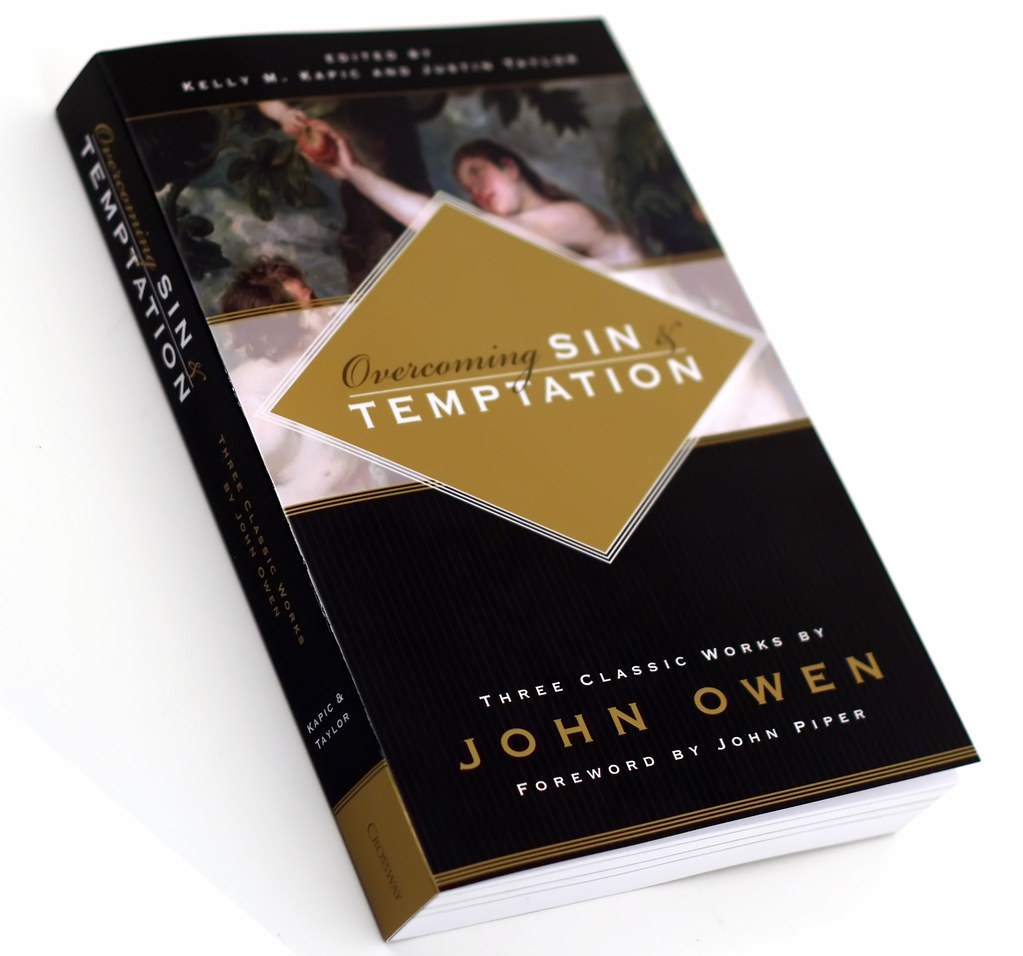
 sin to our Advocate in heaven (1 John 2:1). While we hate personal sin, and long for the moment we look Christ in the eye (1 John 3:2), “let us not be so dejected by them [sins], as cheered by the advocacy of our Savior.”
 unabridged version of volume 6 of John Owen’s works including Mortification of Sin, Of Temptation, and Indwelling Sin. These three works are classics in the Christian fight against sin.
 Tony Reinke