New Easter Post

This morning I posted a new Easter essay on the Desiring God blog: Our Tears Are Being Undone.

As many of you have probably already guessed, most of my blogging work will now be focused there. I am greatly honored to be a part of the incredible DG team here in Minneapolis, focusing my energy on helping to curate, resurface, and spread John Piper’s 30-years-and-running gospel preaching legacy.

[Hyperventilation.]

What that means is the Miscellanies blog (a little blog I started in 2006 to fill a ministry lag), will still be used but only for occasional posts, perhaps once a week or so. If you’d like to follow me, you can always do that more effectively via Twitter or Facebook. I’ll be using both of these channels concurrently to point to my work online, my travels, quotes and quips from mostly dead guys, and of course pictures of stuff I point my iPhone at.

Thank you for reading and following this blog. Because you come here, ministry opportunities have been opened for me (like book writing). So thank you!

Tony

Obey Your Pastors and Submit to Them

Few passages are more commonly misread, or simply avoided, than Hebrew 13:17:

Obey your leaders and submit to them, for they are keeping watch over your souls, as those who will have to give an account.

It shouldn’t surprise us that this passage often goes avoided. This is bound to happen in a culture where postmodernism rejects all claims of authority and where examples of abuses of authority are not hard to find in the news.

To make matters worse, a surface reading of this passage seems to sanction some form of authoritarianism, an unqualified obedience and submission to pastors in all matters. But that’s not the message of this passage, as we will see.

What follows are a few important thoughts on this passage, beginning with a closer look at the idea of “obeying.”

Here is how W. E. Vine defines the Greek word “obey” (πείθο):

In Hebrews 13:17, believers are commanded to obey their leaders. The word used is peithō which has the usual meaning of “convince” or “persuade.” The “obedience” suggested is not by submission to authority, but resulting from persuasion. Peithō and pisteuō, “to trust,” are closely related etymologically; the difference in meaning is that the former implies the obedience that is produced by the latter.

Peithō, “to persuade, to win over,” in the passive and middle voices, “to be persuaded, to listen to, to obey,” is so used with this meaning, in the middle voice, e.g., in Acts 5:36-37 (in v. 40, passive voice, “they agreed”); Rom. 2:8; Gal. 5:7; Heb. 13:17; Jas. 3:3.

The “obedience” suggested is not by submission to authority, but resulting from persuasion. Peithō and pisteuo, ‘to trust,’ are closely related etymologically; the difference in meaning is that the former implies the obedience that is produced by the latter.

In other words, when “one allows oneself to be convinced by someone: one follows and obeys him” (EDNT).

Paul Benware applies this point well in an article [“Leadership Authority in the Church,” Conservative Theological Journal 3.8 (1989), pp. 10-12]:

The emphasis here [Heb. 13:17] is on an obedience that comes from being persuaded that something is true. In this case, it would be the truth of the Word of God that is in view. Here they are being called upon to persuade the people that follow them with the truth of the Word of God… The elders are not to say “Do it because I say so”, but rather “Do what I show you from God’s Word.” …

Leadership authority in the church, then, is the power granted to men to lead the flock of God according to the Word of God, guiding, protecting and feeding them for their benefit and God’s glory. This kind of leadership authority will persuade believers from the scriptures resulting in obedience and submission to Christ the one and only head of the church.

John Owen says much the same in his commentary on Hebrews 13:17:

1st. It is not a blind, implicit obedience and subjection, that is here prescribed. A pretence hereof hath been abused to the ruin of the souls of men: but there is nothing more contrary to the whole nature of gospel obedience, which is our “reasonable service;” and in particular, it is that which would frustrate all the rules and directions given unto believers in this epistle itself, as well as elsewhere, about all the duties that are required of them. For to what purpose are they used, if no more be required but that men give up themselves, by an implicit credulity, to obey the dictates of others?

2dly. It hath respect unto them in their office only. If those who suppose themselves in office do teach and enjoin things that belong not unto their office, there is no obedience due unto them by virtue of this command. So is it with the guides of the church of Rome, who, under a pretence of their office, give commands in secular things, no way belonging unto the ministry of the gospel.

3dly. It is their duty so to obey whilst they teach the things which the Lord Christ hath appointed them to teach; for unto them is their commission limited, Matt. 28:20: and to submit unto their rule whilst it is exercised in the name of Christ, according to his institution, and by the rule of the word, and not otherwise. When they depart from these, there is neither obedience nor submission due unto them.

Finally, Matthew Henry, in his old (and under-appreciated) commentary, offers this pointed one-sentence summary:

Christians must submit to be instructed by their ministers, and not think themselves too wise, too good, or too great, to learn from them; and, when they find that ministerial instructions are agreeable to the written word, they must obey them.

Ultimately pastoral ministry centers on Christ and His Message, not on the pastor and his role as messenger. And so to obey and submit to our pastors is a call to esteem and respect and obey the Word of God. This is why it can be said that “an elder with no Bible is an elder with no authority” (Mark Lauterbach).

Hebrews 13:17 is beautifully balanced and stabilizing for Christians who live in a culture suspicious of all authority. It encourages our biblical discernment. It encourages us to find a solid church where the Bible is taught clearly and persuasively. It moves our attention off autonomous human authority. It focuses our attention on the weightiness of Scripture. And it encourages humble submission of our lives to the faithful preaching and counsel we receive from our still-fallible pastors. It is a passage that helps us see the faithfully preached word for what it is — an authoritative message from God to be obeyed.

The Deepest Motive for Holiness and Charity

Richard B. Gaffin, By Faith, Not by Sight (Paternoster, 2006), page 78:

Ultimately, in the deepest sense, for Paul “our good works” are not ours, but God’s. They are his work begun and continuing in us, his being “at work in us, both to will and to do what please him” (Phil. 2:13). That is why, without any tension, a faith that rests in God the Savior is a faith that is restless to do his will.

In 1 Corinthians 4:7 Paul puts to the church those searching rhetorical questions, “Who makes you different from anyone else? What do you have that you did not receive? And if you did receive it, why do you boast as though you did not?” (NIV). These questions, we should be sure, have the same answer for sanctification as for justification, for our good works as well as for our faith. Both, faith and good works, are God’s gift, his work in us. The deepest motive for our sanctification, for holy living and good works, is not our psychology, not how I “feel” about God and Jesus. Nor is it even our faith. Rather, that profoundest of motives is the resurrection power of Christ, the new creation we are and have already been made a part of in Christ by his Spirit.

In Celebration of Long Sentences

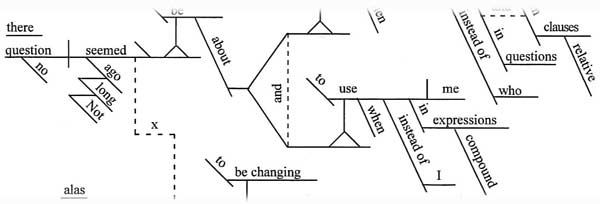
C. S. Lewis said he had no use for reviews of his own works. The positive reviews puffed him up, the critical reviews riled him up, and neither the puffing nor the riling were good for the soul. So I should stop reading blog reviews, I really should, especially after the most recent one said my book was too “wordy.” That’s never been said of me before. What most people would never guess is that I am a fan of the long sentence, and here are some nice quotes on their value.

Writes essayist and novelist Pico Iyer in his recent article:

No writer can compete, for speed and urgency, with texts or CNN news flashes or RSS feeds, but any writer can try to give us the depth, the nuances — the “gaps,” as Annie Dillard calls them — that don’t show up on many screens. Not everyone wants to be reduced to a sound bite or a bumper sticker.

Enter (I hope) the long sentence: the collection of clauses that is so many-chambered and lavish and abundant in tones and suggestions, that has so much room for near-contradiction and ambiguity and those places in memory or imagination that can’t be simplified, or put into easy words, that it allows the reader to keep many things in her head and heart at the same time, and to descend, as by a spiral staircase, deeper into herself and those things that won’t be squeezed into an either/or. With each clause, we’re taken further and further from trite conclusions — or that at least is the hope — and away from reductionism, as if the writer were a dentist, saying “Open wider” so that he can probe the tender, neglected spaces in the reader (though in this case it’s not the mouth that he’s attending to but the mind).

The long sentence does make probing ambiguity possible, but it can also communicate stout specificity that short sentences sometimes lack. Says Brooks Landon in his course Building Great Sentences:

Cumulative sentences [ie long, right-branching sentences] can take any number of forms, detailing both frozen or static scenes and moving processes, their insistent rhythm always asking for another modifying phrase, allowing us to achieve ever-greater degrees of specificity and precision, a process of focusing the sentence in much the same way a movie camera can focus and refocus on a scene, zooming in for a close-up to reveal almost microscopic detail, panning back to offer a wide-angle panorama, offering new angles or perspectives from which to examine a scene or consider an idea. …

Cumulative sentences that start with a brief base and then start picking up new information much as a snowball gets larger as it rolls downhill, fascinate me with their ability to add information that actually makes the sentence easier to read and more satisfying because it starts answering questions as quickly as an inquisitive reader might think of them, using each modifying phrase to clarify what has gone before, and to reduce the need for subsequent explanatory sentences, flying in the face of the received idea that cutting words rather than adding them is the most effective way to improve writing, reminding us that while in some cases, less in indeed more, in many cases more is more, and more is what our writing needs.

Lost, But Great

Writes Francis Schaeffer [Works, 4:258­­–259]:

I am convinced that one of the great weaknesses in evangelical preaching in the last years is that we have lost sight of the biblical fact that man is wonderful. We have seen the unbiblical humanism which surrounds us, and to resist this in our emphasis on man’s lostness we have tended to reduce man to a zero.

Man is indeed lost, but that does not mean he is nothing. We must resist the humanism, but to make man a zero is not the right way to resist it. You can emphasize that man is totally lost and still have the biblical answer that man is really great. In fact, only the biblical position produces a real and proper “humanism.” Naturalistic humanism leads to a diminishing of man and eventually to a zeroing of man. But the Christian position is that man is made in the image of God and even though he is now a sinner, he can do those things that are tremendous—he can influence history for this life and the life to come, for himself and for others. …

In short, therefore, man is not a cog in a machine; he is not a piece of theater; he really can influence history. From the biblical viewpoint, man is lost, but great.

Prayer for 2012

Valley of Vision (Banner of Truth), page 112:

O Lord,

Length of days does not profit me except the days are passed
in thy presence,
in thy service,
to thy glory.

Give me a grace that
precedes,
follows,
guides,
sustains,
sanctifies,
aids every hour,
that I may not be one moment apart from thee,
but may rely on thy Spirit
to supply every thought,
speak in every word,
direct every step,
prosper every work,
build up every mote of faith,
and give me a desire
to show forth thy praise,
testify thy love,
advance thy kingdom.

I launch my bark [ship] on the unknown waters of this year,
with thee, O Father, as my harbour,
thee, O Son, at my helm,
thee, O Holy Spirit, filling my sails.

Guide me to heaven with my loins girt,
my lamp burning,
my ear open to thy calls,
my heart full of love,
my soul free.

Give me thy grace to sanctify me,
thy comforts to cheer,
thy wisdom to teach,
thy right hand to guide,
thy counsel to instruct,
thy law to judge,
thy presence to stabilize.

May thy fear be my awe,
thy triumphs my joy.