Overpopulation

From economist Jay W. Richards in his book Money, Greed, and God: Why Capitalism is the Solution and Not the Problem (HarperOne, 2009), page 183:

“You’ve heard it a million times. The earth is overpopulated. We’re breeding like rabbits and eating like locusts, and soon we’ll run out of food, farmland, and fuel. We are members of the crew of ‘Spaceship Earth.’ We have to preserve our dwindling supply of provisions or our mission will soon be aborted. Our industrial technology is poisoning the water, the soil, and the air. If we don’t make radical changes now, it will be too late. We’ll destroy the earth. We’ll all die.

Fears about running out of resources are as old as the human race. But this planet-sized vision of disaster started with the nineteenth-century demographer Thomas Malthus. In his early writings, he predicted that a swelling human population would quickly overtake food production and lead to widespread famine. He was wrong, of course: it didn’t happen and still hasn’t. He changed his tune in his later years, but that hasn’t discouraged a long line of Malthus wannabes from updating this old argument by moving the date forward, like those Bible-prophecy experts who keep missing and then moving the date of Jesus’s return.”

On Lame Christian Fiction

Flannery O’Connor writes in Mystery and Manners, page 163:

“Ever since there have been such things as novels, the world has been flooded with bad fiction for which the religious impulse has been responsible. The sorry religious novel comes about when the writer supposes that because of his belief, he is somehow dispensed from the obligation to penetrate concrete reality. He will think that the eyes of the Church or of the Bible or of his particular theology have already done the seeing for him, and that his business is to rearrange this essential vision into satisfying patterns, getting himself as little dirty in the process as possible. His feeling about this may have been made more definite by one of those Manichean-type theologies which sees the natural world as unworthy of penetration. But the real novelist, the one with an instinct for what he is about, knows that he cannot approach the infinite directly, that he must penetrate the natural human world as it is.”

Christ’s Suffering

Yesterday as a family we hunted used books. Generally I return home empty handed. But while thumbing across the bottom shelf in a dusty corner of a book warehouse I discovered an attractive collection of sermons by Brooke Foss Westcott titled The Victory of the Cross, a remarkably well preserved first edition published in 1888. Westcott was a noteworthy theologian in 19th century England and served as the Bishop of Durham for over a decade.

When we returned home the kids napped and I sunk into my reading chair with hot tea in hand and the snow falling outside the window. Not surprising, Westcott’s sermons are rich with insights, the gems of a life devoted to the serious study of the Bible.

At one point Westcott speaks of the Savior’s suffering. Christ’s sufferings were heavy, not merely because they were aggressive acts personally directed at him but because they were the acts of spiritually blind sinners. We can harden ourselves to opposition, Westcott writes, but Christ did not. He could not. It was his compassion that compounded his suffering. Listen carefully to what Westcott writes:

“We arm ourselves against pain by checking our emotions, by hardening ourselves to opposition, by closing our eyes to the extent of the evil about us. But it was not so with Christ. No isolation of absolute purity separated Him from the outcast, while His sinlessness was the measure of His loathing at sin. Every denunciation of woe which He uttered was wrung from a righteousness which was but the other side of love. The wrongs which He endured were more terrible as a symptom of spiritual blindness in those who inflicted them than as a personal agony. How often when He was threatened, and rejected and reviled, must the prayer have arisen in His heart which found a final expression upon the Cross: Father, forgive them, for they know not what they do. They knew not, but He knew, and even then He bore the burden of their hardness and unbelief.” (p. 67)

That line, “The wrongs which He endured were more terrible as a symptom of spiritual blindness in those who inflicted them than as a personal agony,” is worthy of reflection. It seems that the Savior’s compassion, in light of the sinner’s ignorance, compounded the Savior’s suffering to a degree that we cannot imagine.

Bookshelf Warping

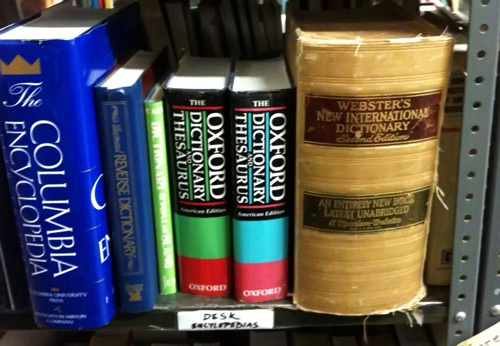
The Philistines of literature live in the reference section. This is where unabridged dictionaries walk. On Monday, while out on a used book hunting trip with the family, I spotted this beast—the 3,200 page Webster’s New International Dictionary, Second Edition (1937). Its neighbor, the Oxford dictionary weighs 5.4 pounds. I tried holding the Webster. I’d guess it weighs over 30 pounds, the Goliath of reference books. (Sure makes me thankful for online dictionaries!)

Reading Good Theology

From Marilynne Robinson’s The Death of Adam: Essays on Modern Thought (Picador, 2005), page 117:

“Good theology is always a kind of giant and intricate poetry, like epic or saga. It is written for those who know the tale already, the urgent messages and the dying words, and who attend to its retelling with a special alertness, because the story has a claim on them and they on it. … Theology is written for the small community of those who would think of reading it. So it need not define freighted words like ‘faith’ or ‘grace’ but may instead reveal what they contain. To the degree that it does them any justice, its community of readers will say yes, enjoying the insight as their own and affirming it in that way.”