Preaching to Thin Pews

I know that a number of you who read this blog are pastors of small churches (thanks for reading!). Tonight I came across this from Arthur J. Gossip in his book on preaching, In Christ’s Stead (1925), pages 27–28. I thought I would pass it along:

“…religion is by far the most interesting subject in the world, and the people prove it by the way they flock to hear about it, even yet [1925]. Take any other theme you choose, politics let us say, and through a heated fortnight at an election time you can gather eager meetings. But let them continue, in scores and hundreds of places in the cities, week in and week out the whole year round, and what size would they be in a year? But you—oh, you at times will be grumpy over thin pews. Watch yourself then; be sure that that is really zeal for Christ, and not, as is much more likely, merely hurt pride that stings you. Never rail at a congregation because it is small. It is not the fault of those who are there. And in your deeper moods you will stand gazing in amazement at the folk coming back, sitting there looking hopefully toward you, not yet discouraged, it appears, by the sad persistent failures of the past, apparently still sure that God is going to break through all our imperfections to them.”

[HT: T-Bomb]
Deliver us from morality

C.S. Lewis:

“…In reality [William] Tyndale is trying to express an obstinate fact which meets us long before we venture into the realm of theology; the fact that morality or duty (what he calls ‘the Law’) never yet made a man happy in himself or dear to others. It is shocking, but it is undeniable. We do not wish either to be, or to live among, people who are clean or honest or kind as a matter of duty: we want to be, and associate with, people who like being clean and honest and kind. The mere suspicion that what seemed an act of spontaneous friendliness or generosity was really done as a duty subtly poisons it. In philosophical language, the ethical category is self-destructive; morality is healthy only when it is trying to abolish itself. In theological language, no man can be saved by works. The whole purpose of the ‘gospel,’ for Tyndale, is to deliver us from morality. Thus, paradoxically, the ‘puritan’ of modern imagination—the cold, gloomy heart, doing as duty what happier and richer souls do without thinking of it—is precisely the enemy which historical Protestantism arose and smote.”

Source: English Literature in the Sixteenth Century Excluding Drama (Cambridge: Cambridge University Press, 1944), 187.

HT: D-Math

Shalom’s Linchpin

If I had a list of favorite books for 2009 I would likely put this one at the top.

Graham A. Cole, God the Peacemaker: How Atonement Brings Shalom (Downers Grove, Ill: IVP, 2009), 229-230:

The God of the Bible is the righteous God of holy love. The trouble is, however, that we have become paradoxically the glory and garbage of the universe. Our great need is peace with God, and not just with God but also with one another. …

There is no shalom, however, without sacrifice. Peace is made through the blood of the cross. The atoning life, death and vindication of the faithful Son bring shalom by addressing the problem of sin, death the devil and wrath definitively. Sacrifice, satisfaction, substitution and victory are key terms for understanding God’s atoning project in general and the cross in particular. Eschatologically speaking, the realization of the triune God’s reconciling project will see God’s people in God’s place under God’s rule living God’s way enjoying shalom in God’s holy and loving presence to God’s glory. …

The broad notion should humble us at the thought of a righteous God of holy loving purpose who, in love, has never abandoned his wayward creatures but in a plan of rescue has begun to reclaim the created order and will in the end restore creation to himself and to his glory. Love is the motive, glory the goal. The narrow one brings us to Christ and his cross. He is the linchpin of the plan. We are brought to a real Christ, to a real cross, to a real cost.

Lessons Learned from Writing a Book

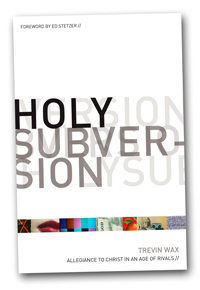
Most of my blog reading is compacted into a day at the end of the week but there are five blogs I read every day and Trevin Wax’s Kingdom People is one of them. As of today Trevin’s new book, Holy Subversion: Allegiance to Christ in an Age of Rivals (Crossway, 2010) is in stock at Amazon and other bookstores. Can’t wait to read it. He began writing the book in the summer of 2007 and the final edits were approved in May 2009 making it about a 30-month process from start to stock. Today on his blog Trevin shares 5 lessons he learned during the course of writing:

1. Writing is harder than most people realize.

2. Writing is deeply personal.

3. Every writer is deeply influenced and inspired by others.

4. Authors are never fully satisfied with the final product.

5. It is difficult for the Christian author to realize where book promotion ends and personal ambition begins.

Billy Goat Trail

…And hike we did. Today my son (8) and I traversed the 1.64 mile Billy Goat Trail. It was the first time either of us had finished the strenuous trail. And it was a huge achievement for him to finish in 72 minutes. The BGT has some nasty drops and and requires jumping over some some fairly dangerous rock gaps and formations. But those areas also provide a stunning view of the Potomac. A beautiful winter day filled with warm MD sunshine!

Here are the hike stats thanks to a G3 iPhone and the RunKeeper app: