“How Great Your Name,” a new song by Will Pavone
HT: Bob Kauflin via Tommy
“How Great Your Name,” a new song by Will Pavone
HT: Bob Kauflin via Tommy
 Book review
ESV The Literary Study Bible
edited by Leland Ryken and Philip Graham Ryken
Some of the best Christian scholarship aims to unfold the beauty of Scripture for general readers. The new ESV Literary Study Bible is one excellent example.
Editor Dr. Leland Ryken is a top-notch literary scholar, noted for his many books (like a personal favorite The Word of God in English) and his work as literary stylist for the ESV. His son, Dr. Philip Graham Ryken, is a noted author and preacher known for excellent books like The Doctrines of Grace.
Together, their work has produced a masterful study Bible.
Size, price, purpose
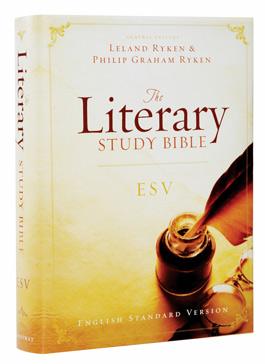 The printed ESV LSB will be available on Sept.
 14th 23rd in a hardcover format, 6×9 inches in size (slightly smaller than the reverse interlinear and slightly larger than the classic reference edition) and nearly 2,000 pages in length (700 pages longer than the reverse interlinear and classic reference edition). The LSB will retail for about $50.00.
The twofold goal of the ESV Literary Study Bible is clearly stated, “(1) to make the Bible reader friendly and (2) to show how application of literary tools of analysis helps in reading and understanding the Bible” (xvii).
We’ll look at each goal individually.
Scripture as Literature
The premiere benefit of the LSB is viewing Scripture as literature, without reducing Scripture to the level of mere literature. In Leland Ryken fashion, rebuttals are given to show that viewing Scripture as literature (1) does not show a liberal bias, (2) reinforces Scripture’s view of itself as literature, (3) does not reduce Scripture to fiction, (4) does not reduce Scripture to another mere piece of literature, (5) nor deny the inspiration of Scripture. In fact, the editors argue that an accurate interpretation of Scripture first requires an understanding of the many literary features of Scripture.
“To approach the Bible as literature as this literary Bible does is not like dessert — something pleasurable to add to more important aspects of the Bible. The literary approach is the first item on the agenda — the starting point for other approaches to the Bible. This has been a point of neglect among Bible readers and Bible scholars that this literary Bible aims to correct” (ix).
Because, the editors make clear, “meaning is conveyed through form, starting with language itself but moving beyond that to a whole range of literary forms and genres” and “There is no meaning without the form in which a piece of writing is expressed” (vii). Forms directly impact interpretation.
The number of identifiable biblical genres in Scripture “readily exceeds one hundred” and that does not include archetypes, motifs, styles, rhetoric, and artistry (x). Scripture is a wonderfully diverse collection of literature with great variety. None are better qualified to bring these to the surface than Leland Ryken.
But this study Bible does not require an advanced degree in literature. Every term from “antithetic parallelism” to “dramatic monologue” to “theophany” is defined in the 17-page glossary of genres and literary terms.
Perhaps, like the Self-Interpreting Bible by John Brown of Haddington in the 18th century, this ESV LSB will become a primary literature text in homeschool education? Something to consider.
Reader-friendly
The goal is not to weigh the reader down in definitions and genres, but to provide helpful guidance for the reader to comprehend large swoops of biblical text. Many features make this an excellent reader’s Bible.
1. Format. The ESV text is single-column, black text set in 8.5-point Veritas font. Very clean and easy to read.
2. Introductions and overviews. Each book of Scripture receives a detailed introduction and content overviews. The overall literary genres and styles are summarized at the beginning. Ryken and Ryken bring great balance between the literary context and the content/outline of Scripture. We’ll see this later.
3. Subsection prenotes. Before each subsection of Scripture (normally one chapter in OT and every half chapter in NT), the editors provide important literary notes and an overall snapshot of the upcoming content. These are like prenotes, compared to the footnotes common in study Bibles. These prenotes peak interest and drive the reader into the text. “This literary Bible is a guide to the Bible that pushes the reader into the text instead of providing mere summaries of the content that readily become substitutes for reading the Bible” (xvii). These chapter notes reinforce the literary styles mentioned in the book introductions, provide overviews of upcoming Scripture content, and function well in helping the reader chomp through large sections of Scripture in single settings.
4. New reading plan. The annual reading plan of the LSB is quite innovative. The daily readings include one section from each of the four categories: Psalms and Wisdom Literature; Pentateuch and the History of Israel; Chronicles and Prophets; and Gospels and Epistles. But four important books – the Psalms, Isaiah, Luke and Romans – are read twice annually! The readings through the OT are arranged chronologically, and the NT readings by author. For example, readers progress from the Gospel of John to 1 John, 2 John, 3 John and conclude with Revelation.
5. Designed for group study. The LSB was designed purposefully for group studies. As stated in the introduction, the editors intend to help discussion leaders formulate application questions. The reading schedule, literary notes, and outlines are very thoughtful and will foster fruitful group study.
Example
The value of this LSB can be illustrated with one chapter prenote from the Psalms. First, take up a favorite Bible and read Psalm 38. Now read the prenote and see how the literary backdrop changes your interpretation of Psalm 38:
“I confess my iniquity [Psalm 38]. This is the third of the church’s traditional penitential psalms. Penitential psalms are a variation on the conventional lament psalm. In them, the poet defines a dire crisis and asks for God’s deliverance. But the twists on the lament form are these: the speaker’s antagonist is not an external enemy but himself; the threat is not physical threat or slander but spiritual guilt; the petition is to be delivered not from a threat to life or political oppression but from peril of soul. The outline is as follows: introductory cry to God (v. 1); definition of the crisis, a highly metaphoric portrayal of the effects of guilt, including physical symptoms (vv. 2–10); as an extension of the crisis, a picture of the isolation of the speaker from others, in a manner reminiscent of the more customary lament psalms (vv. 11–14); statement of confidence in God (vv. 15–16); confession of sin (vv. 17–18); a return to the portrait of the speaker’s enemies (vv. 19–20); prayer to God for deliverance (vv. 21–22)” (p. 787).
You can see that both the genre and general outline of the contents are mixed together well (as you would expect from a literary scholar/pastor team). Phrases like “My wounds stink and fester, because of my foolishness” (v. 5) take on new spiritual meaning in light of the genre. The reader is now well equipped to read the Psalm for herself and glean valuable wisdom. Without any open application questions, the LSB note has brought the reader to the brink of rich application.
If you’re like me, you want more than one excerpt and a review before investing in a new Bible. Here’s a suggestion: In a few weeks, find a local bookstore that carries the Bible and set aside 1-2 hours some weekend to read the book of Job, notes and all (pp. 684-743). Start at the beginning and read it through. Don’t stop to understand every detail in the text, just keep reading to catch the overall flow and direction. Here in Job, the features and strengths of the LSB are on full display.
Literature as Experience
Which brings me to a final point. I am aware of my personal tendency to reduce passages Scripture to nice, indexed, systematic categories (no wonder I personally struggle through Job!). Systematizing ideas is easier for me, compared to reading narrative literature and poetry. By viewing Scripture first as literature (and secondarily as theological content to fill a systematic outline), something important surfaces. Scripture is experienced.
“The goal of literature is to prompt a reader to share or relive an experience. The truth that literature imparts is not simply ideas that are true but truthfulness to human experience. The implication for interpretation is that Bible readers, teachers, and expositors need to be active in re-creating experiences in their imagination, identifying the recognizable human experiences in a text (thereby building bridges to life in the modern world), and resisting the impulse immediately to reduce a biblical passage to a set of theological ideas” (xi).
It occurs to me that once we experience literature, literature becomes integrated into our experience. For example, Augustine’s Confessions are saturated with the Psalms because the Psalms saturated Augustine’s experience. The LSB encourages me to further experience Scripture by using the literary composition as a door into experiencing the text for myself. If you read Job, you’ll likely experience this firsthand (as I did).
Conclusion
If the boom in abridged Bibles and contemporary dynamic equivalence translations tell us anything, it’s this: Our church culture is noticeably uncomfortable with the literal text of Scripture. With the ESV LSB, Ryken and Ryken highlight the beautiful intricacies of Scripture and preview content to help readers navigate through the literal, unabridged text of the ESV. The product of their scholarship is both a study Bible and reading Bible, centering around a literal translation that accents the literary beauty of the Bible and invites readers to experience Scripture firsthand.
In a word, the ESV Literary Study Bible is masterful and will serve those who seek daily nourishment from the pure milk of God’s Word.
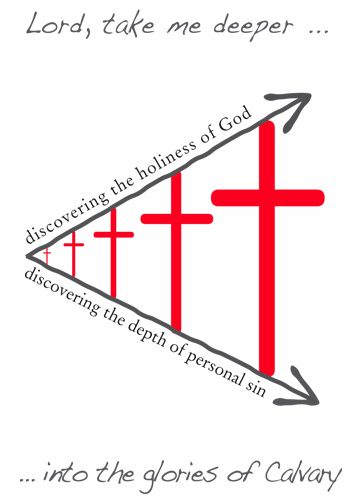
At the conclusion of Sunday celebration – after a sermon on 1 Timothy 1:15-17 — pastor Rick Gamache pondered the question: How does God take us deeper into the glories of the Cross?
In this text, Paul acknowledges himself the worst sinner he knows (v. 15). And God, he exclaimed, is glorious in holiness and majesty (v. 17).
It’s here, between a deepening understanding of personal sin – that I am the worst sinner I know – and a growing understanding of God’s holiness, that we grow deeper into the glories of Calvary. When we grow up into God’s holiness, and grow down in properly understanding the depth of our personal sin, we better see the wrath of God that was appeased in the Cross, the emptiness of our self-righteousness and the magnitude of the glorious, reconciling Cross!
A great image of the Cross-centered life!
“For this reason I bow my knees before the Father, from whom every family in heaven and on earth is named, that according to the riches of his glory he may grant you to be strengthened with power through his Spirit in your inner being, so that Christ may dwell in your hearts through faith—that you, being rooted and grounded in love, may have strength to comprehend with all the saints what is the breadth and length and height and depth, and to know the love of Christ that surpasses knowledge, that you may be filled with all the fullness of God.” (Eph. 3:14-19)
The sermon, titled “A Functional Doctrine of Sin,” is perhaps the best message on sin I have heard. Amazing! (Listen here).
———–
Related: The song “The Glories of Calvary” was written by Steve & Vikki Cook and available for a paltry buck.
“… In our entertainment-saturated culture we find another kind of gospel, however — the gospel of avoidance. And this gospel is about putting our faith in distractions. We use entertainment to save ourselves from the pain of our lives. Unlike the real gospel, though, the ‘good news’ of entertainment doesn’t truly save us from our problems. It only masks them, helps us repress them. Keeps us from becoming the men God created us to be.
Rather than going to the cross, many of us take our wounds to our computers, TVs or game consoles and say, ‘Here, you take them.’ And all these technologies oblige … for a time. At some point, though, we have to press the off button, go to class and face the challenges of the world outside our entertainment bubble. What do we do then? Distract ourselves to such a degree that we haven’t got the time to ponder what’s really going on in our lives?
That’s the gospel of avoidance. And for too many of us, it’s our only saving grace. …”
– Matthew John, Entertainment: The Gospel of Avoidance
 Understanding the differences between medieval Roman Catholicism and the Protestant Reformers is important because many of the core distinctions exist today. In the final week of September we have interviews planned with scholars to help further unpack the contemporary importance of the Protestant Reformation.
Today we post the comments of Scott Manetsch, associate professor of church history at Trinity Evangelical Divinity School. In a recent book review (download pdf) he wrote it is “impossible to reconcile the classic Protestant solas with the teaching of the Catholic Catechism.”
Manetsch summarizes the differences well:
– For Roman Catholics, Scripture and Tradition are two distinct but equal modes of revealed authority which the magisterium of the Roman Church has sole responsibility to transmit and interpret. For the early Protestant reformers, the holy Scripture provides final normative authority for Christian doctrine and practice, standing as judge above all institutions and ecclesial traditions.
– For Roman Catholics, sinners are justified because of inherent righteousness. For the mainstream Protestant reformers, sinners are accepted on the basis of the righteousness of another―namely, the alien righteousness of Christ imputed to them.
– For Roman Catholics, sinners are both justified by unmerited grace at baptism and (subsequently) justified by those infused graces merited by cooperating with divine grace. For the magisterial reformers, sinners are justified before God by grace alone.
– For Roman Catholics, sinners are justified by faith (in baptism), but not by faith alone. For the sixteenth-century Protestant reformers, sinners are justified by faith alone.
– For Roman Catholics, justification is a process of renewal that affords no solid basis for Christian assurance in this life. For reformers such as Luther and Calvin, justification is God’s decisive verdict of forgiveness and righteousness that assures Christian believers of the acceptance and love of their heavenly Father.
HT: Justin Taylor
 Yesterday morning I realized my post on organizing a library was incomplete. I answered Noah’s question about books, but without explaining the bigger picture of my organizational method I left out key pieces. So today I hope to complete the puzzle.
When I initially set out to organize my library, I was thinking only of printed books. And because I was only thinking of printed books, I invested in an electronic book organization software called Booxter (Mac only). Loved it! I hooked up my webcam and the webcam read the barcode off most books, automatically retrieving the book information from Amazon. It was fun. I scanned about 10 books per minute. All my books were added into the database and I felt all organized.
But then reality hit.
First, I realized I have 3,000 original Puritan and Reformed electronic books on my computer. How do I organize those on Booxter? Then I realized I had a massive mp3 sermon collection on my hard drive, and I had no idea what content I actually possessed. Then I came across great quotes on blogs and websites. How do I catalogue them? And what about my file folders of magazine clippings? And what about my personal sermon notes? And what about favorite quotes? I realized printed books comprised less than half of my library!
Which is why I eventually scrapped Booxter and returned to the Microsoft Excel database (explained last time).
Although it seems a bit archaic, in a customized database I can equally categorize books, chapters of books, single quotes from books, magazine articles, blog posts, websites, mp3 audio sermons, DVDs, personal sermon notes, online videos and any other form of media.
Here’s what I mean.
Using the same format I proposed in the last post, I will to add to my database.
1. Blog posts or websites
Spreadsheets allow me to hyperlink text to the web or an electronic file on my computer. Sometimes I forget the rich quotes I posted in the TSS archives! I never want to forget the quote by John Piper on “What is sin?” But I don’t want to print this quote out and stuff it into some forgettable file folder. Here are two examples of how I index blog posts in my database:
2. Audio and video
Audio sermons and videos, either on your hard drive or on the Web, are easily organized, too. Even your DVD collection will fit. Let me give you some examples:
3. Personal sermon notes
I take a lot of sermon notes because I sit under excellent biblical preaching! I write in a Moleskin notebook I fill annually. Once the notebook is stuffed, I write in my own page numbers so I can index. As of today I’m over half done with volume three. Here are my recent sermon notes …
Putting it all together
So let’s assemble the entire database from today and last time:
As you can see, my system provides great flexibility to organize any type of media as specifically as you prefer, a limitation of Booxter and Library Thing.
All these categories are customizable. Change and modify as needed and then simply sort the data alphabetically (Excel does this with one click of a button).
Added benefits
There are three great benefits to creating your own categories on a spreadsheet (besides an organized library).
1. Mental organization. In essence you are forced to organize your thoughts systematically. If you have trouble seeing the big picture (as I do) a list of categories will help you organize your thoughts systematically.
2. Prioritizing the small. Small bits of information and precious short quotes are easily forgotten between all the books in your library shelves. In my system it doesn’t matter how wide the spine is, because it places importance not on the size of the work, but its value to you.
3. Strengths/weaknesses. Being forced to categorize all your media will reveal your interests and strengths but also your library’s weaknesses that should be more thoroughly studied.
LibraryThing
I get a lot of questions about LibraryThing, an online book organizing system. I guess this is a good place for some thoughts…
Part of my occupation is online marketing and I can spot online money-making techniques fairly quickly. I noticed LibraryThing is affiliated with Amazon and makes commissions on all Amazon purchases through LT links. This is why book recommendations and Amazon are both prominent themes of the website. LT is essentially a brilliant marketing tool that uses your public library information to unite readers with similar interests to convince them to buy books through Amazon and make an affiliate profit though these sales (on top of payment for LT services).
I’m not against LibraryThing and see great social benefits to using it. But please remember they can use your library to sell similar books to readers of similar interests. I cannot find where this is disclosed on the website.
Please, always consider buying from a reformed bookseller (like Monergism Books) to support them in their valuable ministry.
Does this post help clarify my organizational system? Let me know and thanks for reading TSS!
————–
UPDATE: Augustine’s Confessions is a personal favorite (Vintage Spiritual Classics edition). Augustine covers several diverse topics and gives great examples of various life situations. To help give you a better understanding of the value of indexing quotes and ideas, I post a pdf edition of my personal notes. The index is old and detailed and my system has since changed in some ways but it illustrates the important freedom needed to categorize single books in various categories and point to specific pages/chapters. See for yourself and download my personal index.
 Tony Reinke